

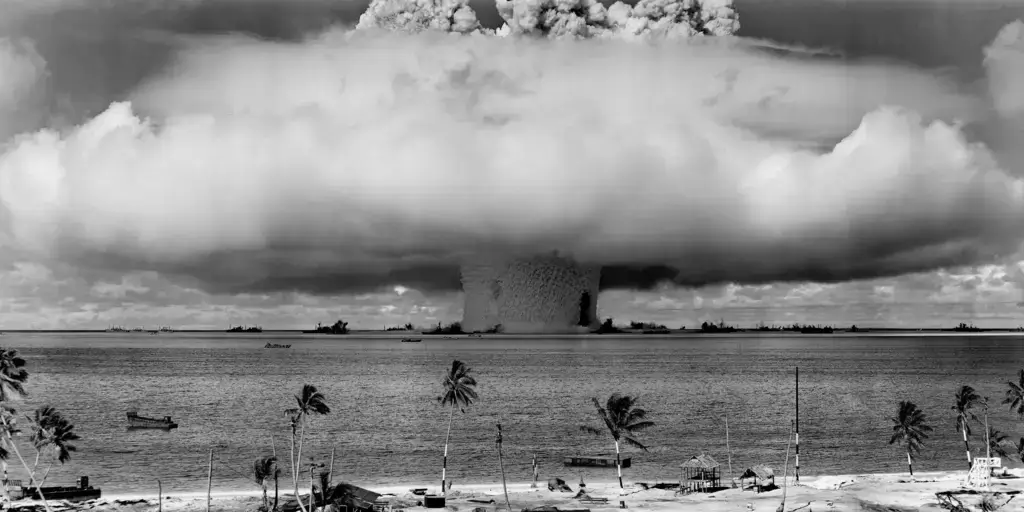
Since the dawn of the nuclear age, the immense power of atomic weaponry has both fascinated and terrified humanity. At the pinnacle of this destructive capability lies the hydrogen bomb, a device that marks a significant leap forward in nuclear technology compared to its predecessors, the fission bombs dropped during World War II.

How the Hydrogen Bomb Works
The hydrogen bomb, or H-bomb, operates on the principle of nuclear fusion, contrasting with the fission reactions harnessed by the atomic bombs of the 1940s. In nuclear fusion, light atomic nuclei combine to form a heavier nucleus, releasing energy in the process. This is the same reaction that powers the sun.
The typical hydrogen bomb employs a two-stage process:
- Primary Stage: This stage involves a fission bomb, similar to the ones used in Hiroshima and Nagasaki, which acts as a trigger. It generates the extraordinarily high temperatures required to initiate the fusion reaction.
- Secondary Stage: Here, the fusion fuel—usually isotopes of hydrogen such as deuterium and tritium—is compressed and heated by the energy from the primary stage, leading to a powerful fusion explosion.
The Science Behind the Ferocity
The hydrogen bomb’s staggering power comes from the nature of fusion reactions themselves. Fusion releases much more energy per unit of fuel than fission, and because it can be repeated in a staged manner within a single bomb, the potential yield is essentially only limited by the design.
Fusion reactions require temperatures of millions of degrees, much hotter than the center of the sun, which is achieved by the initial fission explosion. Once initiated, the energy release is exponentially greater than what fission alone can produce.
Comparison: Atomic Bomb vs. Hydrogen Bomb
| Feature | Atomic Bomb | Hydrogen Bomb |
|---|---|---|
| Reaction Type | Fission | Fusion (with fission trigger) |
| Yield Potential | Up to 500 kilotons | Measurable in megatons; virtually unlimited |
| Release Style | Single-stage | Two-stage (fission-fusion) |
The yields of H-bombs are typically in the range of several megatons of TNT, compared to the kiloton yields of fission bombs. For instance, the bomb dropped on Hiroshima was about 15 kilotons, whereas the most powerful hydrogen bomb ever tested, the Tsar Bomba by the Soviet Union, yielded over 50 megatons, equivalent to 3,300 bombs of the type dropped on Hiroshima.
Historical Context and Impact
The first successful test of a hydrogen bomb was conducted by the United States on November 1, 1952, at Enewetak Atoll in the Pacific Ocean. This test successfully demonstrated the potential of hydrogen bombs and significantly intensified the Cold War nuclear arms race. The Soviet Union followed this advancement with their own hydrogen bomb test in August 1953.
The development of hydrogen bombs was motivated by military strategy during the Cold War, as each superpower sought to maintain or obtain a technological edge. This led to an era of intense nuclear testing, with atmospheric and subterranean blasts causing widespread ecological and health concerns.
International Response and Treaties
As the destructive power of these weapons became evident, various treaties were enacted to dissolve nuclear arsenals. Notable among these was the Nuclear Non-Proliferation Treaty (NPT) signed in 1968, which has been a cornerstone of international efforts to prevent the spread of nuclear weapons and technology.
The Comprehensive Nuclear-Test-Ban Treaty (CTBT), although not universally ratified, prohibits all nuclear explosions for both civilian and military purposes, advancing the goal of nuclear disarmament by halting the development of new arsenals.
Ethical and Philosophical Considerations
The creation of the hydrogen bomb poses deep ethical questions. Its sheer capacity for destruction challenges the value and morality of wielding such power. As renowned physicist J. Robert Oppenheimer famously said, citing the Bhagavad Gita, “Now I am become Death, the destroyer of worlds.” This sentiment resonates especially when considering the indiscriminate nature of nuclear weapons, which affect civilians and combatants alike.
Many argue that the existence of hydrogen bombs serves as a deterrent against large-scale wars, a notion critiqued through the lens of mutual assured destruction (MAD). This concept suggests that the potential for global annihilation creates a stable peace, albeit one rooted in fear.
While the hydrogen bomb remains a testament to human ingenuity in harnessing the fundamental forces of nature, it also stands as a symbol of the abyss of destruction that could be visited upon the world. The ongoing challenge for humankind is to manage this power responsibly, ensuring that these weapons remain shackled in their silos, never to be unleashed again.