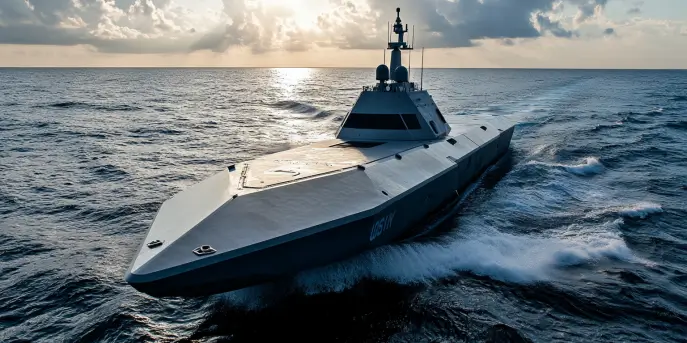


How AI Is Changing the Fighting Vehicle
Armored warfare is entering a new phase in which the tank is no longer defined only by thick armor and a large gun. The next generation of combat vehicles is increasingly shaped by AI-assisted targeting, sensor fusion, automation, and uncrewed or remote-controlled turrets. These changes are not simply cosmetic. They affect how crews survive, how quickly a tank can detect and engage threats, and how effectively a vehicle can operate in a battlefield crowded with drones, precision munitions, electronic warfare, and fast-moving armored threats.

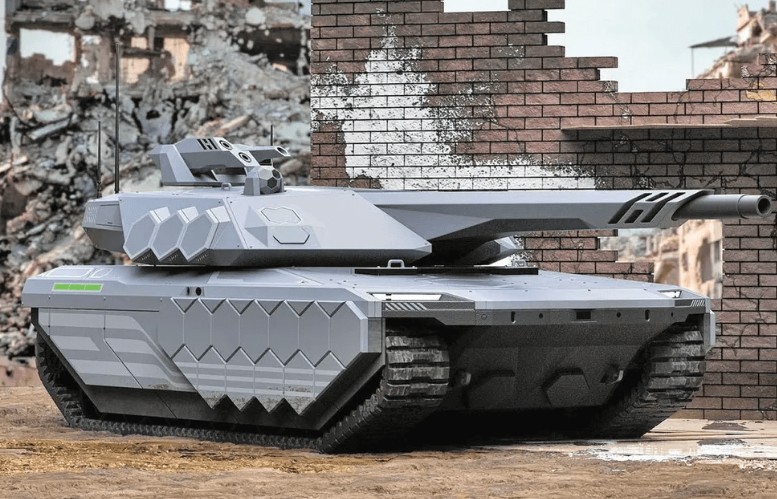
The core idea is straightforward: move the crew farther away from the most dangerous parts of the vehicle, reduce the size of the turret silhouette, and use machines to help search, identify, track, and prioritize targets. While a traditional tank turret is a human-centric fighting compartment mounted directly above the hull, an uncrewed turret can be compact, heavily automated, and optimized for low visibility. A remote-controlled turret takes this further by allowing some or all of the weapon operation to be conducted from a protected internal station, or even from a separate vehicle in certain architectures.
These systems do not eliminate the tank crew. Instead, they change the crew’s role from manual operation to supervision, decision-making, and exception handling. The tank becomes less of a purely mechanical gun platform and more of a networked combat node.
What AI-Assisted Targeting Actually Does
AI-assisted targeting is often misunderstood as a fully autonomous weapon deciding who to shoot. In practice, current and near-term systems are far more limited and usually focus on decision support. Their job is to help the crew find and track threats faster than a human can using only optical sights and radio reports.
Typical AI-enabled functions include:
- Target detection from thermal, daylight, radar, or multispectral sensor feeds.
- Automatic tracking of moving objects once the crew designates them.
- Threat classification based on shape, motion, size, and behavioral patterns.
- Fire-control assistance such as lead calculation, ballistic corrections, and stabilization support.
- Prioritization cues that suggest which contact may be the most dangerous.
- Counter-drone awareness through short-range classification of small aerial targets.
For tank crews, the biggest advantage is time. In a modern combat environment, the side that detects and engages first usually has the upper hand. If AI reduces the delay between sensor contact and a usable firing solution, the vehicle gains a major tactical edge. This is especially important against drones, loitering munitions, and concealed anti-tank teams, where seconds matter.
Why Uncrewed Turrets Are Attractive
Uncrewed turrets offer several advantages that make them appealing to designers of future armored vehicles. First, they allow the crew compartment to be placed lower in the hull, often behind heavier armor and away from the turret bustle. This can improve survivability if the turret is hit or if ammunition is compromised. Second, without the need to fit crew seats, optics, and manual controls into the turret, the profile can be much smaller. A smaller target is harder to spot and harder to hit.
Third, uncrewed turrets can be optimized for automation. Weapons, autoloaders, sensors, and active protection systems can be arranged without the ergonomic limitations of human operators. That means better use of internal volume and potentially better ammunition handling. In theory, the vehicle can also become lighter or redirect saved weight into armor, sensors, or additional defensive systems.
Remote-controlled turrets provide another benefit: if the crew is not physically inside the weapon station, then the turret can be placed where it is best for battlefield performance rather than human comfort. This can also support modular designs, where the same turret architecture is adapted for main battle tanks, infantry fighting vehicles, and specialized support vehicles.
Key Specifications and Design Priorities
While exact figures vary by program and nation, future AI-assisted tanks with uncrewed or remote-controlled turrets tend to emphasize a similar set of technical priorities.
| Feature | Typical Goal |
|---|---|
| Crew placement | Protected hull compartment, often lower and farther from ammunition |
| Turret occupancy | Uncrewed or remotely operated |
| Sensors | Thermal imagers, day cameras, laser rangefinders, radar, acoustic or multispectral aids |
| Targeting | AI-assisted detection, tracking, and fire-control support |
| Main armament | Typically 120 mm or 125 mm class gun on main battle tank designs, though variants differ |
| Secondary armament | Coaxial machine gun, remote weapon station, or counter-drone systems |
| Protection | Composite armor, active protection, soft-kill jammers, and reduced turret silhouette |
| Mobility | High-power diesel or hybrid-electric powertrains depending on program goals |
These systems are usually designed around sensor fusion. That means the vehicle does not rely on a single sight or one human observer. Instead, multiple inputs are combined into a single tactical picture. The result is better situational awareness, especially when the turret is stabilized, the vehicle is moving, or visibility is poor.
How the Crew Experience Changes
In a traditional tank, the gunner and commander rely on direct visual systems, periscopes, and manual procedures. In an AI-assisted vehicle, the crew may spend more time monitoring fused displays, reviewing automated target cues, and confirming machine suggestions. This can reduce workload during routine operations, but it may also create new demands for software literacy and systems management.
A future tank crew could spend less time physically hunting targets and more time making decisions about engagement rules, threat urgency, and coordination with drones or supporting units. The commander may act more like a battlefield manager than a traditional sighted observer. The gunner, meanwhile, may become a systems operator who validates automatic target tracks and applies final consent before firing.
This shift comes with both opportunities and risks. On one hand, automation can reduce fatigue and improve reaction time. On the other, excessive trust in machine suggestions could lead to errors if the software is confused by debris, camouflage, weather, or electronic deception. For that reason, most defense developers stress that human oversight remains essential.
Battlefield Problems These Tanks Are Meant to Solve
The modern battlefield is far more hostile to tanks than the open armored engagements of the twentieth century. Small drones can watch from above. Precision-guided weapons can strike from long range. Anti-tank teams can hide in urban terrain. Even when the tank’s armor is formidable, its sensors and awareness can be overwhelmed.
AI-assisted targeting and remote/uncrewed turrets are intended to address several specific problems:
- Rapid target saturation, where multiple threats appear in different directions at once.
- Top-attack vulnerability from drones and loitering munitions.
- Urban ambush risk, where targets appear briefly from windows, alleys, or rooftops.
- Sensor overload, especially in smoke, dust, rain, and battlefield clutter.
- Crew exposure during prolonged operations or in catastrophic turret hits.
A lower-profile uncrewed turret, paired with automated detection, can help the tank spot and engage enemies that would otherwise gain the initiative. Some concepts also integrate dedicated anti-drone weapons, such as remote machine guns, programmable airburst ammunition, or small interceptors that complement the main gun.
Engineering Challenges and Limits
Despite the promise, these technologies are not magic. The battlefield is full of edge cases that challenge software and mechanical systems alike. One of the biggest concerns is reliability. A manually operated tank can often continue fighting in degraded conditions even if some electronics fail. A highly automated system depends much more on sensors, processing power, and stable power delivery.
Another challenge is latency. AI processing must be fast enough to support real-time engagement, but not so aggressive that it generates false cues. False positives can waste ammunition or reveal the vehicle’s position. False negatives can be fatal. Developers must tune algorithms carefully and test them under dust, smoke, jamming, low light, and moving-platform conditions.
Cybersecurity is another major concern. Any networked targeting system creates possible attack surfaces. If adversaries can interfere with data links, spoof sensor inputs, or disrupt navigation and communications, the tank’s effectiveness may drop sharply. Future armored vehicles will likely require hardened processors, redundant channels, encrypted networks, and graceful fallback modes.
There is also the problem of decision confidence. AI can detect patterns, but it does not truly understand battlefield intent. A human commander can weigh context, mission objectives, and rules of engagement in ways that current software cannot fully match. As a result, the most practical near-term model is not full autonomy, but a human-machine team.
Likely Direction of Future Designs
The most plausible next step is not a tank that fights entirely by itself, but one that uses automation to compress the timeline of battle. Future designs may combine:
- Uncrewed turrets for reduced exposure and smaller silhouettes.
- AI-assisted sights that highlight threats and improve first-round hit probability.
- Active protection systems to intercept incoming missiles and drones.
- Networked sensors shared with reconnaissance drones and other armored vehicles.
- Hybrid or high-output power systems to support electronics, cooling, and directed-energy or anti-drone tools.
In that environment, the tank becomes less isolated and more collaborative. A future armored platoon may use each vehicle’s sensors as part of a shared picture, with AI helping sort contacts while human commanders decide the broader maneuver. The turret itself may no longer be a place where soldiers sit and work, but a hardened automated weapon module built to survive, observe, and respond under extreme pressure.
What This Means for Armored Warfare
Future AI-assisted targeting tanks with uncrewed or remote-controlled turrets represent a clear shift in design philosophy. Instead of treating the tank as a heavily armored gun with a crew inside, designers are treating it as a protected combat system integrated with software, sensors, and remote operation logic. That does not make the tank invulnerable, but it may make it more adaptable to the realities of drones, electronic warfare, and fast-changing threats.
The most important question is not whether AI will replace tank crews, but how effectively crews and software can work together. If the systems are reliable, intuitive, and properly constrained, they can extend the tank’s relevance in future wars. If they are overcomplicated or overtrusted, they may introduce new weaknesses. The result will likely be a gradual evolution rather than a sudden revolution, with uncrewed turrets and AI-assisted targeting becoming standard features on the most advanced armored vehicles.