

Moon dust could aid in the production of satellites, bases, and solar energy. Lunar regolith is a metallic dust that contains oxygen, which scientists aim to harness to promote development on the Moon.



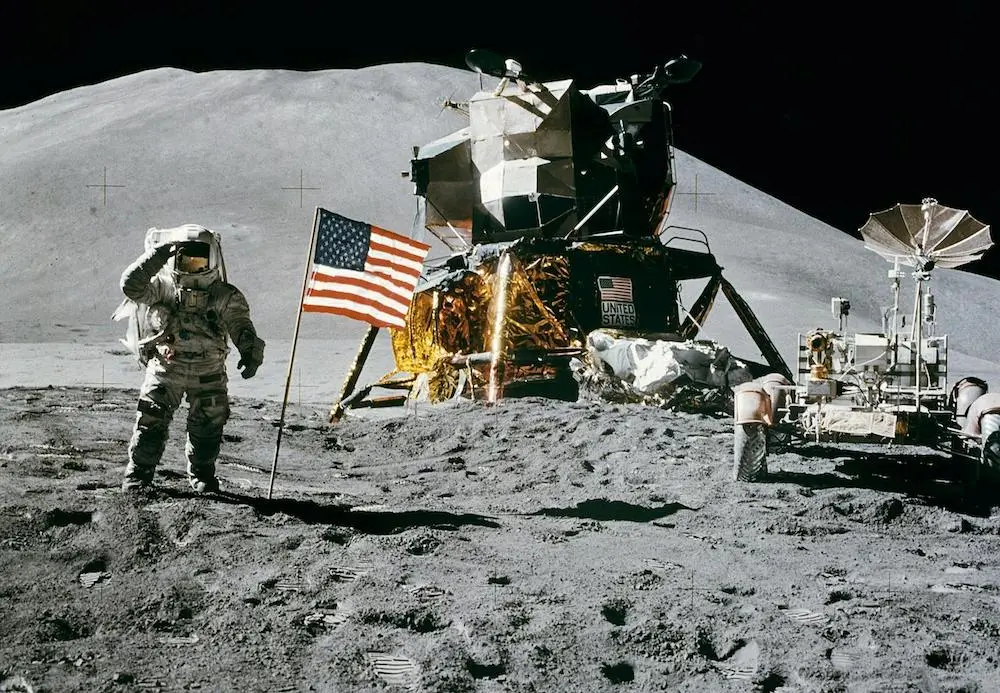
In the coming decades, Earth’s natural satellite could become a hub for deep space activities. A celestial body where humans live, work, and explore might feature base camps, rovers, and state-of-the-art technology. Lunar regolith is a locally available resource that could accelerate construction on the Moon. Researchers from the University of Waterloo suggest that lunar regolith can be used for “life support, energy production, and construction.”
“Our research turns science fiction into reality. Our goal is to help build the infrastructure and technology that will enable sustainable human settlements on the Moon and beyond,” said Connor MacRobbie, a doctoral candidate.
Transporting building materials from Earth to construct infrastructure on the Moon would be costly and inefficient. Lunar regolith, a metallic dust containing oxygen, is being explored for development on the Moon. Researchers at the Laboratory for Emerging Energy Research (LEER) are investigating ways to process raw lunar resources, particularly regolith.
“Since lunar regolith already contains oxygen, we can use it to produce thermal energy without the need for atmospheric oxygen. This is known as the thermite reaction, which is beneficial in space where oxygen is not readily available,” MacRobbie explained.
The team conducted experiments to assess the viability of using lunar regolith for various applications, such as heating and production.
Given the challenge and expense of obtaining real lunar soil from the Moon, the team used simulated regolith provided by NASA. This simulant closely mimics the composition and properties of lunar regolith.
Researchers tested different combinations of fuels and oxidizer compositions to optimize the thermite reaction for space applications in a specialized combustion chamber that simulates the lunar environment.
“The results demonstrate the viability of lunar regolith for initiating lunar development, allowing humans to explore and settle the Moon’s surface. We are now continuously working on better extraction of metals and other useful materials from regolith, as well as designing automated processes in collaboration with Canadian and international researchers to facilitate resource utilization on the Moon and support a circular space economy,” said John Wen, director of LEER.
Interestingly, researchers are also addressing the growing issue of space debris. The LEER team views non-functional satellites as valuable resources. Metal debris from these satellites often travels to Earth and lunar orbits. Researchers are considering using non-functional satellites as a fuel source for space development because they contain aluminum, which can be combined with lunar regolith for a thermite reaction to generate heat. However, more research is needed to realize this idea.
Using space debris through the thermite reaction can support the maintenance and enhancement of solar satellite systems in space. Testing this method could pave the way for a reliable energy source for future space exploration.