

In a groundbreaking experiment, NASA has successfully used a powerful new laser communication system to send photos and videos of pets to the International Space Station (ISS) at speeds surpassing most home internet connections.


The primary objective of the experiment was to test this remarkable new technology. Traditionally, NASA has relied on radio waves for spacecraft communication, but lasers offer a significantly faster and more efficient alternative.
NASA tested its first two-way laser system in this experiment. The technology transmitted data at a blazing speed of 1.2 GB per second. This follows a recent demonstration during the Psyche mission, where a video of an orange cat was sent over a distance of 19 million kilometers to the Psyche spacecraft via laser connection.
Inspired by the success of the Psyche mission, NASA astronauts Randy Bresnik, Christina Koch, and Kjell Lindgren, along with other agency employees, transmitted pet photos and videos to the ISS. NASA’s Space Communications and Navigation (SCaN) mission showcased the potential of laser communication and evaluated new networking technology.
“Not only have we demonstrated how these technologies can play a crucial role in enabling NASA’s future scientific exploration missions, but the teams also had a fun new opportunity to contribute to this innovative demonstration using their pets,” said Kevin Coggins of the SCaN program at NASA Headquarters in Washington.
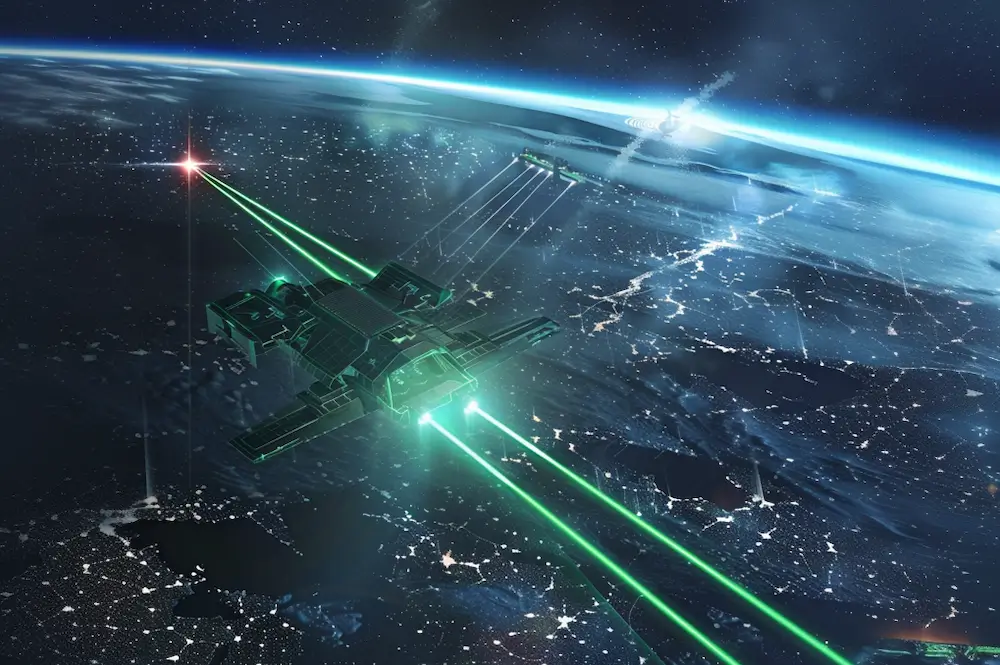
Laser communication depends on infrared light for transmitting and receiving information. The pet photos and videos were sent to space via optical communications after a series of processes. Initially stored on a computer at the mission control center in Las Cruces, New Mexico, the data was transferred to optical ground stations in California and Hawaii. These stations are equipped with lasers capable of transmitting data to space.
“The teams modulated the data onto infrared light signals or lasers and sent them to NASA’s Laser Communications Relay Demonstration (LCRD), which is in geosynchronous orbit at an altitude of about 35,400 kilometers,” NASA explained in a statement.
The LCRD satellite then transmitted the data to the Integrated LCRD Low Earth Orbit User Modem and Amplifier Terminal (ILLUMA-T) attached to the ISS. This terminal is equipped with a receiver that can detect the faint laser signal and convert it back into the original data—photos and videos of pets in this case.
A significant challenge in space communication is signal disruption. To address this, NASA employed Delay/Disruption Tolerant Networking (DTN), which monitors the storage and forwarding process. If the signal is interrupted, DTN stores all the data and sends it later to ensure it arrives safely. This mission also tested a faster version of DTN, called High-Data-Rate Delay Tolerant Networking (HDTN), which allows data to travel up to four times faster than standard DTN.
This mission has demonstrated the potential of laser communication and DTN, paving the way for their implementation and improvement in future Artemis program missions.