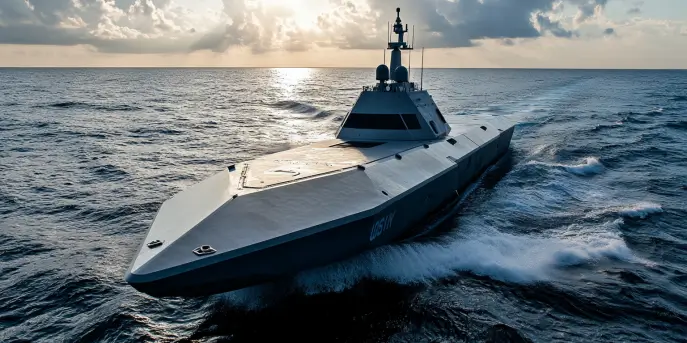


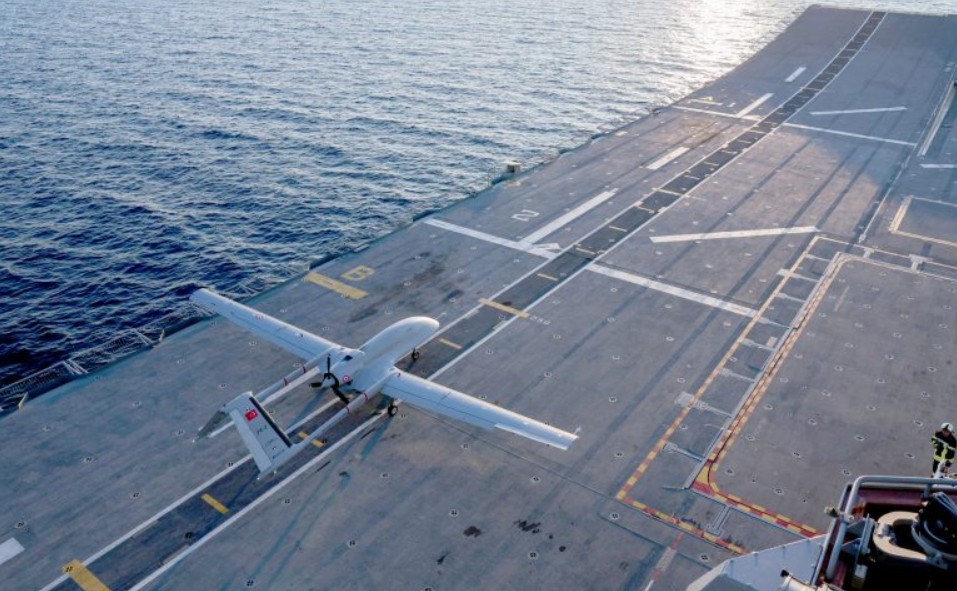
Naval power has always evolved in step with technology, but the emergence of drone carriers marks a particularly sharp shift in how states think about sea control, force projection, and deterrence. At the center of that conversation stands TCG Anadolu, Turkey’s flagship amphibious assault ship that has come to symbolize a new era of maritime aviation. Designed around a flexible mix of unmanned systems, helicopters, and amphibious operations, Anadolu is more than a ship — it is a statement about the future of naval warfare.
A ship built for a changing battlefield
For decades, the logic of carrier design revolved around launching and recovering manned fixed-wing aircraft. That model remains powerful, especially for the world’s largest navies, but it is increasingly expensive, technically complex, and vulnerable to long-range missiles and surveillance networks. The rise of unmanned aerial vehicles has opened a different path. Instead of concentrating all capability into a handful of high-value jets, navies can disperse risk across smaller, cheaper, and more adaptable platforms.
TCG Anadolu fits neatly into that shift. Originally conceived as a landing helicopter dock, the ship became an early and visible example of how a large amphibious vessel can be repurposed to operate drones. This is not a simple substitution. It changes the ship’s role from a classic assault platform into a multi-domain node capable of reconnaissance, strike support, amphibious lift, command and control, and maritime presence.
The idea resonates because modern conflicts reward flexibility. A drone carrier does not need to match a supercarrier in size or tonnage to be strategically relevant. Instead, its value lies in persistence, distributed sensing, rapid response, and a lower operating cost per mission. In regions where tensions are high but budgets are constrained, that formula is attractive.
What makes TCG Anadolu different
TCG Anadolu stands out because it bridges several categories at once. It is not merely an amphibious assault ship, nor a traditional aircraft carrier. It sits at the intersection of both, with the added dimension of unmanned aviation. That hybrid identity is exactly what has made it a headline-grabber.
The ship is associated with Turkey’s ambitions to develop and field indigenous drone systems, especially the Bayraktar family of UAVs. The pairing is strategically important: the ship provides the naval launch platform while the drones provide the sensing and strike capability. Together, they create a mobile aerial base that can be deployed far from home waters.
One of the most important ideas behind the Anadolu concept is operational adaptability. A ship that can carry helicopters, drones, vehicles, and troops can be reconfigured based on mission needs. It can support amphibious landings, humanitarian assistance, maritime security, disaster response, or fleet support. That broad utility helps justify the investment and makes the ship relevant in both wartime and peacetime.
Drone carriers and the economics of power
The rise of drone carriers is not only about technology; it is about economics. A conventional aircraft carrier and its air wing are among the most costly military assets ever built. Their operational demands are immense, their maintenance cycles are long, and their training pipelines are demanding. By contrast, drones are usually cheaper to produce, easier to replace, and less politically risky to deploy.
That does not mean drones are a perfect substitute. They often have lower speed, smaller payloads, and more limited survivability than crewed combat aircraft. But in many missions, those trade-offs are acceptable. Surveillance, target acquisition, maritime patrol, loitering strike, and communications relay are all areas where drones excel.
For a country like Turkey, the value proposition is compelling. A drone-enabled amphibious ship offers a way to expand reach without entering the financial and industrial league of supercarriers. It allows the navy to experiment with new doctrines while leveraging a national ecosystem that already has strong momentum in unmanned systems.
TCG Anadolu at a glance
| Specification | Details |
|---|---|
| Ship type | Amphibious assault ship / drone-capable aviation platform |
| Class | TCG Anadolu class |
| Length | Approximately 232 meters |
| Beam | Approximately 32 meters |
| Displacement | About 27,000+ tons |
| Propulsion | Combined diesel and gas (CODAG) arrangement |
| Aviation role | Helicopters, UAVs, VTOL-capable aircraft concepts |
| Primary mission set | Amphibious assault, maritime security, drone operations, humanitarian support |
| Operator | Turkish Naval Forces |
Note: exact loadouts and operational configurations can vary depending on mission and modernization plans.
The Bayraktar connection
Much of the fascination around Anadolu comes from its association with Turkish-made drones, especially the Bayraktar TB3 and related unmanned platforms. The TB3 was designed with naval operations in mind, including the ability to operate from short decks and perform maritime missions. That is a notable leap from traditional land-based UAV use.
The navalization of drones changes their tactical utility. Sea-based launch expands reach without depending on nearby airbases. It also complicates enemy planning, because the launch point can move. A drone carrier can patrol a broad area, reposition quickly, and serve as a distributed forward node in a wider campaign.
In practical terms, that means a ship like Anadolu can support surveillance over contested waters, cue missiles or manned aircraft, and maintain a persistent presence near choke points or unstable coastlines. For maritime security operations, that is highly valuable. It also reinforces the principle that control of the sea increasingly depends on control of information.
Doctrine is changing faster than hardware
One of the most important lessons from Anadolu is that doctrine often evolves more slowly than technology. Building a drone-capable carrier is not the same thing as having an effective drone-carrier force. The navy must develop launch and recovery procedures, maintenance routines, deck handling protocols, communications links, sensor integration, and command structures.
It must also decide how to use the ship in combat. Should drones be used primarily for surveillance, or are they expected to carry weapons? How much of the ship’s aviation capacity should be reserved for helicopters versus UAVs? What is the balance between amphibious lift and aerial operations? These are not trivial questions, and the answers will shape the ship’s strategic identity.
There is also the issue of survivability. Drone carriers may be more flexible than traditional carriers, but they remain large and visible targets. Their effectiveness depends on escort ships, electronic warfare support, air defense, and intelligent mission planning. As with any capital ship, the platform is only as useful as the broader network protecting it.
A platform for political signaling
Ships like TCG Anadolu carry meaning beyond their military utility. They are tools of diplomacy, prestige, and industrial signaling. When a state commissions a vessel like this, it sends a message about ambition and technological self-confidence. That message can be particularly powerful when paired with an indigenous drone industry.
Turkey has used Anadolu to showcase a vision of national defense that combines shipbuilding, aerospace engineering, and unmanned systems development. The result is a highly visible symbol of defense autonomy. For observers, the ship demonstrates not just what the Turkish navy can do today, but what it hopes to do tomorrow.
This signaling effect matters in a crowded regional security environment. Maritime platforms are inherently political because they can be moved, displayed, and deployed. A drone carrier can appear in exercises, patrol disputed waters, support allied missions, or contribute to humanitarian efforts after disasters. Each role communicates capability and resolve.
How drone carriers may shape future navies
TCG Anadolu may not be the last or the largest drone carrier, but it is one of the most important early examples of the concept. Other navies are watching closely because the underlying logic is broadly applicable. Medium-sized powers may find that unmanned aviation from sea offers a practical middle path between patrol ships and supercarriers.
Several trends point in the same direction:
- Smaller airframes reduce cost and simplify carrier aviation.
- Autonomy and AI-assisted targeting improve mission efficiency.
- Longer loiter times make drones ideal for maritime surveillance.
- Distributed operations reduce dependence on a single high-value base.
- Modular deck designs allow ships to adapt to different missions.
In that environment, drone carriers may become an important category in their own right. They will not replace all manned aviation at sea, but they can expand the toolset available to commanders. The most capable fleets of the future may be those that blend crewed aircraft, unmanned systems, submarines, surface combatants, and space-enabled sensing into a coherent network.
Challenges ahead
Despite the enthusiasm, several challenges remain. Drones are dependent on secure data links, resilient software, and reliable maintenance. Weather can affect operations, deck handling must be precise, and contested electronic environments can degrade performance. A ship optimized for drones also has to compete for deck space and power with other mission demands.
There is also a strategic question: how much combat power can a drone carrier truly generate in a high-end fight? Drones can identify and distract adversaries, but they may struggle against advanced air defenses unless supported by larger systems. Their real strength may lie in enabling the rest of the force rather than replacing it.
Still, the significance of Anadolu does not depend on it being perfect. Its importance lies in proving that a navy can reimagine an existing platform to support a new aviation concept. That alone makes it a milestone.
Why TCG Anadolu matters
TCG Anadolu captures a moment when naval thinking is being reshaped by unmanned systems, industrial strategy, and the need for flexible power projection. It shows how a ship can be more than a transport or assault vessel; it can be an airborne sensor hub, a drone launchpad, and a symbol of evolving maritime doctrine.
As drone technology matures, the idea of the drone carrier will likely become more familiar. But Anadolu will remain important because it helped make the concept concrete. It transformed an abstract debate into a real ship, a real flight deck, and a real test case for future navies.
In that sense, TCG Anadolu is not just a ship of today. It is a preview of tomorrow’s naval battlefield.