

Germany’s armored future is getting a serious glow-up
Few defense topics get armor geeks leaning in quite like Germany’s next-generation tank ambitions. On one side is the legendary Leopard lineage, the battle-proven backbone of European armored warfare for decades. On the other is the Panther KF51, Rheinmetall’s aggressively modern vision of what a 21st-century main battle tank can look like when you start with a clean sheet and a very bold design brief. Put them together, and you get one of the most interesting heavyweight debates in modern land warfare: what comes after the Leopard 2?

The answer is not as simple as naming a single successor. Depending on who you ask, Germany’s next tank could be an evolutionary Leopard 3 concept, a more revolutionary platform like the Panther KF51, or some hybrid path that blends proven Leopard architecture with next-generation weapons, sensors, and protection. Either way, the era of merely tweaking a 1980s design is fading fast. The new generation is about digital architecture, active protection, crew survivability, uncrewed teaming, and enough firepower to keep pace with the heaviest armor threats on the planet.
Why the Leopard family still matters
The Leopard 2 is one of the most successful tanks ever built. It has served across Europe and beyond, evolved through multiple upgrades, and built a reputation for mobility, reliability, and excellent fire control. That matters because any future German tank will inherit more than a name. It inherits a standard of logistical trust, NATO interoperability, and combat credibility that few platforms can match.
The term Leopard 3 is often used informally to describe a future upgrade path or successor concept rather than a single finalized production vehicle. In practical terms, that means a tank that could preserve the Leopard’s strengths while adding:
- next-generation turret and gun systems
- stronger protection against top-attack threats
- advanced sensors and battle management
- greater automation for the crew
- growth margin for future ammunition and electronics
If the Leopard 2 was the mature heavyweight boxer of the Cold War, the Leopard 3 concept is the athletic, sensor-packed fighter built for a far more dangerous ring.
The Panther KF51: Rheinmetall’s big swing
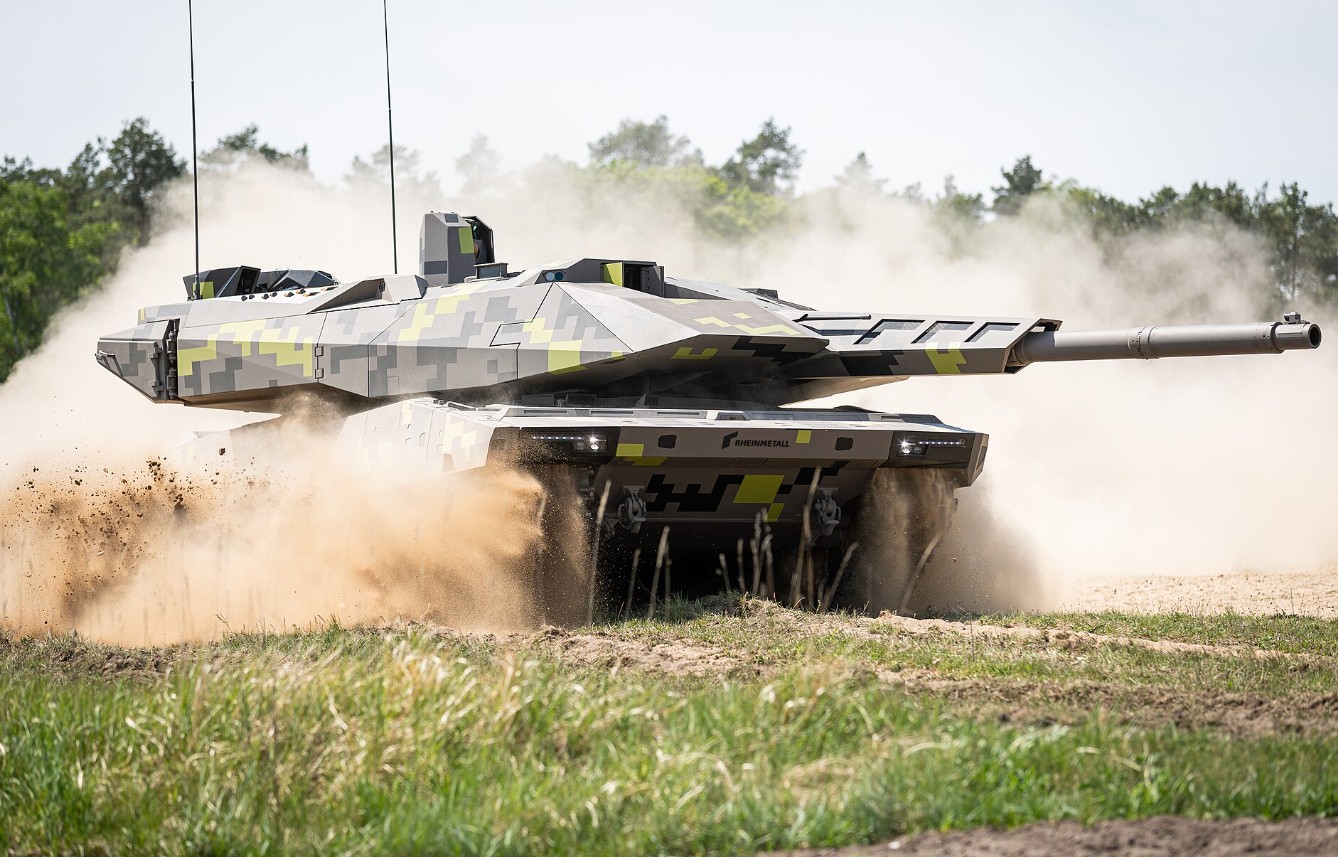
The Panther KF51 is where things get spicy. Rheinmetall unveiled it as a next-generation main battle tank with a strong emphasis on digital integration, upgraded lethality, and protection built for modern anti-tank threats. It is not simply a Leopard 2 with a fresh turret bolted on. The KF51 is presented as a new vehicle family design with a new turret, new systems architecture, and serious room for future upgrades.
The headline feature is the 130mm smoothbore gun. That is a major leap from the standard 120mm NATO tank gun and signals a clear intent: if future adversary armor gets thicker and smarter, the Panther wants more energy on target. Rheinmetall has also talked up advanced automation, improved ammunition handling, and the potential for loitering munitions integration, which is one of those deliciously modern ideas that makes old tank doctrine sweat a little.
The Panther is also designed around a highly digitized battlefield. That means better sensor fusion, faster target acquisition, and a vehicle that is more of a node in a combat network than a lone steel beast rolling around on its own. In modern warfare, that kind of connectivity can matter just as much as raw armor thickness.
Leopard 3 versus Panther KF51: the core differences
If the Leopard 3 is the conservative path, the Panther KF51 is the bold one. The distinction is not simply about who has the bigger gun. It is about philosophy.
Leopard 3 concept:
- likely evolutionary, leveraging Leopard 2 industrial familiarity
- focused on upgradeability and lower integration risk
- could be optimized for NATO commonality
- may emphasize active protection, digital architecture, and survivability
Panther KF51:
- new design language and more radical architecture
- 130mm gun as a headline capability
- highly modular and digitally oriented
- aimed at future threats rather than incremental modernization
This is the classic defense procurement tension: do you evolve the platform that already works, or do you leap forward to a more ambitious design that may deliver more capability but also more risk?
Specs snapshot: what we know so far
| Feature | Leopard 3 concept | Panther KF51 |
|---|---|---|
| Role | Future main battle tank / Leopard 2 successor concept | Next-generation main battle tank |
| Main gun | Likely 120mm or future larger-caliber option, depending on final design | 130mm smoothbore gun |
| Crew | Likely 3-4, depending on automation | 3 |
| Architecture | Evolutionary Leopard family path | Clean-sheet / heavily reworked new design |
| Protection | Likely advanced composite armor plus active protection | Advanced armor, active protection, modular survivability features |
| Digital systems | Modernized battle management and sensors | Highly digitized sensor and combat network integration |
| Future growth | High, if based on Leopard industrial base | Very high, with modular design emphasis |
Some of these details remain fluid, especially for any platform called “Leopard 3,” since that label has been used more as a shorthand for future German tank development than as a locked-down official product name. The Panther KF51, by contrast, has been shown publicly in a more concrete form, though actual procurement and configuration decisions can still change a great deal before any large-scale fielding.
Firepower is only part of the story
Tank enthusiasts love gun caliber debates, and for good reason. A 130mm gun is a huge statement. But in modern armored warfare, the tank that wins is often the one that sees first, shoots first, and survives the return fire. That is why active protection systems, soft-kill measures, hard-kill interceptors, signature reduction, and sensor fusion are such a big deal.
Both the Leopard 3 concept and the Panther KF51 are expected to prioritize survivability against:
- top-attack anti-tank guided missiles
- loitering munitions and drones
- advanced kinetic penetrators
- artillery submunitions and precision strike threats
That reflects a brutal reality: the modern battlefield is not a tank duel in an open field. It is a layered threat environment where the tank is hunted by sensors, drones, and missiles long before it ever gets a clean shot. Any next-generation German armor has to be a fortress, a networked sensor platform, and a mobile gun system all at once.
Mobility, power, and the weight problem
Here is the part that every tank designer eventually has to wrestle with: every new layer of armor, electronics, and weaponry adds weight. And weight demands power, which drives engine, transmission, suspension, and logistics requirements. The Leopard family has long been admired for balancing mobility and protection, and that balance remains crucial. A tank that is too heavy becomes strategically awkward, tactically sluggish, and expensive to sustain.
The Panther KF51 and any Leopard 3 successor will need to avoid becoming overbuilt monsters. They must still cross bridges, move with mechanized formations, and deploy across NATO terrain without turning every road march into an engineering operation. That means clever design, not just brute force. Better materials, smarter packaging, and efficient power management will be just as important as armor thickness.
Industrial politics: the real battlefield
Armor procurement is never just about engineering. It is also about industrial strategy, national sovereignty, and European defense politics. The Leopard 2 ecosystem is deeply embedded in Germany and across allied armies. That gives an evolutionary Leopard 3 approach real advantages in terms of supply chains, maintenance, and existing expertise.
Meanwhile, Rheinmetall’s Panther KF51 represents a strong push to shape the future market around a newer platform. If it succeeds, it could influence not only Germany’s next tank but also export customers searching for a future-proof alternative. If it stalls, it may still have done something valuable: force the conversation toward bigger guns, more automation, and more modular survivability.
This is why the contest matters beyond one national procurement. Europe is in the middle of a broader armored modernization cycle, and the outcome will shape how NATO land forces think about mass, lethality, and resilience for decades.
What to watch next
The most important questions are not whether these tanks look impressive on a trade-show floor. They absolutely do. The real questions are:
- Will Germany choose an evolutionary Leopard-based path or a more radical redesign?
- How much emphasis will be placed on 120mm versus 130mm armament?
- Will active protection become standard, not optional?
- Can industry deliver the promised digital architecture at scale?
- How will human crew size, automation, and remote systems evolve?
For now, the Leopard 3 and Panther KF51 represent two different answers to the same problem: how does a tank survive and dominate in a battlefield where drones, precision fires, and networked sensors have changed the rules? One answer leans on the trusted DNA of the Leopard. The other starts with a more radical leap. Both are fascinating, and both tell us that the main battle tank is not obsolete at all. It is evolving into something smarter, more connected, and far more lethal.
And that makes Germany’s armored future one of the most exciting development stories in defense right now.