

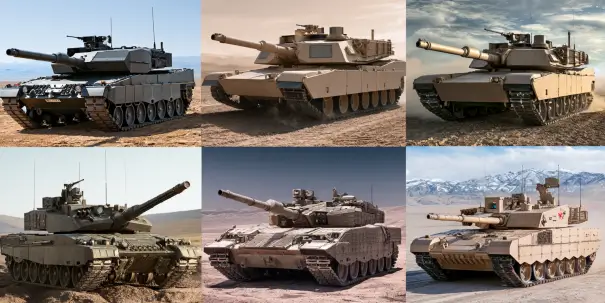
Main battle tanks remain the blunt instrument of modern land warfare: heavy, survivable, intimidating, and still highly relevant when a fight turns into close, ugly, mixed-terrain combat. Despite drones, top-attack munitions, and precision artillery reshaping the battlefield, a well-designed MBT still gives commanders the ability to punch through defenses, hold ground, and survive punishment that would destroy lighter vehicles. The best tanks in service today are not simply the heaviest or the most expensive. They are the ones that combine firepower, protection, mobility, and crew ergonomics in a way that actually works in the field.

There is no single tank that wins every category. Some are built around raw protection, others around fire control and first-round hit probability, and some around a balance that makes them easier to support and sustain. The battlefield also matters. A tank that is superb on European training ranges may be less ideal in desert dust, jungle humidity, mountain roads, or urban rubble. From a practical standpoint, the best MBT is the one that can keep moving, keep firing, and keep its crew alive when the situation inevitably goes wrong.
What makes a top-tier MBT
In the field, tank crews care less about brochure claims and more about whether the machine starts on the first turn, tracks straight, can see before being seen, and can survive a hit long enough to get out of trouble. The best current MBTs usually share a few traits:
- Excellent fire control with thermal sights, stabilized guns, and reliable laser rangefinding.
- Strong protection from kinetic and chemical threats, usually combining armor arrays, reactive armor, and active protection systems.
- Good mobility for their weight, because a tank that cannot cross a bridge, climb a slope, or recover quickly is a liability.
- High crew survivability through ammunition stowage design, spall liners, and compartmentalization.
- Sustainability in terms of fuel use, maintenance, and parts availability.
That last point is often overlooked by outside observers. A tank that is excellent on paper but hard to maintain will lose its edge fast once it enters sustained operations. Real armies need vehicles that can be repaired forward, recovered under fire, and returned to service without a six-week wait for a specialist team.
Leopard 2A7 and Leopard 2A7V
The German Leopard 2 family remains one of the most respected MBT lines in service. The latest versions, including the Leopard 2A7 and 2A7V, are not just old tanks with a fresh coat of paint. They represent a mature platform that has been steadily improved with better armor, electronics, situational awareness, and support for modern battlefield demands.
What sets the Leopard apart is its balance. It has strong mobility for a tank in the 60-plus-ton class, a highly capable 120 mm gun, and a reputation for precision fire control that matters when the first shot counts. In practice, that means crews can find, range, and engage targets quickly, even while moving. The tank also benefits from broad user experience across multiple NATO and partner nations, which makes logistics, upgrades, and interoperability more manageable than with some more specialized designs.
The Leopard 2 is not the lightest tank on the list, and it is not cheap to operate. But for armies that want a proven, adaptable MBT with a long upgrade path, it remains a benchmark.
M1A2 SEP v3 Abrams
The Abrams remains the standard by which many armies judge heavy armor, and for good reason. The M1A2 SEP v3 is a heavily upgraded version of a combat-proven design that continues to evolve with better electronics, improved armor, more efficient power management, and improved integration of modern battlefield systems. The Abrams has earned its reputation the hard way, in real combat conditions where performance matters more than marketing.
From a crew perspective, the tank is built around survivability and lethality. Its fire control system is excellent, its 120 mm gun is well proven, and the protection package gives crews confidence in a close fight. The downside is well known: fuel consumption is high, and the tank is heavy. In a logistics-heavy army like the United States, that is manageable. In a force without that kind of support structure, it can become a major burden.
The Abrams is not the easiest tank to keep in the field, but if an army can support it properly, it is still one of the most formidable MBTs in service anywhere.
K2 Black Panther
South Korea’s K2 Black Panther is one of the most advanced MBTs in service and arguably the most elegant blend of sensor fusion, mobility, and modern firepower currently fielded. It was designed for a demanding operational environment, including the possibility of rapid maneuver, poor weather, and high-threat engagements. That shows in the engineering.
The K2 is known for its advanced suspension, automated systems, and excellent fire control suite. It can engage accurately while moving and has a strong reputation for tactical mobility. For a crew, the tank feels like a modern system rather than a heavily upgraded legacy platform. It also reflects a design philosophy that values rapid response and flexibility rather than sheer brute mass alone.
One of the K2’s strengths is that it was built with modern electronics from the start, not added in layers over decades. The result is a tank that is more integrated than many older competitors. The main challenge is cost and complexity, which can make acquisition and sustainment difficult for smaller armies.
Challenger 3
The British Challenger 3 is still entering service, but it deserves attention because it represents a major reset of a uniquely survivable tank lineage. The original Challenger 2 already had a strong reputation for crew protection, and the Challenger 3 upgrade package aims to bring the platform into a more modern combat environment with a new turret, improved sensors, and a 120 mm smoothbore gun. That gun change alone is significant, because it improves ammunition commonality with NATO partners and broadens tactical flexibility.
The Challenger series has always been known for armor and survivability. What it historically lagged in was modernization speed and some aspects of firepower standardization. Challenger 3 is intended to close that gap. If the program performs as intended, it will give the British Army a tank that is more relevant in high-intensity combat while preserving the platform’s core strengths.
For practical users, the real test will be reliability in service and whether the upgrade delivers enough improvement to justify the cost. The design promise is strong.
Merkava Mk 4 and Mk 4 Barak
Israel’s Merkava series is different from most MBTs because it was shaped by the tactical realities of a small state expecting close combat, anti-armor threats, and frequent urban operations. The Merkava Mk 4, especially in its more modern Barak configuration, is built around crew protection, battlefield awareness, and adaptability. It is not the fastest tank in the world, but it is one of the most thoughtfully arranged for crew survival.
One of the most practical advantages of the Merkava is its layout. The engine is forward-mounted, which adds a layer of protection for the crew compartment. The tank is also designed to support infantry interaction and casualty evacuation in some configurations, which reflects how Israeli armored forces actually fight. The Barak upgrade adds modern digital architecture and improved situational awareness, making the tank more capable in complex, sensor-saturated environments.
In a region where anti-tank missiles, drones, and urban ambushes are real and persistent threats, the Merkava remains a highly relevant design.
T-90M Proryv
The T-90M is one of the most capable Russian MBTs in service and a major step up from earlier Soviet-era designs. It combines a more modern fire control suite, improved armor, and a stronger gun system than older variants. From a design standpoint, it reflects an emphasis on compactness, lower silhouette, and battlefield mass.
In the field, the T-90M is a reminder that tank design is always a tradeoff. Its lower profile can be useful in concealment, and the platform is deeply rooted in a long production line with a relatively compact logistical footprint compared with some Western heavyweights. At the same time, crew ergonomics and ammunition storage remain less forgiving than the best Western designs, and survivability under modern top-attack and drone-delivered threats is a significant concern.
The T-90M is still an important combat tank, but like many Russian systems, its effectiveness depends heavily on tactics, support, and the quality of the broader combined-arms package around it.
Type 99A
China’s Type 99A is often discussed less than its Western peers, but it is a serious MBT with modern armor, a powerful gun, and increasingly sophisticated electronics. It is designed for China’s operational needs, which include large-scale maneuver, regional contingency operations, and the ability to field a domestically produced heavy armored force at scale.
The Type 99A offers strong mobility and a modernized fire control architecture. Its overall design reflects an effort to close the gap with the best Western tanks while maintaining domestic production independence. For outside observers, the biggest challenge is that there is less open-source operational data than for the Abrams, Leopard, or Merkava families. Still, on paper and in observed exercises, it belongs in the top tier of current MBTs.
How these tanks compare in the real world
When comparing the world’s best tanks, it is tempting to crown a single winner. That usually misses the point. The Leopard 2A7 is a superb all-rounder. The Abrams is a combat-proven heavyweight with excellent survivability. The K2 is a technologically advanced and highly mobile modern design. The Merkava is optimized for crew protection and the realities of a lethal, drone-rich urban battlefield. The Challenger 3 aims to modernize a heavily protected British platform. The T-90M and Type 99A show how Russia and China are pushing their own design philosophies forward.
In a real war, the best tank is the one that is integrated into a competent combined-arms system. Tanks do not win by themselves. They need infantry, engineers, artillery, air defense, reconnaissance, electronic warfare, and logistics. A top-tier MBT without those enablers is just an expensive target. But when used properly, these vehicles still shape the battlefield in a way few other systems can.
That is why main battle tanks remain important. Not because they are invincible, but because they are still one of the few systems that can deliver mobile direct fire, absorb punishment, and hold a line under pressure. The names change, the armor packages evolve, and the sensors get better, but the battlefield logic stays the same.