

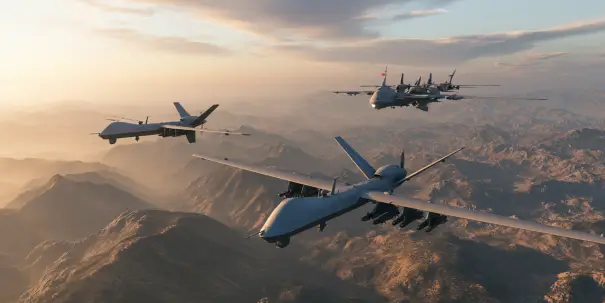
Military drones have moved from niche reconnaissance tools to central instruments of combat power, reshaping how states detect, target, and strike adversaries across the modern battlespace. Their impact extends well beyond the air domain: drones are altering force structure, lowering the threshold for persistent surveillance, and forcing militaries to rethink air defense, maneuver doctrine, and electronic warfare priorities. In conflicts from the Caucasus to the Middle East and Eastern Europe, unmanned systems have demonstrated that even relatively low-cost platforms can impose disproportionate operational effects when integrated into a wider sensor-shooter network.
From surveillance asset to strike weapon
Early military drones were primarily built for intelligence, surveillance, and reconnaissance — often flying long endurance missions to feed commanders a real-time picture of the battlefield. Today, many are armed, networked, and increasingly autonomous in selected functions. This shift has compressed the sensor-to-shooter cycle. Targets that once required dedicated aircraft, artillery observers, and lengthy command approval chains can now be detected, tracked, and engaged in minutes.
The strategic consequence is significant. Drones do not merely provide information; they enable continuous battlefield pressure. A unit under persistent drone observation loses freedom of movement, struggles to mass forces, and is compelled to disperse, camouflage, or operate at night. This changes the tempo of war and increases the value of concealment, deception, and signature management.
Why drones matter in contemporary doctrine
Modern military doctrine increasingly treats drones as a layer in a broader kill chain rather than as standalone platforms. Their utility depends on integration with satellites, ground sensors, command networks, electronic warfare units, and precision munitions. This networked approach allows commanders to allocate drones to tasks such as target acquisition, battle damage assessment, relay communications, decoying air defenses, and direct strike missions.
For smaller or resource-constrained militaries, drones offer a path to asymmetry. They can extend reach without the political and financial burden of large manned air fleets. For major powers, drones provide persistence, reduce risk to pilots, and create a more distributed force architecture. In both cases, unmanned systems are helping militaries project power in ways that are more flexible, scalable, and, in some cases, more politically acceptable than sending manned aircraft into contested airspace.
Operational effects on the battlefield
The most visible battlefield effect of drones is their role in targeting. Artillery units, missile batteries, armored columns, logistics convoys, and command posts are all vulnerable to persistent aerial observation. Once detected, these assets can be rapidly engaged by loitering munitions, guided artillery, or aircraft. This has elevated the importance of mobility and reduced the survivability of static formations.
Drones also influence defensive operations. Air defense units must now account for small, slow, low-flying platforms that can be difficult to detect and classify. This has prompted the expansion of layered air defense architectures that combine radar, electro-optical sensors, jammers, short-range missiles, and directed-energy concepts. In practical terms, drones have forced defenders to spend more effort and money to counter relatively inexpensive threats.
Another major effect is psychological. The presence of drones overhead can degrade morale, increase fatigue, and create a sense of constant vulnerability. This is especially true when drones are paired with loitering munitions or when they enable rapid artillery correction. The battlefield becomes not just contested, but persistently watched.
The counter-drone challenge
As drone use has expanded, so has the need for counter-UAS capability. This has become a major procurement and doctrine issue. Militaries now require layered defenses that can detect, identify, jam, spoof, capture, or destroy unmanned systems at varying ranges and altitudes. The challenge is made harder by the proliferation of commercially derived components, autonomous navigation aids, and low radar cross-section designs.
Electronic warfare is particularly important because many drones rely on datalinks, GPS, or other navigational signals. However, EW alone is not sufficient. Some systems can operate with inertial navigation, pre-programmed routes, or terminal autonomy. That means physical interception, kinetic defeat, and passive defense measures remain essential. Camouflage, concealment, decoys, hardened shelters, and disciplined emissions control are now core survivability measures.
Industrial scale and the economics of mass
One of the most disruptive aspects of military drones is economics. A relatively inexpensive drone can force an adversary to expend costly missiles, radar time, crew attention, and maintenance effort. This cost-exchange ratio is strategically important. It rewards the side able to produce, field, and replace drones quickly, even if individual systems are not highly sophisticated.
This has accelerated interest in attritable unmanned systems and swarm concepts. The logic is straightforward: if a military can field large numbers of drones at low cost, it can saturate defenses, complicate targeting, and maintain pressure after losses. In this environment, industrial capacity, software iteration, and supply-chain resilience become combat variables. The ability to build drones at scale can matter as much as the performance of a single platform.
Geopolitical and strategic implications
Drones are influencing the balance of power in several ways. They enable regional powers and non-state actors to threaten critical infrastructure, disrupt logistics, and impose costs on stronger adversaries. They also reduce the barrier to long-range strike, especially when combined with precision navigation and networked intelligence. As a result, strategic depth is shrinking. Rear areas are no longer safe simply because they are far from the front line.
At the same time, drone warfare is pushing militaries toward greater autonomy and machine-speed decision-making. This raises questions about command authority, escalation control, and the ethics of lethal autonomy. As systems become more capable, the line between remote-controlled and autonomous strike will continue to blur. That will shape arms control debates, export policy, and alliance interoperability for years to come.
What the future battlefield may look like
The future combat environment will likely be defined by a dense contest between sensors and counter-sensors. Drones will be used not only for strike and reconnaissance, but also for electronic attack, communications relay, decoying, and battlefield management. Manned aircraft will remain relevant, but they will increasingly operate alongside unmanned wingmen and stand-off support systems designed to reduce exposure in contested airspace.
For militaries planning force modernization, the key lesson is that drones are not a standalone capability. They are part of a broader ecosystem that includes data links, artificial intelligence, precision weapons, electronic warfare, resilient logistics, and training for dispersed operations. Those who understand drones as a system-of-systems problem — rather than merely a platform acquisition issue — will be better positioned for future conflict.
Military drones have already changed the character of war by making surveillance persistent, targeting faster, and airspace more contested. Their next transformation may be even greater: enabling forces to fight at longer range, with greater dispersion, and under constant observation. In the coming decade, success will belong to militaries that can not only fly drones, but also survive them, counter them, and integrate them into a coherent operational design.