

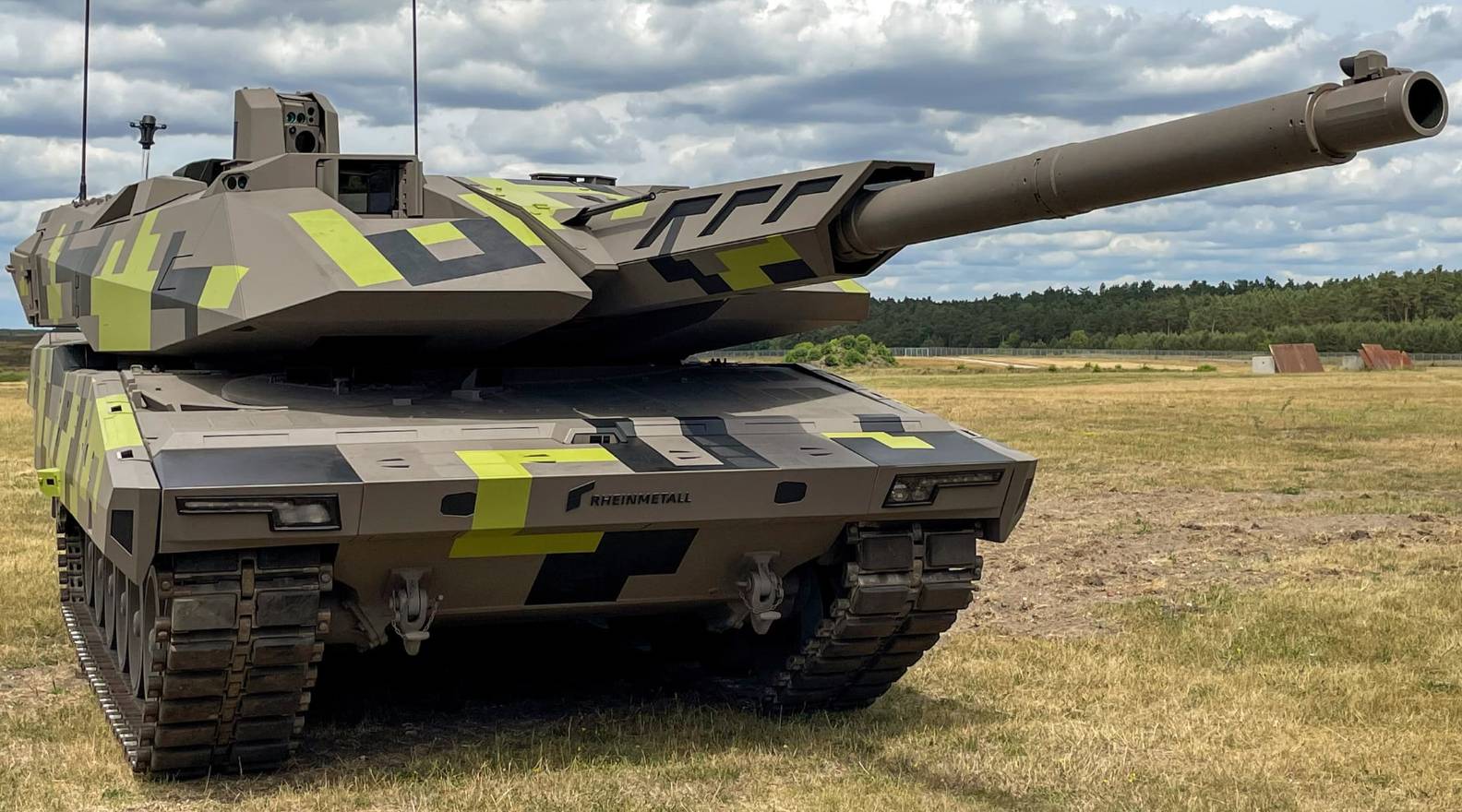
When Rheinmetall unveiled the KF51 Panther, it did so with the confidence of a company that understands a timeless truth in armored warfare: the tank is always evolving, but never from scratch. The Panther is presented as a next-generation main battle tank, yet its roots are unmistakably European and, more specifically, German. It draws on the long shadow cast by the Leopard family, especially the Leopard 2, the Cold War standard-bearer that has spent decades proving that balance matters as much as brute force.
In that sense, the KF51 is less a clean-sheet break from the past than the latest step in a lineage that stretches back through the Leopard 2A7, the Leopard 2A4 of the late Cold War, and even farther to the hard lessons of the Second World War. German armored design has repeatedly returned to a central question: how do you combine firepower, protection, mobility, and battlefield awareness without allowing any one to dominate the others? The Panther attempts to answer that question for an era shaped by drones, top-attack munitions, precision artillery, and digital battle management.
A Panther in name, a Leopard in spirit
The name Panther is historically loaded. During the Second World War, the Panzer V Panther was one of the Wehrmacht’s most formidable tanks, admired for its sloped armor and high-velocity gun, even as mechanical complexity and the realities of industrial war limited its impact. Rheinmetall is clearly invoking that reputation: a fast, lethal, technologically sophisticated German tank for a new age. But unlike wartime Germany’s rushed wartime designs, the KF51 is built in the context of a mature NATO industrial base and a broad ecosystem of modern subsystems.
Just as important, the KF51 appears to leverage the Leopard 2 chassis architecture rather than abandoning it. That choice matters. The Leopard 2 became one of the most successful postwar tanks because it offered an excellent combination of reliability, upgrade potential, and tactical flexibility. From the mechanized fields of the Cold War to the dusty, asymmetric battlefields of Afghanistan, Leopard variants demonstrated that survivability is not just thick armor, but maintainability, sensor integration, and the ability to keep fighting after taking a hit. The Panther builds on that philosophy while trying to leap ahead technologically.
Firepower: the heart of the design
The most visible departure from earlier Leopard variants is the weapon system. The KF51 mounts a 130 mm smoothbore gun, a significant escalation from the 120 mm guns long associated with NATO main battle tanks. The move recalls earlier periods in tank history when larger-caliber weapons were introduced to keep pace with stronger armor: the transition from 75 mm to 88 mm in World War II, or the Cold War race between armor and gun power that drove continual modernization.
The 130 mm gun is intended to provide greater kinetic energy and improved lethality against current and future armored threats. Rheinmetall has also discussed a new family of ammunition and automation to support the larger weapon. In practical terms, that means the KF51 is designed not merely to hit harder, but to preserve a margin of overmatch against the most heavily protected vehicles likely to appear on future battlefields.
Complementing the main gun is a remote-controlled weapons station, often associated with a 7.62 mm or similar machine gun, and an integrated loitering munition capability. That last feature is a telling sign of the times. Tanks once dominated open terrain through direct line-of-sight gunnery; now they must survive in a world where the threat may come from beyond the tank’s own optics, or from a drone operator several kilometers away. By incorporating organic drone and loitering munition options, the KF51 acknowledges that the armored fight is no longer a duel between tanks alone.
Protection in the age of top-attack threats
Armor has always been a contest between projectile and protection, but the character of that contest has changed. The classic tank threat was frontal penetration from another tank’s gun. Today’s threats include top-attack missiles, attack drones, precision artillery submunitions, and tandem-warhead weapons designed to defeat reactive armor. The KF51 is therefore expected to combine passive armor, modular add-on protection, and active protection systems.
That layered approach reflects a historical shift. In the early tank age, protection meant thicker steel. By the late 20th century, composite armor and spaced arrays became standard. In the 21st century, survivability increasingly depends on sensors, electronic countermeasures, and active defeat mechanisms that intercept incoming threats before they strike. If the Leopard 2 family represented the mature end of passive-armor excellence, the Panther aims to push further into the era of active survivability.
Details of the KF51’s exact protection suite remain limited in open sources, but the design clearly emphasizes modularity. That is no small matter. Modular armor allows armies to tailor protection to mission profile, whether operating in a high-intensity European theater or a lower-threat expeditionary environment. It also simplifies upgrade cycles, a lesson many armies learned the hard way after buying tanks that were difficult to modernize once the threat environment changed.
Digital warfare and crew survival
Perhaps the most important revolution in the KF51 is not visible from a distance. Like other advanced armored vehicles, it is designed around digital networking, sensor fusion, and improved situational awareness. Where earlier tank crews relied on optical periscopes, radio chatter, and hard-won intuition, modern crews must process a flood of data: thermal imagery, battlefield management feeds, unmanned aerial reconnaissance, and threat alerts from active protection sensors.
This shift has historical precedent. The introduction of radios in interwar tanks transformed armored warfare in the same way that the internal combustion engine transformed cavalry. Later, thermal imaging and laser rangefinding changed the pace of gunnery. The KF51 is part of the next wave: a tank as node in a distributed combat system, not an isolated steel fortress.
The crew arrangement also reflects the push toward automation. By reducing the burden of ammunition handling and integrating modern fire-control systems, the KF51 may help ease the cognitive load on its crew. That matters because survivability is now as much about speed of decision as thickness of armor. A tank that sees first, shoots first, and relocates quickly can survive against larger threats than one that merely resists them.
Specifications at a glance
| Specification | Details |
|---|---|
| Designation | Rheinmetall KF51 Panther |
| Type | Main battle tank |
| Main armament | 130 mm smoothbore gun |
| Secondary armament | Remote weapon station; machine gun; loitering munition integration |
| Base heritage | Leopard 2 chassis architecture |
| Crew | Reportedly 3 to 4, depending on final configuration |
| Protection | Modular armor, active protection, digital survivability features |
| Status | Prototype / concept demonstrator |
Why the KF51 matters
The KF51 Panther is significant not because it already dominates the battlefield, but because it reveals where armored warfare may be heading. For years, some observers predicted the tank’s decline in the face of missiles, drones, and precision strike systems. Yet conflicts from Nagorno-Karabakh to Ukraine have shown that armor remains indispensable, provided it adapts. Tanks are not obsolete; they are under pressure to become more networked, more protected, and more lethal at longer ranges.
That is exactly where the Panther fits. It is a response to lessons that older generations of tank builders would recognize: the need for overmatch, the need for mobility, and the need to survive in a battlefield defined by rapidly changing threats. The leap from Leopard 2 to KF51 is therefore not unlike earlier evolutionary jumps in tank history. The silhouette changes, the systems become more complex, and the crew’s relationship to the machine becomes more digital, but the central purpose remains the same: deliver decisive force where the fighting is hardest.
Whether the KF51 becomes a production success or remains a technological showcase, it already serves as a marker of intent. It tells us that the tank is not being retired from history. It is being rewritten for it.