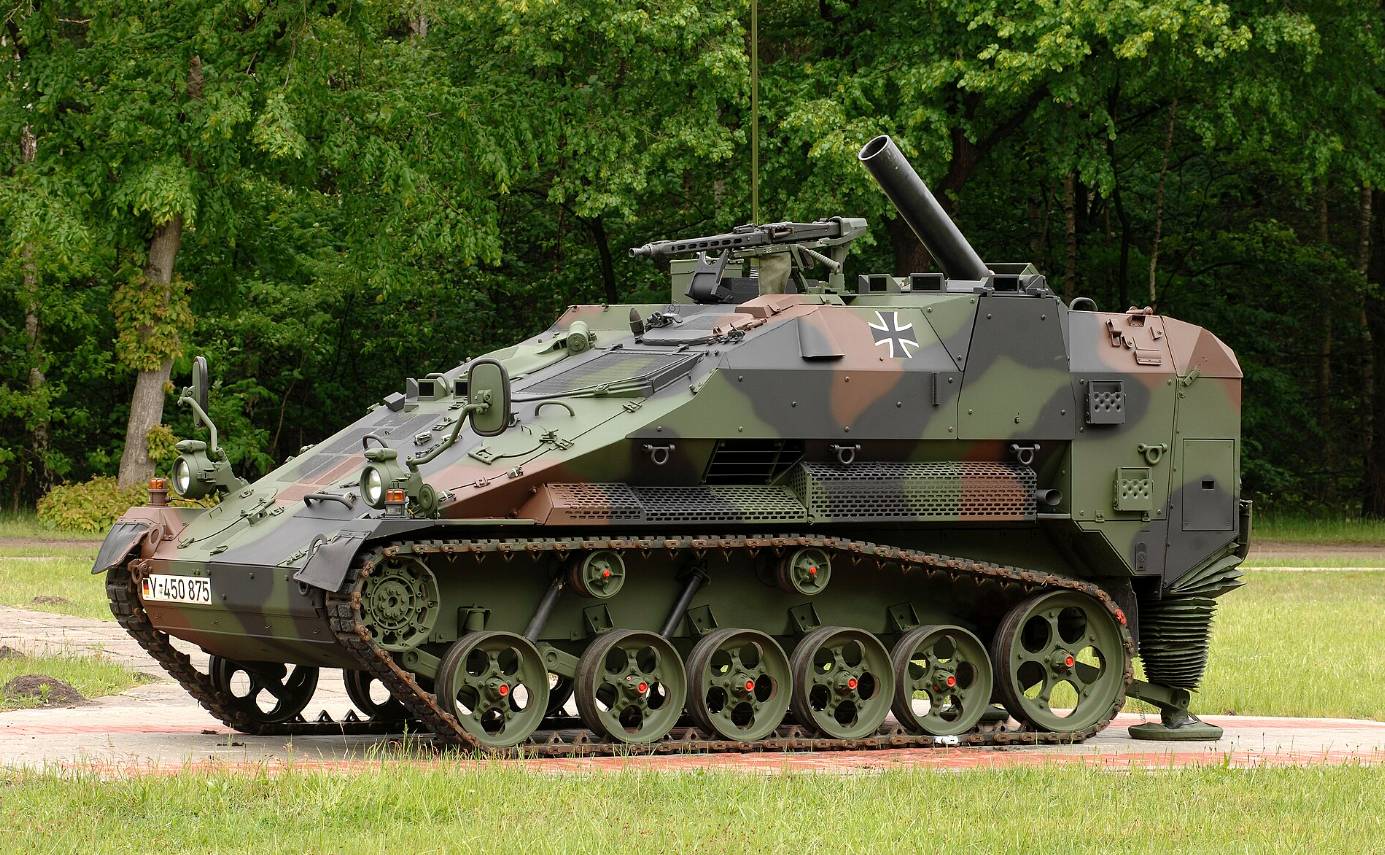
The German Wiesel 2 family has long occupied a niche that few armored vehicles can credibly fill: a compact, highly mobile combat platform light enough to be transported by helicopter or cargo aircraft, yet sufficiently robust to carry sensors, command systems, and weapon stations for airborne and rapid-reaction forces. When configured for air defense roles—including radar, fire control, and anti-aircraft missile launchers—the Wiesel 2 becomes a highly specialized short-range air defense node designed for expeditionary operations where strategic lift, low silhouette, and fast deployment matter more than heavy armor.
What makes the concept notable is not simply that a small tracked vehicle can be air-transported. It is that the platform can be integrated into a layered air defense architecture while remaining tactically relevant after landing. In modern battlefield terms, the Wiesel 2 air defense variant is less a tank and more a mobile air defense sensor-shooter optimized for dispersed operations, protection of airborne formations, and point defense against helicopters, low-flying aircraft, and certain classes of unmanned aerial systems.
Platform architecture and mobility
The Wiesel 2 is an enlarged evolution of the original Wiesel concept, retaining the same design philosophy: minimal footprint, low mass, and excellent transportability. The chassis is a compact tracked vehicle with a very low profile, which provides two immediate tactical benefits. First, it is easier to conceal in terrain. Second, it reduces the visual and radar signature compared with heavier air defense vehicles. In the air defense role, signature reduction is not a luxury; it directly influences survivability against counter-battery fire, loitering munitions, and enemy reconnaissance drones.
In engineering terms, the Wiesel 2 trades armor mass for mobility and deployability. This is a deliberate compromise. It cannot survive the same level of direct fire as larger infantry fighting vehicles or armored air defense systems, but it can be moved rapidly by air, operate from constrained landing zones, and support airborne troops within minutes of arrival. That is precisely the operational envelope for which it was designed.
Typical transportability options include helicopter external lift, internal carriage by large transport aircraft, and rapid offload from tactical airlifters. This gives commanders the ability to insert air defense assets into austere or semi-prepared locations far ahead of heavier formations. In practice, that means the Wiesel 2 can help close the most dangerous gap in expeditionary warfare: the interval between landing and the establishment of a protected air defense umbrella.
Air defense variant: sensor-shooter integration
The air defense configuration of the Wiesel 2 is most interesting when viewed as a system rather than a vehicle. A modern short-range air defense platform needs three core elements: detect, identify, and engage. The Wiesel 2 can be fitted with surveillance radar, electro-optical fire control, and a missile launcher, creating a compact engagement unit able to operate independently or as part of a networked air defense battery.
Radar provides early warning and target cueing. In an airborne context, the radar must be compact, low-power, and quick to deploy. The engineering challenge is to balance detection range with vehicle stability, power consumption, and mast or turret packaging. A small tracked chassis has limited electrical generation and limited space for antenna arrays, so designers must prioritize the most relevant target set: helicopters, fixed-wing aircraft at low altitude, and small low-signature aerial threats within short to medium range.
Electro-optical and infrared systems complement radar by enabling passive tracking and identification. This is especially important when the force is operating under emission control or when hostile electronic warfare is expected. The missile launcher itself is usually arranged in a compact turret or elevating mount, preserving the low silhouette while allowing rapid engagement. The launcher’s compactness is not cosmetic; it is a direct response to the need for airdrop/air-transport constraints and battlefield survivability.
Typical configuration and known technical characteristics
Exact fit varies by mission module and customer requirement, but the Wiesel 2 family commonly sits in a class of vehicles that emphasizes very light weight, compact dimensions, and high tactical agility. The air defense version is built around the same philosophy. Where available, the system is generally associated with short-range missile launchers and lightweight radar components designed for rapid deployment.
| Specification | Typical Wiesel 2 Air Defense Configuration |
|---|---|
| Platform | Tracked light armored vehicle |
| Crew | 2 to 3, depending on mission module |
| Combat weight | Approx. 4 to 6 tonnes, depending on fit |
| Transportability | Helicopter-liftable; air-transportable by tactical airlifter |
| Primary role | Short-range air defense, point defense, airborne force protection |
| Sensor fit | Surveillance radar, electro-optical/infrared fire control |
| Weapon fit | Anti-aircraft missile launcher, typically short-range class |
| Mobility | Tracked cross-country mobility optimized for rough terrain |
| Signature | Low visual profile and reduced target exposure |
Because module options vary, published figures for speed, protection levels, and sensor performance can differ from one configuration to another. That said, the platform class is defined by its ability to move quickly across broken terrain while carrying enough electrical and mechanical capacity to support mission electronics. The compact chassis also means that weight distribution is critical. Radar mast placement, launcher elevation, and ammunition or missile canister positioning all affect center of gravity and traverse stability.
Engineering trade-offs: why small is both a strength and a limitation
The Wiesel 2 air defense vehicle is an exercise in disciplined compromise. Its greatest strength—extreme deployability—also creates constraints on armor, endurance, sensor aperture, and missile loadout. A larger air defense vehicle can carry a more powerful radar, a greater number of missiles, thicker armor, and a more capable command post. The Wiesel 2 cannot compete on mass or magazine depth. Instead, it wins by being where heavier systems cannot be on time.
That trade-off is especially important in expeditionary warfare. Airborne troops are vulnerable immediately after insertion, when enemy aircraft, helicopters, and drones can exploit the absence of layered air defense. A light tracked launcher can move with the force, occupy concealed firing positions, and establish a defensive screen before the main body of support vehicles arrives. In this role, survivability comes from mobility, concealment, and networked operation rather than from armor thickness.
There is also a command-and-control trade-off. Small platforms are excellent tactical nodes, but they are not ideal for carrying large battle management systems. As a result, the Wiesel 2 is best employed as part of a larger air defense ecosystem, receiving cueing from higher-echelon radars or distributed sensors and contributing its own local engagement capability. This reduces reaction time and conserves missile inventory by minimizing false or low-priority engagements.
Operational role within layered air defense
The Wiesel 2 air defense variant is best understood as a low-altitude point-defense layer. It is not intended to replace medium- or long-range air defense systems. Instead, it fills a critical gap around high-value assets, forward landing zones, artillery positions, command posts, and airborne infantry concentrations. In a layered network, it protects against threats that penetrate outer air defense zones or appear suddenly at low altitude.
Its utility is particularly strong in three mission sets:
- Airborne force protection after parachute or air assault landing.
- Forward area defense for lightly equipped units operating beyond the reach of heavy formations.
- Mobile counter-UAS and rotary-wing defense in complex terrain where line-of-sight engagements are brief and frequent.
The vehicle’s low profile and tracked mobility make it especially effective in wooded, urban-edge, and broken terrain where wheeled air defense systems may struggle with soil conditions or exposure. When paired with a radar cueing source, it can rapidly shift firing positions, improving survivability against enemy suppression efforts.
Comparative assessment
Compared with larger self-propelled air defense systems, the Wiesel 2 offers dramatically better strategic mobility and deployment speed, but at the cost of payload, radar power, and sustained endurance. Compared with man-portable air defense teams, it offers greater sensor integration, protected mobility, and faster reaction time. That middle ground is what gives the platform its niche value.
| Category | Wiesel 2 Air Defense | MANPADS Team | Medium SHORAD Vehicle |
|---|---|---|---|
| Deployability | Excellent | Excellent | Moderate |
| Sensor integration | High | Low to moderate | Very high |
| Missile loadout | Low to moderate | Very low | Moderate to high |
| Armor protection | Light | Minimal | Moderate |
| Strategic mobility | Outstanding | Outstanding | Good |
| Best use case | Airborne point defense | Dispersed ambush defense | Layered brigade defense |
Why the concept still matters
Even as drone warfare and electronic warfare reshape short-range air defense, the logic behind the Wiesel 2 remains highly relevant. Lightweight tracked launchers can be dispersed, hidden, and networked. Their low footprint makes them easier to transport into threatened sectors, and their modular architecture allows sensor and weapon updates as threat patterns evolve. The rise of small UAVs, loitering munitions, and fast pop-up helicopter threats has only increased the importance of rapidly deployable point-defense systems.
In that sense, the Wiesel 2 air defense vehicle is less a relic than a prototype of a continuing requirement: a tiny, air-portable, network-aware missile carrier that can keep pace with airborne troops and survive long enough to matter. Its value does not come from dominating the battlefield through firepower alone. It comes from solving a very specific operational problem with elegant engineering: putting credible air defense on the ground before the enemy can exploit the opening.
Bottom line: the air-dropped Wiesel 2 with radar and anti-aircraft missiles is a specialized but highly effective answer to expeditionary short-range air defense. It is not a heavy shield. It is a fast, compact, and tactically intelligent tripwire—one that gives airborne forces a real chance to hold the sky overhead until deeper layers of air defense arrive.