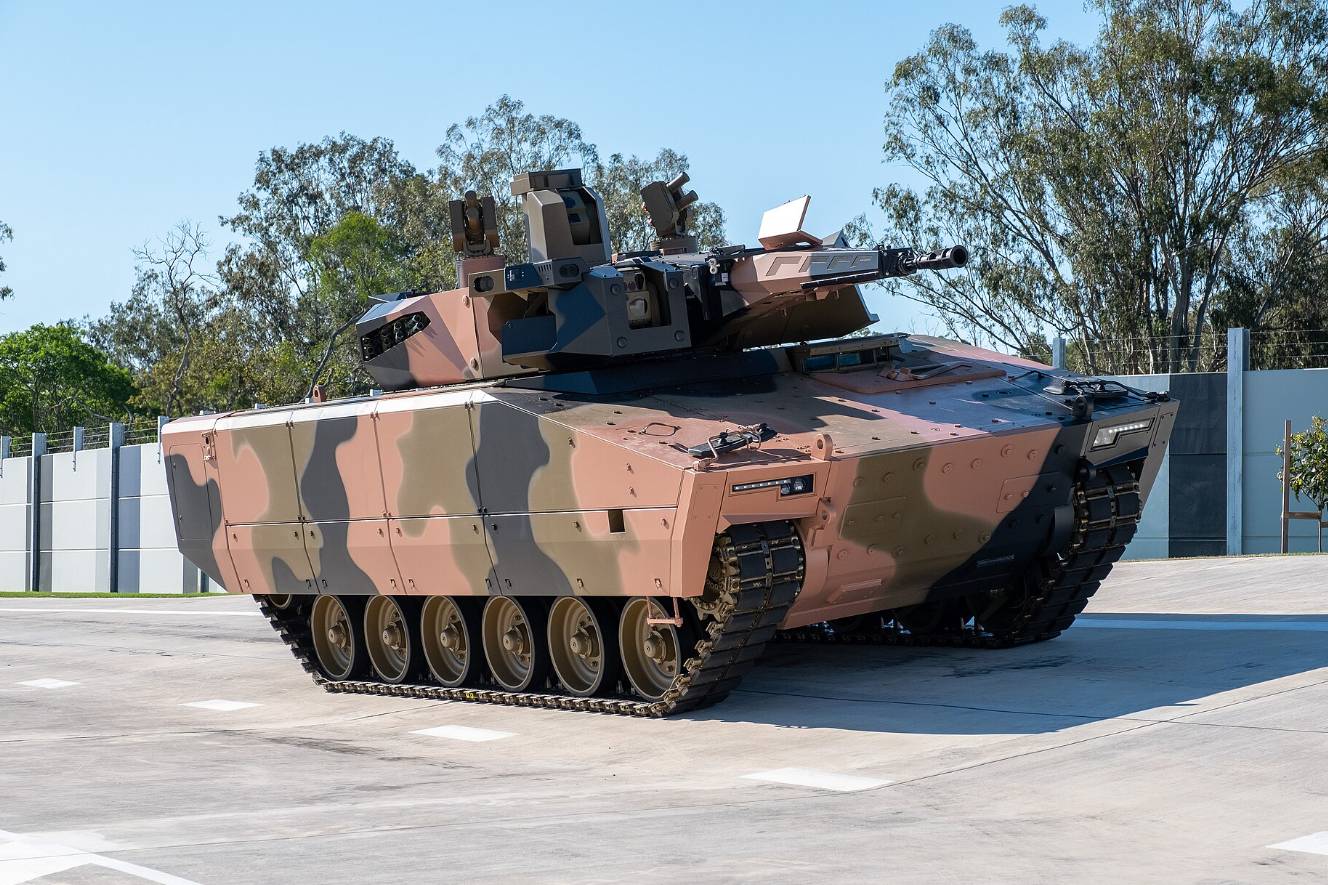
The U.S. Army’s XM30 Mechanized Infantry Combat Vehicle is the most consequential armored-vehicle development program in decades: a deliberate attempt to replace the M2 Bradley with a platform that is materially better in lethality, survivability, digital architecture, and growth margin. The Bradley has served for over 40 years and, through successive upgrades, remains a capable infantry fighting vehicle. But its basic constraints—payload margin, electrical power, armor growth, internal volume, and automotive growth—are now structural limits rather than upgrade gaps. XM30 is designed to reset that baseline.
In practical terms, XM30 is not just a “new Bradley.” It is intended to be a modular, digitally native tracked combat vehicle capable of carrying a mechanized infantry squad into high-threat environments while integrating active protection, open-systems electronics, advanced sensors, and a weapon suite able to defeat both legacy armored vehicles and emerging unmanned threats. The program is also a test case for how the Army wants to field ground combat systems in the 2030s: iterative, software-defined, and open to rapid technology insertion rather than frozen around a single baseline for 30 years.
Program background and operational requirement
The Bradley entered service in the 1980s as a fast, well-armed infantry fighting vehicle meant to accompany M1 tanks and exploit breakthroughs. It has proven remarkably adaptable, but modern battlefields now punish older assumptions. Top-attack munitions, loitering munitions, advanced anti-tank guided missiles, pervasive drones, and dense electronic warfare environments all place pressure on the survivability model of legacy armored fleets. The Army’s next infantry combat vehicle therefore needs far more than thicker armor. It needs sensing, signature management, digital resilience, and protection against threats arriving from every azimuth and elevation.
XM30 is the Army’s answer under the Optionally Manned Fighting Vehicle effort, which evolved into the current mechanized infantry combat vehicle competition. The core requirement is to provide a vehicle that can transport a dismounted squad, fight mounted, survive on a multi-domain battlefield, and accept future upgrades without extensive redesign. That requirement has driven unusually strong emphasis on growth capacity: payload, electrical generation, open electronics, cooling, and internal architecture are all central design parameters rather than secondary considerations.
Expected design philosophy
Although final production specifications remain under development, the XM30 concept is broadly centered on a medium-weight tracked chassis with a larger internal volume than the Bradley, a more powerful hybrid or conventional powerpack architecture depending on final configuration, and a turreted remote weapon station or manned turret solution optimized for a mix of cannon and anti-armor effects. The vehicle is also expected to emphasize modular armor and mission kits so that protection can be tuned to threat and transport constraints.
The most important engineering shift is the move toward a digital backbone. Instead of adding subsystems through bespoke wiring and stovepiped computers, XM30 is intended to use a common vehicle architecture with standardized interfaces. That means sensors, fire control, active protection, communications, robotics control, and battle management can be integrated with less rework. In armored vehicle terms, this matters as much as raw armor thickness: it reduces integration risk, lowers lifecycle cost, and creates room for future upgrades in autonomy, counter-UAS tools, and software-driven lethality enhancements.
Likely performance targets and design trade-offs
The Army has not publicly locked every specification, but the program direction implies a vehicle heavier and more sophisticated than the Bradley, yet still transportable and tactically mobile. The trade-offs are familiar and unavoidable: more armor and sensors increase weight; more weight reduces strategic mobility and increases automotive stress; more electronics demand more power and cooling; and a larger internal volume can improve troop comfort and survivability but enlarges the protected silhouette. XM30’s challenge is balancing those competing requirements better than the Bradley ever could.
Compared with the Bradley, the XM30 is expected to offer improved acceleration retention, better obstacle negotiation, a higher survivability envelope against kinetic and shaped-charge threats, and significantly better growth potential. The trade is that the Army must accept a more complex and expensive platform, likely with a higher unit cost and a more demanding maintenance ecosystem. In exchange, it gains a combat vehicle designed from the outset for sensors, networked warfare, and active defense rather than one retrofitted around them.
Key capability areas
- Protection: Modular armor, mine and IED resistance, and an active protection system capable of defeating RPGs, ATGMs, and selected kinetic threats.
- Firepower: A medium-caliber cannon, advanced ammunition, coaxial machine gun, and likely anti-armor missile integration.
- Situational awareness: 360-degree day/night sensors, thermal imaging, passive detection, and networked target handoff.
- Digital resilience: Open architecture, cyber-hardened mission systems, and software-defined upgrades.
- Mobility: Tracked cross-country performance with enough power reserve for future growth kits and sensor loads.
Comparative specifications
| Attribute | M2A4 Bradley | XM30 Expected Direction |
|---|---|---|
| Crew + dismounts | 3 crew + 6–7 infantry | 3 crew + full mechanized squad capacity target |
| Main armament | 25 mm M242 chain gun | Medium-caliber cannon, likely higher-energy class with programmable ammunition |
| Anti-armor capability | TOW missiles on many variants | Integrated anti-armor missiles expected |
| Protection | Up-armored baseline with add-on kits | Modular armor plus active protection system |
| Architecture | Legacy, upgrade-driven | Open, digital, software-defined |
| Growth margin | Limited | Designed for substantial future growth |
| Signature management | Incremental improvements | Reduced visual, thermal, and electronic signature emphasis |
| Power generation | Constrained by legacy chassis | Substantial electrical margin for sensors and APS |
Weapons and lethality architecture
The Bradley’s 25 mm chain gun has served effectively, particularly against light armor, infantry, and fortifications, but modern expectations for an infantry fighting vehicle increasingly favor a larger-caliber weapon. XM30 is expected to employ a cannon capable of firing programmable airburst and armor-piercing rounds with better reach and effect than the Bradley’s legacy gun. That could mean a 30 mm, 40 mm, or similar medium-caliber class weapon, depending on final Army decisions and turret integration. The rationale is straightforward: drones, defilade infantry, and lightly armored vehicles are best addressed with flexible ammunition effects, while heavier threats require improved penetration and standoff options.
Equally important is the integration of a robust fire-control system. Modern IFV lethality is not just about muzzle energy; it is about first-round hit probability, sensor fusion, and the ability to engage quickly after detection. XM30 is expected to benefit from advanced thermal sights, stabilized gun-laying, hunter-killer or possibly hunter-killer-killer modes, and digital cueing from offboard sensors. In dense combat, the vehicle that sees first and shoots first often survives regardless of nominal armor specification.
Survivability and active protection
Active protection is one of the defining differences between XM30 and the Bradley. The old paradigm of passive armor alone is increasingly inadequate against modern anti-tank weapons. A new mechanized infantry vehicle must detect, classify, and defeat incoming threats at tactically useful ranges. That means radar or electro-optical warning sensors, fast-processing fire control, countermeasure launchers, and hard-kill interceptors integrated into the vehicle’s combat system.
The engineering challenge lies in coverage, reaction time, and deconfliction. A hard-kill system must work in clutter, around friendly infantry, and under electronic attack. It must also avoid damaging the dismounts it is meant to protect. This is why APS integration is not a bolt-on convenience; it drives vehicle geometry, sensor placement, power supply, and software architecture. XM30’s survivability is therefore a systems-engineering problem, not merely an armor package.
Mine resistance, underbody shaping, blast attenuation, and internal spall protection remain essential, but top-attack and drone-delivered threats have changed the weighting of survivability measures. Expect the XM30 design emphasis to treat roof protection, remote sensing, and signature suppression as first-order concerns rather than afterthoughts.
Mobility, power, and sustainment
Mobility for a vehicle in this class is about more than top speed. It includes acceleration, braking, slope performance, soft-ground flotation, obstacle crossing, and the ability to carry future weight without mobility collapse. The Bradley’s upgrade path has repeatedly pushed close to its automotive limits. XM30 must preserve margin for armor growth, APS, additional sensors, and perhaps even onboard counter-UAS systems. That likely means a stronger suspension, improved final drives, a higher-output powerpack, and a thermal management system sized for worst-case electronic loads.
Maintenance philosophy also matters. A digitally native vehicle can be better instrumented for predictive maintenance, component health monitoring, and faster fault isolation. This does not eliminate the complexity of tracked combat vehicles, but it can reduce downtime if implemented correctly. The Army’s desire for a vehicle with better lifecycle affordability is tied directly to this point: sustainment costs can erase combat performance gains if the platform is too maintenance-intensive.
Industrial competition and acquisition strategy
XM30 has also become a contest of industrial approaches. The Army is seeking a vehicle that can be built at scale, upgraded over time, and supported by a resilient supply chain. That means not just engineering excellence, but manufacturability, digital design maturity, and production readiness. In modern defense procurement, the winner is often the team that can demonstrate both performance and repeatable production without excessive redesign during low-rate initial production.
The competition has highlighted the importance of modularity and the ability to adapt. A successful XM30 will need to accept changes in sensors, radios, electronic warfare modules, and protection suites without structural redesign. That means the vehicle must be engineered around growth from day one. For the Army, this is the opportunity to avoid the Bradley’s long-standing problem: a good chassis repeatedly stretched to accommodate 21st-century demands it was never originally built to carry.
Why XM30 matters
The XM30 is more than a replacement program. It is the Army’s attempt to define what a mechanized infantry vehicle should be in an era of ubiquitous surveillance and precision strike. If successful, it will give armored formations a platform that is more lethal, harder to kill, and easier to modernize than the Bradley ever was. If it fails to manage weight, cost, or integration complexity, it could become another case of exquisite capability arriving at too high a price or too late to matter.
What makes XM30 strategically important is that it sits at the intersection of armored warfare and digital transformation. It is a tracked fighting vehicle, but it is also a software platform, a sensor node, and a survivability system. The Army is not merely shopping for a new infantry carrier; it is trying to field a combat system that can keep pace with drones, active defenses, and networked fires for decades. That is an engineering problem, a doctrinal problem, and an industrial problem all at once.
In that sense, XM30’s success will be measured not only by how it performs in a test lane or live-fire event, but by whether it can remain relevant after the first production block. The Bradley endured because it was repeatedly improved. XM30 must do better: it must be born with the architecture to evolve.
Bottom line: the XM30 is being shaped as a next-generation mechanized infantry combat vehicle that combines heavier lethality, stronger survivability, and a far more flexible digital backbone than the M2 Bradley. Its true test will be whether those improvements arrive with enough growth margin and affordability to make the platform sustainable across the coming decades of armored warfare.