
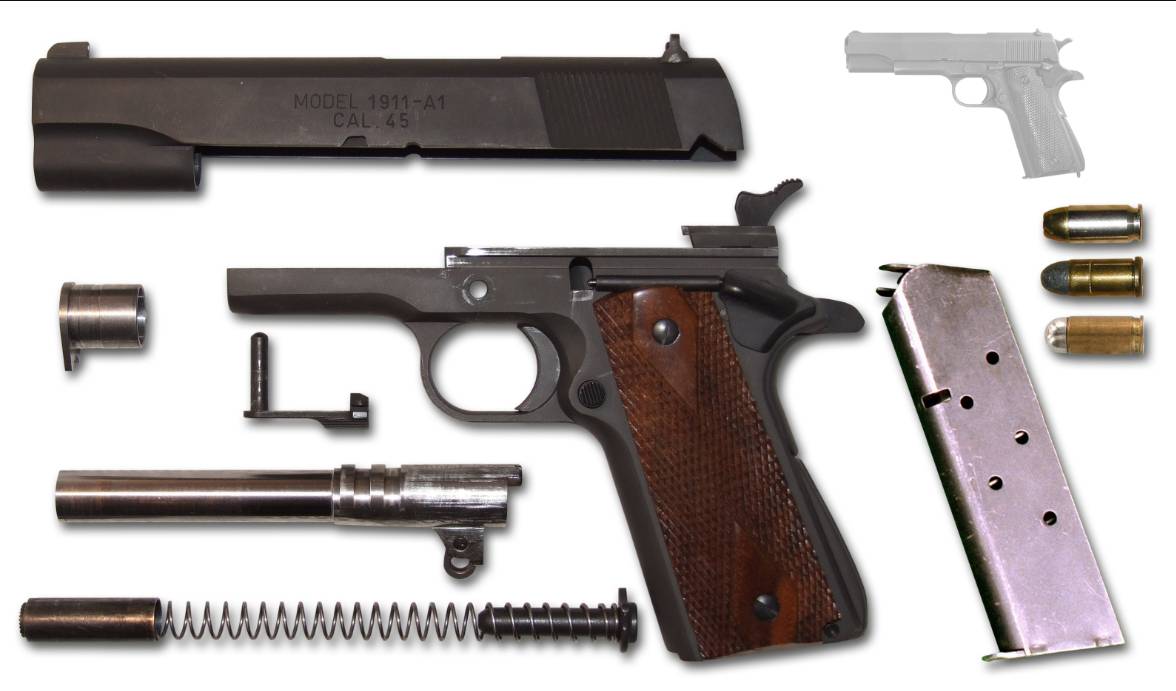
The M1911 is one of those rare weapons that escaped the museum and stayed relevant in the hands of soldiers, police, competitors, and armed professionals for well over a century. Adopted by the U.S. military in 1911, it was born from hard lessons learned on horseback, in jungle heat, and in close-range fighting where a sidearm had to work every time the trigger was pressed. That original requirement still explains why the pistol remains respected today: it is powerful, mechanically straightforward, and proven under pressure.
I have seen plenty of modern pistols come and go with lighter frames, more capacity, and easier maintenance. Many are excellent. But the M1911 keeps a place on the belt and in the safe because it does a few things exceptionally well. It points naturally, delivers a heavy .45 ACP cartridge, and offers a trigger that, when properly fitted, is among the best in service handguns. The design is old, but old does not mean obsolete. In the field, what matters is whether the weapon can be carried, controlled, and trusted when conditions are not ideal. The M1911 answers that test in a way few handguns can match.
Why the Army Chose It
The M1911 came out of a period when the U.S. military was looking hard at stopping power. Experience in the Philippine-American War convinced many officers that the earlier .38-caliber revolvers were not always enough. John Browning’s design chambered in .45 ACP gave the Army a semi-automatic sidearm with more authority and better practical handling than the service revolvers of the day. After trials and refinements, the pistol was formally adopted in 1911.
What made it stand out was not just caliber. Browning built a pistol that locked up solidly, fed from a reliable magazine, and ran with a simple recoil-operated system. The manual of arms was clean and practical: load the magazine, rack the slide, engage or disengage the thumb safety as needed, and press the trigger. For soldiers of the era, that was a major step forward from slower revolvers and more complicated early autos.
The original military gun was not a polished commercial pistol. It was a duty weapon built for hard use, mud, and rough handling. That heritage still shapes every serious M1911 pattern pistol today.
Design That Still Makes Sense
The M1911 remains one of the best examples of a fighting pistol designed by a man who understood mechanical realities. The grip angle is natural for many shooters, and the single-action trigger allows precise, repeatable shots. The slide rides on long rails, the feed geometry is robust, and the barrel locks up consistently when the gun is in battery. These are not glamorous details, but they matter when the weapon must work under stress.
Another reason the M1911 endured is the way it handles recoil. Yes, .45 ACP has more push than 9mm, but the pistol’s weight and bore axis help tame it. A full-size steel M1911 tends to shoot flatter and more comfortably than many expect. For experienced users, that translates into good control in rapid fire and an ability to place follow-up shots where they belong.
There is also the matter of the trigger. The single-action trigger on a well-built M1911 is short, crisp, and predictable. In practical terms, that means less disturbance of the sights during the shot. In competition and in defensive shooting, that matters. It is one of the main reasons shooters still choose the platform even when they have access to newer designs with higher capacity.
Field Performance and Real-World Use
Any honest discussion of the M1911 has to include its reputation for reliability. The truth is simple: a properly built and properly maintained M1911 runs very well. A poorly built or neglected one can be finicky. That has always been part of the platform’s story. The design has tight tolerances, and quality control matters more here than on some newer polymer pistols that will tolerate more abuse before complaining.
In military service, especially during the world wars, the M1911 proved itself in brutal conditions. Soldiers carried it in mud, rain, heat, and dust. It saw use in trenches, on amphibious landings, in tanks, and in close combat where a sidearm was sometimes the last tool left. During that era, the pistol earned a reputation for reliability when fed the right ammunition and kept reasonably clean. That reputation was not created by marketing; it was built in the field.
Modern users still encounter the same pattern. A quality M1911 with good magazines and decent ammunition can be extremely dependable. Problems usually trace back to one of three things: poor magazines, bargain-basement manufacturing, or a gun that has not been tuned correctly. When those issues are addressed, the pistol often performs better than critics expect.
Specifications at a Glance
| Specification | Typical M1911 Service Configuration |
|---|---|
| Caliber | .45 ACP |
| Action | Single-action, semi-automatic |
| Barrel length | 5 in (full-size Government model) |
| Overall length | About 8.5 in |
| Weight | About 39-41 oz unloaded, depending on model |
| Magazine capacity | 7-8 rounds standard, higher with extended magazines |
| Effective role | Sidearm, defensive pistol, competition, precision handgun use |
| Primary features | Grip safety, thumb safety, single-action trigger, tilting barrel lockup |
Those numbers tell part of the story, but not all of it. The M1911 is a full-size pistol by modern standards, and that weight is part of why it shoots so well. The tradeoff is clear: you carry more steel and fewer rounds than you would with many contemporary service pistols. For some users, that is a worthwhile exchange. For others, it is not.
Strengths That Keep It Relevant
The biggest advantage of the M1911 is still the trigger. There is a reason so many precision shooters, from law enforcement marksmen to competitive bullseye and action pistol shooters, gravitate toward it. The trigger helps the shooter. It does not fight the shooter. That advantage becomes obvious when accuracy under pressure matters.
Another strength is ergonomics. The pistol’s slim grip frame fits a wide range of hands. Compared with many double-stack service pistols, the M1911 often feels more manageable, especially for shooters with smaller hands. The controls are also intuitive once learned. The thumb safety, slide stop, and magazine release are all accessible without awkward stretching or shifting.
Then there is the aftermarket. Few pistols have been supported as heavily as the M1911. Sights, grips, safeties, triggers, barrels, recoil systems, and magazines are available in countless variations. That means a user can tailor the pistol for concealed carry, duty use, competition, or range work. The platform’s longevity is partly due to this ecosystem. If something wears out, it can often be replaced. If a shooter wants a custom setup, the M1911 is one of the easiest pistols to build into a personal tool.
Finally, the .45 ACP cartridge still has loyal supporters for practical reasons. It is a large, heavy bullet moving at moderate velocity. While modern terminal performance debates continue, many experienced shooters trust the cartridge because it has a long and well-documented service history. In a pistol that handles it well, the round offers confidence.
Limitations You Have to Accept
No serious article about the M1911 should ignore its drawbacks. The first and most obvious is capacity. Seven or eight rounds in the magazine is not much by modern standards. Even with extended magazines, the gun does not approach the count of contemporary double-stack pistols. That can matter in a real fight, and any user who chooses the platform needs to understand that limitation.
Maintenance is another factor. The M1911 is not difficult to strip and clean once learned, but it is less forgiving of poor parts and bad assembly than many newer pistols. Feed ramp geometry, extractor tension, magazine quality, spring condition, and slide-to-frame fit all play a role in reliability. A shooter who buys a cheap example and expects duty-grade performance may be disappointed.
There is also the manual safety. For some users, the need to train a proper draw stroke and safety manipulation is a feature, not a flaw. For others, it is one more step under stress. That is a training issue, but it is still a real consideration. The platform rewards discipline and practice. It is not the pistol for someone who wants to load it once and forget the manual of arms.
Weight can be both a strength and a weakness. The steel-frame M1911 carries well for some people and feels heavy for others, especially compared to polymer-framed alternatives. The pistol is also wider in some configurations than compact modern options. Concealed carry is certainly possible, but it is not always the easiest solution.
From War to Competition to Carry
One of the reasons the M1911 remains culturally important is that it crosses categories. It is not only a relic of American military history. It is also a competition gun, a concealed carry option, a duty pistol in some circles, and a favorite of collectors. That flexibility is rare.
In competition, the M1911 has long been dominant in disciplines where accuracy and trigger control matter. In defensive carry, many users still trust a well-built 1911 because they know exactly how it shoots and how it handles under stress. In military and law enforcement circles, it has largely been replaced by higher-capacity pistols, but specialized units and individual professionals have continued to use customized versions when the mission calls for it.
The pistol’s long service life also helped shape handgun development more broadly. Modern pistols borrowed and refined ideas the M1911 made mainstream: manual safety placement, ergonomic grip design, and the importance of consistent trigger feel. Even shooters who never carry a 1911 are using design concepts that Browning helped define.
What a Good M1911 Looks Like Today
Modern M1911s vary widely in quality. A good one has tight but not binding slide movement, reliable feeding with several ammunition types, a crisp trigger without excessive creep, and magazines that actually work. The sights should be usable, and the grip safety and thumb safety should function cleanly without requiring the shooter to fight the gun.
Some of the best current examples come from makers who understand that the platform does not need to be reinvented; it needs to be built correctly. Reliability improvements, better materials, improved sights, and enhanced extractors can make a big difference. At the same time, unnecessary changes can spoil what makes the pistol effective in the first place. The best M1911s feel like a refined fighting tool, not a gimmick.
For practical use, a shooter should pay attention to magazines above almost everything else. Many 1911 reliability complaints start there. Good springs, good followers, and proper feed lip design matter. In the field, magazines are consumables. That is true for every pistol, but it is especially true for the M1911.
Why It Still Matters
The M1911 matters because it represents a mature solution to a hard problem. It is a handgun built for combat, refined by experience, and validated across generations. It does not win every modern comparison on paper. It does not offer the highest capacity or the lightest weight. But when a shooter values trigger quality, shootability, and a century of proven service, it remains one of the most credible handguns ever made.
In the field, weapons earn trust one round at a time. The M1911 earned that trust long ago and never fully lost it. That is why it persists in armories, holsters, and collections around the world. A well-made 1911 is not a nostalgia piece. It is a tool with a long track record, and in the right hands, it still does exactly what it was designed to do.