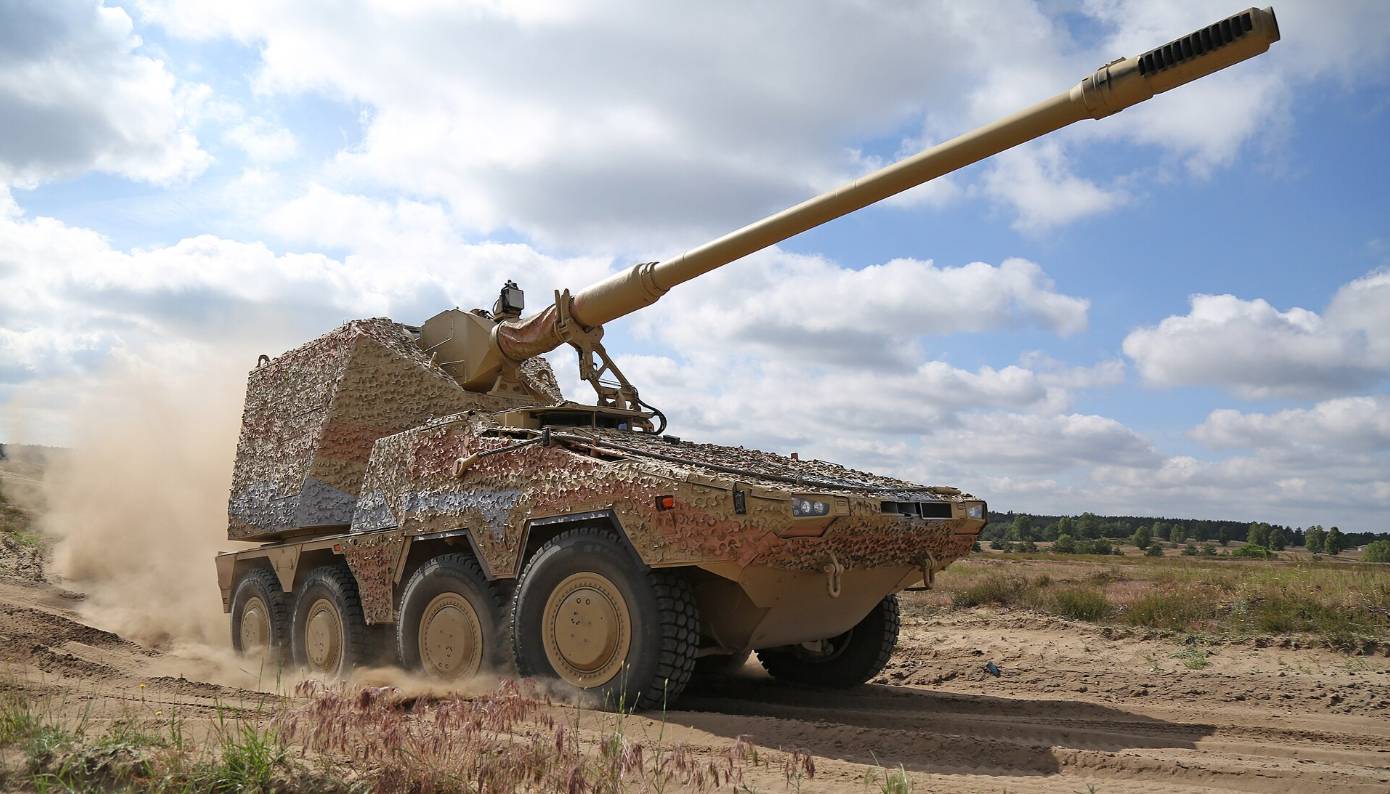
Artillery that can fire and relocate without ever really stopping to breathe? That is the core promise of the RCH 155, one of the most intriguing modern self-propelled howitzer concepts in service-oriented development today. Built around the marriage of a proven artillery piece and a highly mobile wheeled platform, the RCH 155 is all about shoot-and-scoot speed, reduced crew burden, and a digital fire-control architecture that feels far more like a precision weapon system than a traditional gun truck.

A howitzer built for the age of drones and counter-battery fire
The battlefield has changed dramatically. Once upon a time, artillery could linger after firing because detection and counter-fire took longer. Not anymore. Modern sensors, loitering munitions, counter-battery radars, and ubiquitous drones have made stationary guns vulnerable almost immediately. That is where the RCH 155 comes in with a brutally modern answer: hit fast, move fast, survive.
RCH stands for Remote Controlled Howitzer, and that name is not just marketing flair. The system is designed to keep the crew protected inside the armored vehicle hull while the gun itself is operated remotely. In practical terms, that means the crew is shielded from the worst of the blast, fragmentation, and battlefield exposure, while the vehicle can execute firing missions with impressive speed.
The engineering trick: a 155 mm gun on a Boxer chassis
At the heart of the RCH 155 is the 155 mm/L52 artillery system, mounted on the widely respected Boxer 8×8 armored vehicle. That combination is a big deal. The Boxer gives the gun a highly mobile, well-protected wheeled foundation with excellent road speed, strategic deployability, and strong survivability for a wheeled platform. The 155 mm/L52 barrel provides the kind of reach and ballistic performance modern armies demand.
The Boxer’s modular architecture also matters. It allows the artillery module to be integrated onto a platform already known for protection, mobility, and flexible mission use. In other words, the RCH 155 is not just a gun bolted to a truck bed. It is a carefully engineered artillery system built to exploit the strengths of a mature armored chassis.
Key specifications at a glance
| Specification | RCH 155 |
|---|---|
| Caliber | 155 mm |
| Gun length | L52 |
| Platform | Boxer 8×8 armored vehicle |
| Crew | 2 |
| Operation | Remote-controlled, automated firing system |
| Maximum range | Up to about 54 km with extended-range ammunition |
| Rate of fire | Up to 9 rounds per minute |
| Mobility | Road-mobile, highly deployable wheeled system |
| Primary role | Self-propelled artillery, rapid shoot-and-scoot fire missions |
Note: some values can vary by ammunition type, configuration, and program baseline.
Only two crew members? Yes, and that is a major flex
One of the RCH 155’s most attention-grabbing features is its two-person crew. That is remarkably lean for a 155 mm artillery system. Traditional artillery units often rely on larger crews for loading, laying, driving, communications, and fire direction tasks. The RCH 155 leans heavily into automation to reduce manpower requirements while increasing tempo.
This is not automation for the sake of looking futuristic. It is about practical battlefield advantages:
- Reduced crew exposure to incoming fire and harsh environmental conditions
- Lower personnel demand for a system that can still deliver serious artillery punch
- Faster mission cycles through automated loading and remote operation
- Improved consistency in aiming and firing procedures
In an era where trained personnel are a strategic resource, cutting crew size without sacrificing effectiveness is a major operational win.
Firepower that punches well above its weight
A 155 mm/L52 gun is already a serious beast, and the RCH 155 uses that caliber to full effect. Depending on the ammunition, the system can strike targets at impressive distances, including beyond 50 km with advanced extended-range rounds. That kind of reach gives commanders the ability to engage deep targets, support maneuver units from safer standoff distances, and complicate enemy counter-battery calculations.
Just as important as raw range is the system’s ability to get rounds downrange quickly. With a reported rate of fire of up to 9 rounds per minute, the RCH 155 can deliver a concentrated burst of fire and then reposition before enemy sensors can localize the muzzle flash, sound signature, and ballistic origin.
This is the essence of modern artillery tactics. The RCH 155 is not designed to sit and duel like a bunker. It is built to appear, fire, and disappear with minimal delay. That rhythm is exactly what keeps artillery alive on a contested battlefield.
Automation changes the artillery game
The remote-operated turret and automated loading system are not just convenience features. They are the technological heart of the platform. Automation enables rapid target engagement, reduces physical strain on the crew, and helps maintain performance in high-tempo operations. For artillery, where seconds matter and fatigue can degrade precision, automation is a force multiplier.
The digital fire-control architecture also helps the system integrate into modern networked warfare. That means compatibility with sensor feeds, command-and-control systems, and digital fire missions that can be assigned and executed quickly. In a battlefield shaped by real-time data, the ability to receive, process, and act on target information rapidly is just as valuable as raw muzzle energy.
Wheeled mobility versus tracked tradition
Artillery has long been associated with tracked vehicles, and for good reason: tracked platforms offer excellent off-road performance and stability. But the RCH 155 makes a compelling case for wheels. The Boxer chassis provides strong road mobility, lower logistical burden, and easier strategic transport compared with heavier tracked alternatives.
That makes the system especially attractive for forces that need to move artillery quickly between sectors, deploy over long distances, and reduce maintenance complexity. Wheeled artillery also tends to benefit from lower operating costs and easier integration into forces that already field wheeled armored vehicles.
Of course, the tradeoff is that tracked systems may still hold advantages in very rough terrain. But for many modern operational environments, especially where road networks and rapid redeployment matter, the RCH 155’s wheeled layout is a very smart choice.
Why the RCH 155 matters strategically
The RCH 155 represents more than a single vehicle. It reflects the direction of next-generation artillery: automated, networked, protected, and highly mobile. It is a response to a battlefield where artillery must survive under constant surveillance and threat from above.
Its strengths line up neatly with current defense priorities:
- Survivability through remote operation and fast displacement
- Operational efficiency through a tiny crew and automated systems
- Long-range precision fire through a 155 mm/L52 gun
- Strategic mobility through the Boxer 8×8 chassis
That combination makes the RCH 155 especially interesting for armies looking to modernize artillery without accepting the burden of very large, heavy tracked vehicles. It is also a system that fits neatly into the logic of distributed, sensor-rich combat where artillery must be both lethal and elusive.
The bottom line for military tech enthusiasts
If you love the intersection of firepower and engineering, the RCH 155 is a seriously exciting machine. It takes the old-school thunder of 155 mm artillery and wraps it in a thoroughly modern package of automation, protection, and mobility. The result is a platform that feels built for the realities of 21st-century combat: fast detection cycles, constant counter-battery threats, and the need to strike hard without staying in one place too long.
In short: the RCH 155 is not just artillery on wheels. It is artillery that understands the battlefield has become a hunt, and it was designed to be the hunter rather than the target.