

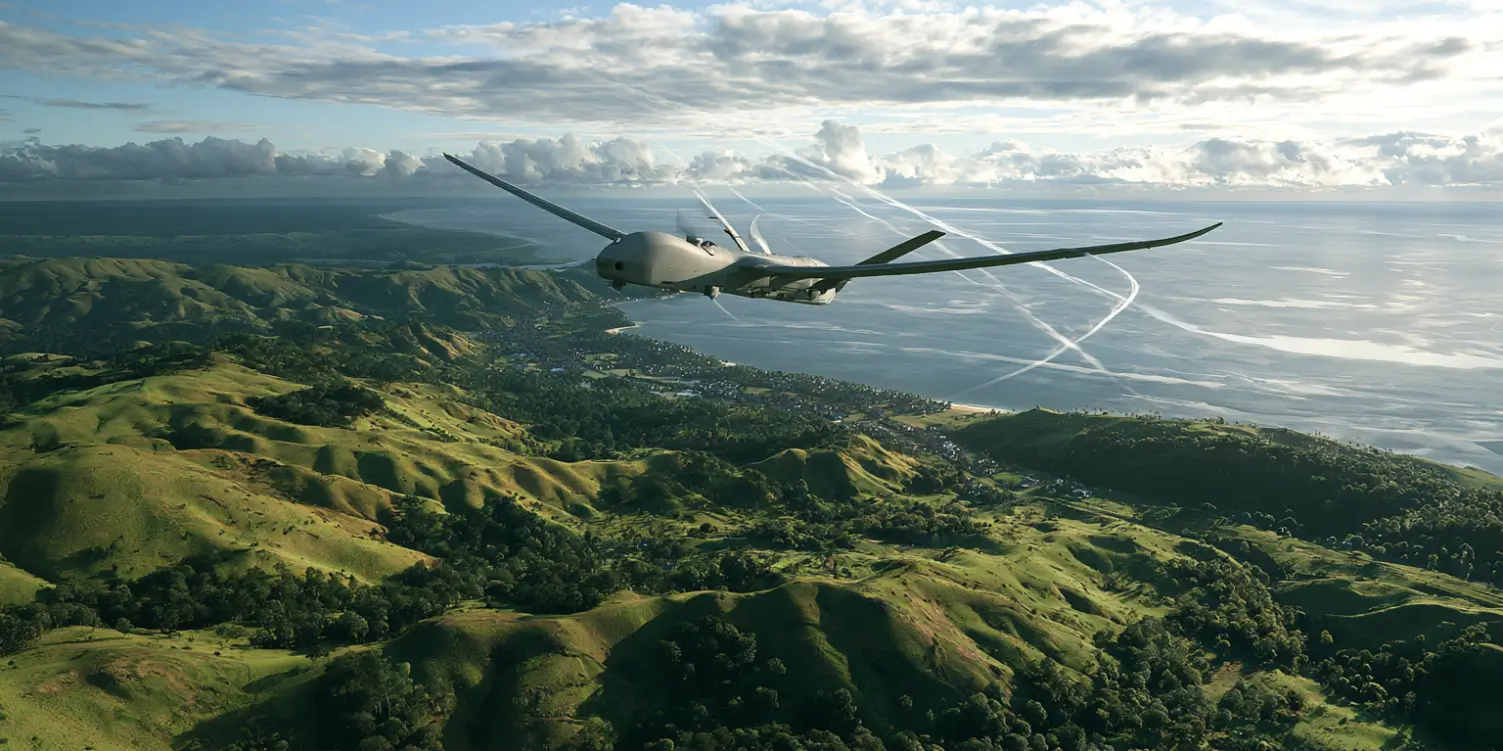
An autonomous unmanned aerial vehicle demonstrating advanced reconnaissance capabilities represents more than a technical milestone; it signals a shift in how modern militaries may acquire, process, and act on battlefield intelligence. As air defense systems become denser, electronic warfare grows more sophisticated, and contested environments become increasingly lethal for crewed aircraft, autonomy is moving from a niche feature to a central operational requirement. The strategic value of such a platform lies not only in its ability to fly without a pilot, but in its capacity to sense, classify, and transmit actionable information with minimal human intervention.
For defense planners, the significance is clear. A reconnaissance UAV that can operate with a reduced communications footprint, navigate complex terrain, and adapt to changing mission conditions can extend sensor reach while lowering risk to personnel. In high-threat environments, where exposing a manned platform may invite immediate interception, an autonomous aircraft can provide the persistence and discretion needed to support targeting, battle damage assessment, route reconnaissance, and maritime surveillance.
What Advanced Autonomy Changes Operationally
Traditional unmanned systems have often depended on continuous links to ground control stations, limiting their resilience against jamming, spoofing, and data-link disruption. Advanced autonomy changes that equation. By fusing onboard processing, machine vision, inertial navigation, satellite cues, and preplanned mission logic, a modern reconnaissance UAV can continue operating even when connectivity is degraded or denied. That capability matters in peer conflict, where electronic attack is not an exception but a baseline assumption.
Autonomy also alters the pace of intelligence collection. A platform that can identify points of interest onboard and prioritize sensor tasking in flight reduces the time between detection and reporting. In practical terms, this shortens the sensor-to-shooter cycle. A UAV that can recognize an air defense radar emitter, a vehicle convoy, or a temporary field position and immediately relay a geolocated track can support long-range fires, special operations forces, or joint strike assets with far greater efficiency than a purely remote-operated aircraft.
Equally important is survivability. Small and medium UAVs are often most vulnerable when they behave predictably. Autonomous route adjustment, terrain masking, and adaptive loiter patterns can complicate enemy interception efforts. If paired with low-observable design features, reduced emissions control, and modular payloads, the result is a reconnaissance asset suited for operations in denied airspace rather than only permissive rear areas.
Doctrine, Not Just Technology
The emergence of autonomous reconnaissance UAVs should be understood through the lens of doctrine. Militaries do not field such systems merely to replace a pilot; they field them to reshape how reconnaissance is conducted across echelons. A brigade commander may use one for immediate tactical overwatch, while theater-level commanders may exploit the same class of aircraft for persistent border monitoring, maritime domain awareness, or campaign-level target development.
This layered utility is especially valuable in distributed operations. As forces disperse to reduce vulnerability, commanders need a surveillance architecture that can match that dispersion. Autonomous UAVs can serve as mobile sensors in a larger networked kill web, feeding data to artillery units, air defense nodes, naval task groups, and command centers. In this role, the platform becomes less a standalone aircraft and more a node in a wider combat system.
There is also a human factors dimension. By automating routine navigational and sensor-management tasks, autonomy reduces operator workload and allows analysts to focus on decision-making rather than manual flight control. That does not eliminate the need for trained personnel; rather, it shifts the human role toward supervising exceptions, validating machine-generated cues, and integrating UAV outputs with other intelligence sources. The military value of the system therefore depends not only on the air vehicle itself, but on the training pipeline, software architecture, and command relationships surrounding it.
Likely Mission Sets
An autonomous reconnaissance UAV with advanced capabilities is likely to be optimized for several mission profiles:
- Route reconnaissance ahead of ground maneuver elements to identify ambush sites, obstacles, and enemy movement.
- Persistent ISR over border regions, maritime approaches, or critical infrastructure.
- Target acquisition in support of artillery, missiles, or loitering munitions.
- Electronic order of battle mapping through passive detection of emitters and communications activity.
- Battle damage assessment following strikes, enabling rapid re-attack decisions.
- Contested resupply and support missions where navigation and observation are required without direct pilot exposure.
In each case, the defining advantage is persistence under uncertainty. The aircraft does not need to make every decision autonomously to be strategically useful; it needs only enough onboard intelligence to preserve mission continuity when human control is degraded. That distinction is crucial, particularly in an era where adversaries increasingly seek to disrupt links rather than destroy platforms outright.
Strategic Implications for Force Posture
The wider strategic implication is that autonomous reconnaissance compresses the geography of war. If an air force can observe deeper into contested territory with less risk, the defender must allocate more resources to air defense, deception, camouflage, and electronic warfare. This creates a direct cost-imposition effect. Even if the UAV itself is relatively inexpensive, the adversary may have to spend disproportionately on counter-UAS radars, missiles, jammers, and integrated air defense assets to blunt its effectiveness.
For expeditionary forces, autonomous reconnaissance also improves force projection. A small contingent operating far from established infrastructure may lack manned airborne ISR support, but a compact autonomous UAV package can provide an organic intelligence layer. That can be decisive in remote theaters, archipelagic environments, or crisis-response missions where rapid situational awareness is essential.
At the same time, the proliferation of such systems will intensify countermeasures. Expect greater emphasis on camouflage, emission control, decoys, deceptive signatures, and cyber-electromagnetic defense. The reconnaissance fight will become increasingly interactive, with autonomy on one side met by spoofing, directed energy, and layered air defense on the other. In that sense, an autonomous UAV is not merely a platform; it is part of a continuing adaptation cycle between detection and concealment.
Industrial and Geopolitical Context
The development of autonomous reconnaissance UAVs also reflects broader industrial trends. Defense companies are integrating commercial AI, miniature sensors, and advanced edge-computing hardware into military airframes at a pace that would have been difficult a decade ago. This convergence lowers barriers to entry, enabling both established primes and smaller firms to compete in a rapidly evolving market. As a result, procurement decisions increasingly hinge on software maturity, data security, and interoperability rather than airframe size alone.
Geopolitically, these systems are attractive because they are scalable and politically flexible. They can support border security, maritime patrol, counterinsurgency, and high-end wartime ISR without the political sensitivity of deploying crewed aircraft. Nations seeking to strengthen deterrence without dramatically expanding manned aviation fleets are likely to see autonomous reconnaissance UAVs as a force multiplier. For allies and partners, they can also improve interoperability through shared data standards and common mission architectures.
Yet the same accessibility that makes these systems attractive also increases proliferation risk. As more states acquire autonomous reconnaissance platforms, regional balances may shift. Persistent surveillance can embolden one side by improving confidence in targeting and maneuver, but it can also destabilize crisis behavior if decision-makers believe they have near-constant visibility of adversary movements. The danger is not simply that wars become more transparent; it is that they may become more compressible, with less warning time and greater pressure for preemption.
What to Watch Next
The most important indicators to monitor are not just flight demonstrations, but software updates, mission autonomy thresholds, and integration with broader command-and-control networks. A UAV that can only follow a route autonomously is useful; one that can dynamically retask sensors, avoid threats, and collaborate with other unmanned systems is far more consequential. The next stage of development will likely involve swarm-enabled reconnaissance, collaborative sensing, and tighter links between autonomous air vehicles and long-range precision fires.
As military requirements evolve, the benchmark will no longer be whether a UAV can fly without a pilot. The real measure will be whether it can provide trustworthy intelligence in environments where connectivity is limited, deception is constant, and the cost of exposure is high. In that contest, autonomy is becoming less of an experiment and more of an operational necessity.