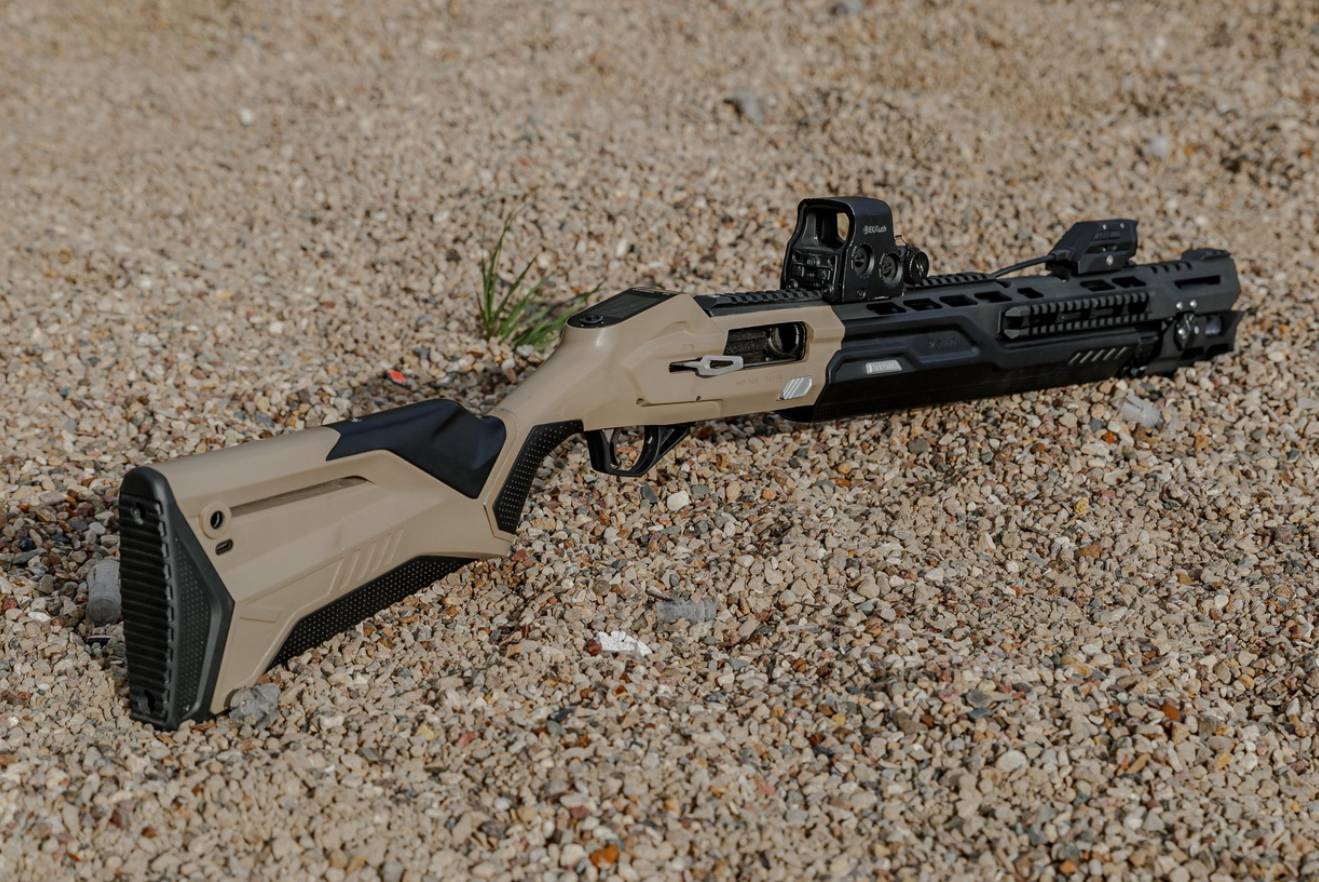
The MP-155 Ultima marks an unusual but telling step in Russia’s small-arms modernization effort: a semi-automatic shotgun fitted with an integrated digital display, onboard computing functions, and a modular architecture intended to push a traditionally low-tech weapon category into the era of networked infantry systems. In practical terms, the weapon is less about replacing combat-proven shotguns than about testing how far digitalization can be pushed into a firearm platform that has historically been valued for simplicity, durability, and immediate lethality at short range.
Built around the well-known MP-155 shotgun family, the Ultima variant is best understood as a technology demonstrator with operational ambitions. Russia has used the platform to showcase domestic competence in electronic integration, optics, accessory management, and human-machine interface design. The broader significance lies not only in the shotgun itself, but in what it says about Russian defense industry priorities: the attempt to field infantry weapons that are more connected, more configurable, and potentially more informative to the shooter than conventional systems.
From conventional smoothbore to digital platform
The baseline MP-155 is a gas-operated semi-automatic shotgun designed for sporting, hunting, and law-enforcement use. The Ultima concept layers on a set of features more commonly associated with smart optics or wearable battlefield electronics. These include a built-in display, a digital control system, accessory rails, and a housing intended to support modern attachments. The result is a smoothbore weapon that is not merely a firing mechanism, but a compact firing system with embedded electronics.
That distinction matters because Russia’s infantry modernization program has increasingly emphasized the integration of individual weapons into a broader digital battlefield ecosystem. The smart shotgun concept is a niche example, but it reflects the same logic driving more serious programs: better situational awareness, faster adaptation to mission profiles, and a greater ability to manage accessories and information at the point of use.
For a shotgun, these priorities may seem excessive. Yet in urban operations, internal security missions, breaching tasks, and specialized close-quarters roles, the value of rapid configuration and status feedback can be more relevant than long-range ballistic optimization. The MP-155 Ultima suggests an effort to explore whether even a close-range weapon can be turned into a data-rich, mission-adaptive tool.
Notable technical features
Publicly available material indicates that the MP-155 Ultima incorporates a number of features that distinguish it from a standard semi-automatic shotgun. While not all parameters have been fully published, the platform is notable for the following:
- Integrated onboard computer for weapon management and user interface functions
- Digital display embedded into the stock or receiver area
- Accessory rail system for optics, lights, and ancillary equipment
- Modernized stock and furniture designed for modular use
- Semi-automatic gas operation inherited from the MP-155 family
- Intended compatibility with multiple mission profiles, including sporting, training, and tactical roles
The embedded computer appears to serve as the centerpiece of the design, enabling the user to access weapon-related functions through a screen rather than relying purely on external accessories. In concept, this could support mode selection, ammunition-related information, diagnostics, or other digitally mediated features. Whether all of these functions are fully mature in field conditions is another question; as with many concept platforms, the gap between demonstration and operational reliability is often the decisive issue.
Specifications table
| Specification | Details |
|---|---|
| Platform | MP-155 Ultima |
| Type | Semi-automatic shotgun |
| Operating system | Gas-operated |
| Caliber | 12 gauge |
| Magazine | Detachable box magazine or tubular-fed configuration, depending on variant |
| Electronics | Integrated onboard computer and digital display |
| Purpose | Concept / demonstrator / tactical-adjacent platform |
| Origin | Russia |
Some publicly discussed details of the Ultima have varied across presentations, prototypes, and promotional material. As with many advanced small-arms concepts, the exact configuration can shift depending on the version shown. That uncertainty itself is significant: the program appears to be as much about signaling industrial capability as it is about delivering a finalized service weapon.
Why smart features matter on a shotgun
At first glance, adding a computer to a shotgun may appear like a solution in search of a problem. The shotgun is already one of the simplest and most immediate weapons on the battlefield or in law-enforcement service. Its close-range effectiveness comes from patterning, payload diversity, and ease of employment in confined spaces. However, a digital layer can offer practical advantages in specialized contexts.
For example, a smart interface could support faster configuration between mission sets, particularly if the weapon is expected to be used with different ammunition types or accessory packages. A digital display might provide status information for a user operating in low-visibility or high-stress environments. Diagnostic data could help armorers or operators assess function, battery state, or accessory readiness before deployment.
The strategic logic is similar to what has driven the adoption of helmet-mounted displays, networked sights, and smart fire-control systems elsewhere: reduce cognitive burden, improve reaction speed, and increase the amount of actionable information available to the operator. Even if the Ultima’s actual field utility remains limited, it represents an attempt to extend that logic to the most basic level of infantry firepower.
Tactical niche and likely employment
The most credible use cases for the MP-155 Ultima are likely to be urban security operations, training and demonstration roles, and specialized close-quarters missions rather than conventional frontline combat. Shotguns remain useful in door breaching, short-range room clearing, riot-control-adjacent tasks, and situations where spread pattern and payload variety are tactically useful.
In such roles, a smart shotgun could serve several purposes:
- Faster mission setup through configurable digital menus
- Accessory management for lights, optics, or aiming aids
- Operator feedback on system status
- Training value as a platform for familiarizing users with digitized weapons
- Publicity and signaling for domestic arms innovation
It is less likely that the Ultima would be issued in large numbers to regular motor-rifle formations. Modern infantry combat tends to privilege rifles, carbines, precision weapons, drones, and electronic warfare support. A digitally enhanced shotgun is therefore better understood as a specialist tool and a technology showcase than as a mass infantry replacement.
Industrial and geopolitical signaling
Russia’s decision to present the MP-155 Ultima has broader industrial implications. In a defense sector under sanctions pressure and constrained by access to certain imported components, the ability to integrate consumer-style electronics into weapons systems has symbolic value. It suggests an effort to demonstrate that domestic industry can still innovate at the intersection of arms manufacturing, software, and human-machine interaction.
This kind of signaling matters in both domestic and international contexts. Domestically, it helps project an image of resilience and technological sophistication. Internationally, it supports the narrative that Russia remains capable of generating exportable, attention-grabbing defense products despite economic headwinds. Even if the Ultima never becomes a major military program, it serves as a proof-of-concept for a wider ecosystem of smart small arms, training systems, and connected accessories.
There is also a doctrinal dimension. Russian military thought has increasingly acknowledged the importance of information dominance, sensor fusion, and small-unit adaptability. While much of the attention goes to drones, counter-UAS tools, artillery networking, and encrypted communications, small arms modernization remains part of the same trend. A smart shotgun may be a modest platform, but it fits the narrative of a force that wants every echelon to be digitally aware.
Limitations and questions of field reliability
Any weapon that integrates electronics into a harsh operating environment must answer difficult questions about durability, battery life, weather resistance, electromagnetic compatibility, and maintainability. A shotgun used in tactical conditions may be exposed to shock, moisture, dust, temperature extremes, and rough handling. Each added electronic feature increases the number of failure points.
That creates a classic trade-off: more capability versus more complexity. A conventional shotgun is valued precisely because it is simple, rugged, and easy to keep running. An onboard computer can enhance the user interface, but it also introduces power dependency and potential software or hardware failure modes. If the display goes dark or the electronics malfunction, the weapon must still function as a basic firearm without becoming awkward or compromised.
There is also the issue of doctrinal necessity. Not every improvement that looks impressive in a showcase translates into meaningful combat advantage. For a smart shotgun to justify itself, it must offer tangible benefits over a conventional platform with a good optic, a weapon light, and disciplined training. If it cannot outperform that simpler baseline in reliability or mission speed, its utility remains mostly experimental.
How the Ultima fits into the future of infantry weapons
Despite its niche status, the MP-155 Ultima is part of a larger global trend: the digitization of individual weapons. Armies and police forces alike are exploring systems that connect firearms to data, sensors, and user interfaces. The logic is the same whether the platform is a rifle, a machine gun, or a shotgun: better information and better ergonomics can improve lethality, safety, and responsiveness.
Russia’s contribution to this trend is distinctive because it comes from a defense ecosystem that has often emphasized ruggedness and mass over refinement. The Ultima therefore carries a certain strategic irony. It takes one of the simplest weapons categories and turns it into a showcase for digital modernity. That may not revolutionize combat, but it does reveal where industrial imagination is moving.
If future versions mature, one could imagine smart shotguns being used as experimental nodes in law enforcement, special operations, or training environments, with features such as programmable interfaces, ammunition tracking, and integrated diagnostics. The real question is not whether the idea is novel; it is whether the defense industry can make it robust, affordable, and useful enough to survive beyond the prototype stage.
For now, the MP-155 Ultima stands as a symbol of a defense sector trying to reconcile tradition with digital transformation. It is a shotgun, but it is also a statement: that even the most basic battlefield tools can be recast as data-enabled systems in an era where military advantage increasingly depends on information as much as on firepower.