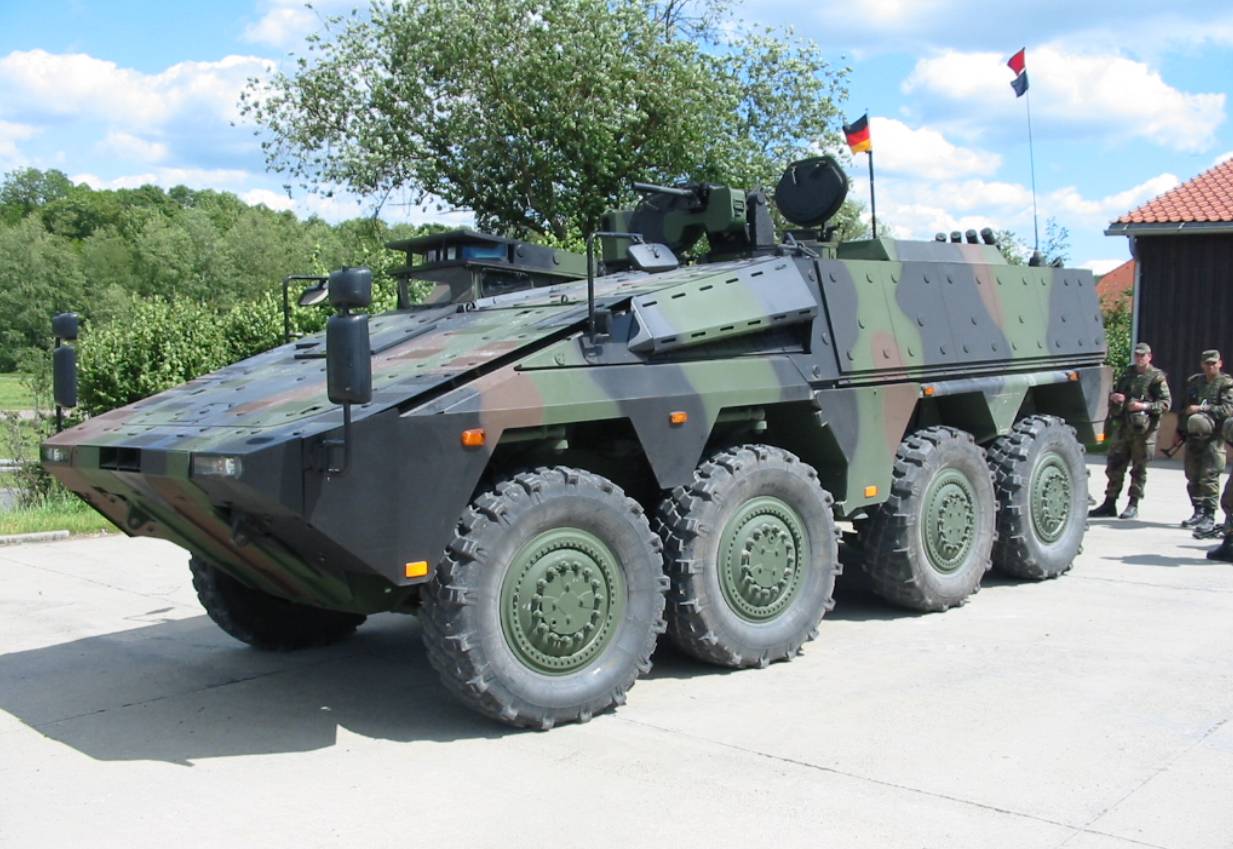
The GTK Boxer has earned a distinct place in modern mechanized warfare as one of the most heavily protected and physically imposing wheeled armored personnel carriers in service. Developed through a multinational European program, the Boxer reflects a design philosophy that prioritizes survivability, modularity, and battlefield adaptability over sheer compactness. In an era where light wheeled vehicles often trade protection for mobility, the Boxer sits at the opposite end of the spectrum: a large, highly survivable platform built to move infantry, command teams, medical personnel, engineers, and specialized mission modules across contested terrain with a level of protection previously associated more closely with tracked armored vehicles.
Design philosophy and strategic purpose
The Boxer was conceived at a time when European militaries were reevaluating expeditionary doctrine, urban combat requirements, and the need to sustain armored units in high-threat environments. Rather than building a single-purpose APC, the program adopted a modular approach centered on a common drive module and interchangeable mission module. This architecture allows a single vehicle family to perform multiple roles, reducing logistical burden while preserving tactical flexibility.
From a strategic standpoint, the Boxer answers a specific operational problem: how to move troops rapidly while surviving modern anti-armor threats, improvised explosive devices, and artillery fragmentation. Its size and mass are not accidental byproducts; they are direct consequences of a protection standard that emphasizes mine resistance, ballistic protection, and crew survivability. The vehicle is therefore best understood not as a traditional wheeled APC in the light mechanized sense, but as a heavy combat mobility platform designed for high-risk theaters.
Why it is considered the heaviest wheeled APC
Among contemporary wheeled APCs and infantry carriers, the Boxer is frequently cited as one of the heaviest. Depending on configuration, armor package, and mission module, combat weight can exceed 40 tonnes. That places it well above many 8×8 peers and closer to the mass range of some tracked infantry fighting vehicles. The consequence of this weight is a vehicle that is visually and tactically imposing, but also one that demands robust transport planning, bridge classification awareness, and careful route selection.
This mass is not merely an engineering curiosity. It is a doctrinal statement. The Boxer’s designers accepted lower strategic simplicity in exchange for significantly improved battlefield resilience. In modern conflicts, where first-contact survivability can determine whether a formation retains momentum, that tradeoff can be decisive.
Protection levels and survivability
The Boxer is engineered for a layered protection profile. Its base hull already provides a high level of ballistic and mine protection, and additional applique armor can be fitted to meet mission-specific threat assessments. The modular mission compartment is designed so that damaged modules can be replaced without taking the entire platform out of service for extended periods, an important advantage for sustainment in prolonged operations.
Its high floor profile, robust underbody design, and energy-absorbing seating are intended to mitigate blast effects from mines and improvised explosive devices. In the broader context of expeditionary warfare and counterinsurgency operations, this makes the Boxer particularly valuable for troop movement through ambush-prone corridors, urban choke points, and rear-area security tasks where threats are often asymmetric rather than conventional.
At the same time, the vehicle’s protection comes with doctrinal implications. A heavily armored wheeled carrier can survive more punishment, but it also requires better fuel support, heavier recovery assets, and more careful maneuver planning. In large-scale combat, these support requirements become part of the vehicle’s combat identity.
Mobility and operational reach
Despite its mass, the Boxer retains strong road mobility. Its wheeled layout provides strategic and operational advantages over tracked vehicles in terms of road march efficiency, lower maintenance burden on paved routes, and reduced wear on infrastructure. This makes it suitable for rapid redeployment between sectors, particularly in European theaters where road and bridge networks are extensive but where weight limits can still impose restrictions.
The Boxer’s mobility profile is best described as a balance between tactical protection and strategic movement. It is not a lightweight reconnaissance vehicle, nor is it intended for aggressive off-road maneuver at the same pace as smaller 8×8 designs. Instead, it excels as a protected transport and support platform that can keep pace with mechanized formations while delivering personnel into contested areas with greater confidence.
Its size, however, can be a limiting factor in dense urban environments and narrow rural routes. Commanders must account for turning radius, street width, bridge capacity, and the possibility of bottlenecks during dispersed operations. This means the Boxer rewards deliberate planning and combined-arms integration rather than improvisational use.
Modularity as a force multiplier
One of the most important aspects of the Boxer is its mission-module concept. The same vehicle family can be configured as an APC, command post, ambulance, engineer vehicle, repair platform, or specialized combat support system. This reduces the number of distinct platforms required within a brigade, simplifying training, parts supply, and maintenance pipelines.
For military planners, modularity carries several benefits:
- Commonality: shared drive components reduce the burden on depots and field maintenance units.
- Flexibility: commanders can tailor force packages to mission requirements without introducing entirely new vehicle families.
- Sustainment efficiency: damaged mission modules can be swapped more quickly than rebuilding a vehicle from the chassis up.
- Scalability: the platform can evolve as threat environments change, without a full redesign.
This approach aligns well with European expeditionary doctrine, where modular brigades must be able to deploy rapidly and adapt to missions ranging from high-intensity combat to stabilization operations and disaster response.
Technical characteristics
The following table summarizes commonly cited specifications for the Boxer family; exact figures vary by variant, armor package, and customer configuration.
| Specification | Boxer GTK |
|---|---|
| Type | 8×8 wheeled armored personnel carrier / modular combat vehicle |
| Origin | Germany / Netherlands |
| Crew | Typically 2 |
| Troop capacity | Up to 8 dismounts, depending on mission module |
| Combat weight | Approximately 33 to 40+ tonnes, depending on configuration |
| Length | About 7.9 m |
| Width | About 2.99 m |
| Height | About 2.4 to 3.0 m, depending on module |
| Engine | MTU diesel, approximately 720 hp class |
| Drive | 8×8 |
| Road speed | About 100 km/h |
| Range | Roughly 700 km, depending on load and terrain |
Operational relevance in contemporary conflict
The Boxer’s relevance is especially clear in the current strategic environment, where the battlefield is increasingly shaped by precision fires, drones, loitering munitions, mines, and dispersed anti-armor teams. In such conditions, a vehicle that can preserve crew integrity while delivering infantry to the decisive point has real operational value.
Its heavy protection makes it well suited to:
- protected troop transport in high-threat areas
- mechanized infantry support during urban clearing
- command and control under fire
- medical evacuation in contested zones
- engineer support for breaching and route clearance
For armies transitioning toward distributed operations, the Boxer also offers a useful bridge between traditional armored formations and more modular, mission-tailored force structures. It can serve as both a protected mobility asset and a platform for command, communications, and battlefield sustainment.
Geopolitical and industrial significance
The Boxer is also significant as a product of European defense-industrial cooperation. Its multinational development reflects a broader trend among allied states to pool resources for complex land systems, reduce duplication, and build common platforms that can be fielded across multiple armies. This has implications beyond the vehicle itself. Shared procurement can improve interoperability, simplify coalition logistics, and support a more resilient European armored industrial base.
At the same time, export success has reinforced the Boxer’s reputation as a benchmark in the heavy wheeled APC category. Customers have been drawn to its survivability, upgrade potential, and ability to absorb new mission sets over time. In a defense market increasingly shaped by lessons from Ukraine and other high-intensity environments, platforms with strong protection and adaptable architecture are likely to remain in demand.
Limitations and tradeoffs
Every advantage of the Boxer comes with a corresponding cost. Its weight can constrain transportability and complicate strategic airlift. Its size can make concealment more difficult and increase its visual signature on the battlefield. Fuel consumption and maintenance demands are higher than those of lighter wheeled carriers. In environments where road infrastructure is poor or where weight limits are severe, these factors can reduce operational freedom.
Yet these drawbacks do not negate the vehicle’s relevance. They simply define the tactical niche in which it excels. The Boxer is not intended to be the most agile or the cheapest armored personnel carrier. It is intended to be one of the most survivable and adaptable, and in that role it has few peers.
The Boxer’s design reflects a hard-earned lesson from modern warfare: mobility without protection is fragile, and protection without adaptability is inflexible. By combining both, the GTK Boxer has become one of the most important wheeled armored vehicles of its generation, setting a high bar for future APC development in Europe and beyond.