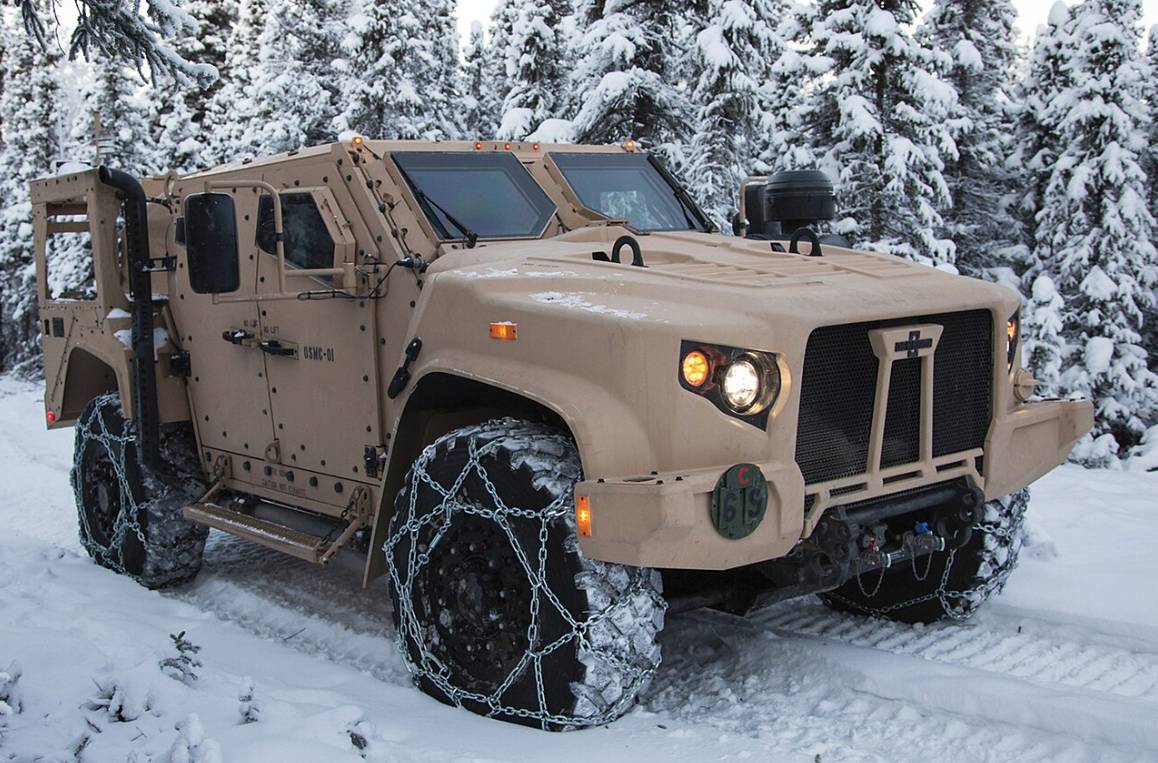
The Oshkosh Joint Light Tactical Vehicle, or JLTV, was built to solve a problem every ground commander knows well: how do you keep a light tactical vehicle mobile, protected, and mechanically reliable when the battlefield stops being permissive? The Humvee served for decades, and it did a lot of jobs well, but modern conflicts exposed the limits of a platform that was never designed for today’s threat environment. The JLTV is the answer the Army and Marine Corps settled on after years of hard lessons.
What is new about the JLTV is not just a fresh body on a chassis. It is a ground-up rethink of what a light tactical truck should be. The vehicle combines better survivability, more electrical power, improved suspension, and a modular design that lets units tailor it to mission needs. In practical terms, it is meant to move troops and equipment faster than heavier armored vehicles, but with far more protection and cross-country performance than the old HMMWV could provide in contested areas.
Why the JLTV replaced the Humvee in many missions
The Humvee earned its reputation in an era when speed, versatility, and low weight mattered more than armored protection. It was a workhorse. But Iraq and Afghanistan changed the calculus. Mines, improvised explosive devices, and ambushes forced units to bolt on armor, which quickly pushed the Humvee beyond its original design limits. That meant more stress on the suspension, reduced mobility, and a vehicle that was often underpowered for the weight it carried.
The JLTV was designed from the start to carry armor without falling apart under it. Oshkosh used its experience with heavy military vehicles and mobility systems to create a truck that could handle the added mass while still keeping up off-road. That matters in the field. A vehicle that looks good on paper but bogs down in mud, sand, or broken terrain is not much use to a platoon trying to get from point A to point B under pressure.
What has changed in the JLTV design
The biggest improvement is survivability without turning the vehicle into a sluggish armored box. The JLTV uses a V-shaped hull and advanced armor solutions to reduce the effects of blasts from below and to improve protection against small arms and fragmentation. It is not a tank, and nobody serious pretends it is. But compared with a legacy Humvee, the difference in crew protection is significant.
Another major change is the independent suspension system. This is one of those details that sounds technical until you drive over rough ground. The JLTV’s suspension allows the wheels to articulate more effectively, which helps maintain traction, ride quality, and stability over broken terrain. For the crew, that means less fatigue and better control. For the maintenance teams, it means a more advanced system to service, but one designed around a military use case instead of a commercial pickup derivative.
Power generation is another area where the JLTV stands out. Modern forces carry radios, command-and-control systems, sensors, jammers, and increasingly power-hungry electronic warfare and drone countermeasure gear. The old light tactical truck often struggled with the electrical load of all that kit. The JLTV was built with greater onboard electrical capacity, which gives commanders more room to install mission equipment without immediately overtaxing the platform.
JLTV variants and mission flexibility
One reason the JLTV has become so important is that it is not a single truck in the narrow sense. It comes in multiple variants, allowing it to fill different roles across combat and support formations. Some versions are optimized for troop transport, others for general utility, weapons mounting, or communications packages. That flexibility is part of the vehicle’s value to the force. Instead of forcing every unit to improvise around the same aging platform, the JLTV gives planners a family of vehicles with a common base and mission-specific configurations.
That commonality matters for logistics. When a fleet is standardized, parts, training, and maintenance procedures become easier to manage. In a deployed environment, that can mean less time waiting for a specific component and more time keeping vehicles in the fight. Anyone who has spent time around motor pools knows that a vehicle is only as useful as the supply chain behind it.
Real-world performance in the field
The JLTV’s reputation has grown because it delivers where many vehicles struggle: mobility under load. It can carry armor and equipment while still handling rough terrain better than an up-armored Humvee. That combination is exactly what modern formations need for reconnaissance, security patrols, logistics escort, command and control, and light combat tasks.
From a field perspective, one of the most important improvements is the balance between protection and mobility. Heavy armor can save lives, but only if the vehicle can still maneuver. The JLTV’s design reflects the recognition that speed, route flexibility, and the ability to avoid predictable paths are just as important as passive armor. In other words, the best protection is often not getting hit in the first place.
The vehicle is also better suited to today’s electronic battlefield. Units are carrying more networked gear than ever before, and the JLTV’s electrical architecture supports that trend. Whether it is secure communications, battlefield management systems, or counter-UAS equipment, the vehicle is built to accept those loads more naturally than the older Humvee platform.
How the JLTV compares to the Humvee
The Humvee still has a place in some roles, especially where lighter weight, lower cost, or air transport constraints matter. But the JLTV is clearly the more capable battlefield vehicle. It offers more protection, better mobility over rough ground, and far better support for modern electronics. It is also more expensive, heavier, and more complex. That is the tradeoff.
For commanders, the question is not whether the JLTV is better in absolute terms. It is. The question is whether a mission justifies the cost, weight, and sustainment burden. In a low-threat environment, a Humvee or other light platform may still be enough. In higher-threat settings, the JLTV’s survivability and performance justify the investment.
Known specifications
| Specification | JLTV |
|---|---|
| Manufacturer | Oshkosh Defense |
| Role | Light tactical vehicle |
| Crew capacity | Typically 4 |
| Drive | 4×4 |
| Engine | Turbo-diesel V8 (varies by configuration) |
| Transmission | Automatic |
| Max road speed | Approximately 70 mph, depending on load |
| Range | Roughly 300+ miles, depending on configuration |
| Protection | Scalable armor, blast-resistant hull |
| Suspension | Independent suspension |
What’s new now
When people ask what’s new in the JLTV, the answer is not a dramatic redesign every year. The platform’s real evolution has been in how it integrates with modern combat systems. The vehicle is increasingly part of a larger digital battlespace. That means better networking, better power management, and more mission packages mounted on a chassis that can support them.
There is also a broader trend toward export, variant development, and adaptation for different services and partner nations. The JLTV has moved beyond being just an American Army and Marine Corps replacement for the Humvee. It is now a baseline tactical platform for allies who need a proven, rugged, and survivable light vehicle that can operate in modern threat conditions.
In the field, a good vehicle earns its reputation by starting every morning, carrying the load, and bringing the crew home. The JLTV was built with that standard in mind. It is not perfect, and it is not cheap, but it reflects the reality of modern warfare far better than the Humvee ever could in its later years. For commanders and crews who need a light tactical vehicle that can survive, move, and power the fight, the JLTV is the right tool for the job.