

Operational Context
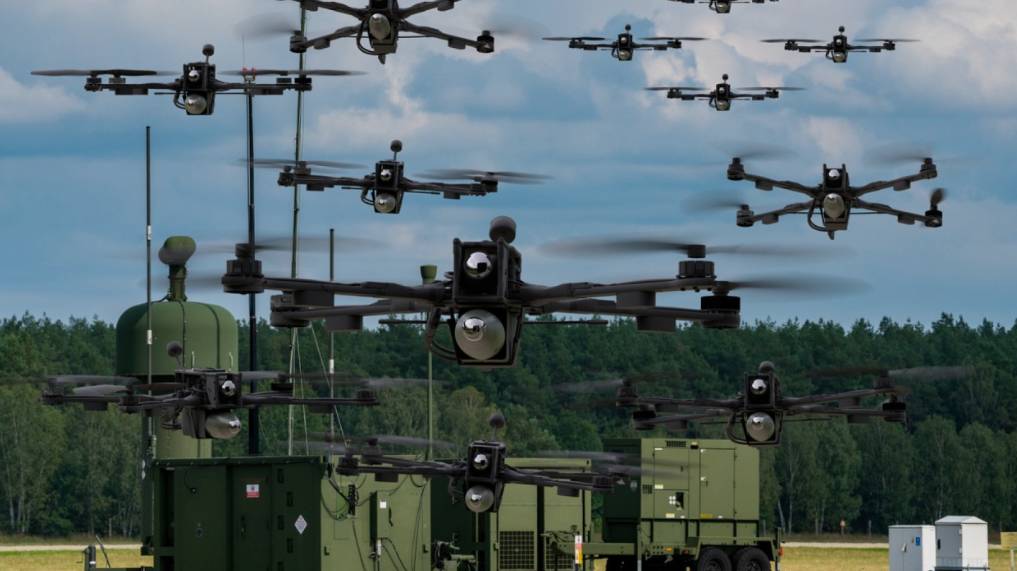
DroneWeaver sits at the intersection of three fast-moving defense requirements: counter-unmanned aircraft systems (C-UAS), command, control, communications, computers, and intelligence (C4I), and directed-energy defeat mechanisms. That combination is significant because the drone threat has matured beyond isolated hobbyist incursions into a layered problem spanning reconnaissance, electronic warfare, loitering munition attacks, swarm saturation, and battlefield target designation. A system that fuses sensing, decision support, and energy-based effectors is not merely another point defense asset; it is an attempt to build a networked air-defense node optimized for the low-altitude fight.
The strategic value of such a system is clear. Modern forces are increasingly challenged by small, cheap, and expendable aerial systems that can be launched in volume, routed around traditional radar coverage, and used to expose artillery positions, logistics hubs, command posts, and high-value infrastructure. In this environment, the decisive advantage lies not only in destruction, but in time-to-detect, time-to-classify, and time-to-engage. A C4I-enabled directed-energy C-UAS architecture is designed to compress that timeline.
System Role and Doctrine
Doctrine for counter-drone defense is shifting from a purely reactive posture to a layered, distributed, and persistent model. DroneWeaver is best understood as a node within that architecture. Rather than replacing kinetic interceptors or electronic attack, it complements them by providing a scalable engagement option against drones that have already penetrated outer layers of defense.
In practical terms, a system like this can serve several doctrinal roles:
- Point defense for command posts, ammunition areas, forward operating bases, radar sites, and critical infrastructure.
- Inner-ring protection for maneuver formations that are vulnerable to quadcopter spotting and one-way attack drones.
- Persistent surveillance denial by creating a local anti-drone bubble around sensitive assets.
- Battlefield deconfliction through C4I integration, ensuring engagements are coordinated with friendly air corridors and electromagnetic spectrum management.
This matters because the drone threat is not uniform. Small quadcopters demand different defeat mechanisms than fixed-wing ISR drones or Group 2/3 loitering weapons. A directed-energy system can be attractive where ammunition logistics, collateral risk, and engagement endurance are all limiting factors. If the energy source and thermal management can support sustained operation, the defender gains a magazine depth measured in power availability rather than in interceptor count.
How C4I Changes the Counter-Drone Problem
The C4I layer is the force multiplier. Standalone sensors and weapons can defeat individual drones, but they do not automatically create an integrated picture. A counter-drone network must fuse radar tracks, electro-optical cues, radio-frequency detections, and operator inputs into a single tactical common operating picture. That is where DroneWeaver’s significance lies: it implies a system architecture in which sensing and effect are tightly coupled through decision support software.
In a dense threat environment, this fusion enables:
- Faster target nomination by correlating multi-sensor tracks.
- Improved classification between birds, civilian drones, and hostile platforms.
- Engagement prioritization based on trajectory, payload suspicion, and target value.
- Battle management across multiple C-UAS nodes to prevent redundant engagements.
The operational payoff is substantial. A C4I-enabled counter-drone system can distribute threat data to nearby units, air defenders, and base security elements, reducing the chance that a single drone is engaged too late or by the wrong effector. It also supports escalation control: not every drone requires a high-power shot, and not every track should trigger the same response. In that sense, the software is just as important as the hardware.
Directed-Energy as a Defeat Mechanism
Directed-energy systems are attractive for counter-drone operations because they offer a low cost-per-shot, rapid engagement, and the possibility of repeated use without ammunition resupply. Their core military utility is to disable or destroy airborne targets by concentrated energy delivery, typically through thermal overload, sensor dazzling, structural compromise, or component failure. For small drones, the threshold for mission kill can be comparatively low, especially when the target is lightly built and exposed.
That said, directed energy is not a universal answer. Its effectiveness depends on line of sight, atmospheric conditions, target maneuverability, dwell time, and beam control. Small drones can move unpredictably, rotate quickly, and present limited surface area. This means the fire-control chain must be exceptionally precise. If DroneWeaver is a mature system, its value likely lies not simply in raw output power, but in the quality of its tracking, beam stabilization, and cueing from C4I sensors.
The tactical implications are important. Directed-energy weapons can be especially useful in:
- Urban or semi-urban defense where kinetic debris is undesirable.
- High-volume engagements where expendable interceptors would be consumed too quickly.
- Electromagnetically contested environments where soft-kill jamming is insufficient or unreliable.
- Layered defenses where a final hard-kill option is needed after electronic attack has failed.
However, the requirement for stable tracking means that weather, obscurants, and terrain masking can degrade performance. Adversaries will exploit these limitations through low-altitude routing, staggered attack profiles, and decoy saturation.
Likely Technical Architecture
While detailed specifications are not publicly confirmed here, a system described as a C-UAS C4I directed-energy suite would typically combine a multi-sensor detection stack, a battle-management software layer, and a high-energy effector mounted on a fixed or mobile platform. The following table summarizes the likely functional elements and their operational relevance.
| Subsystem | Likely Function | Operational Significance |
|---|---|---|
| Radar | Short-range airspace detection and track generation | Provides initial cueing against small, low-flying targets |
| Electro-optical/infrared sensor | Visual confirmation and precision tracking | Supports classification and beam aiming |
| RF detection / direction finding | Identifies drone control links and telemetry | Improves attribution and target prioritization |
| C4I software | Fuses sensor inputs and distributes threat data | Enables coordinated response across the defended area |
| Directed-energy effector | Disables sensors, avionics, or airframe through energy delivery | Provides a repeatable hard-kill or mission-kill option |
| Power and thermal management | Supplies and regulates energy output | Determines endurance and sustained engagement capacity |
If deployed on a vehicle or trailer, the system gains mobility and can be repositioned to protect convoys, temporary command nodes, and expeditionary sites. If fixed-site, it becomes a more persistent shield for strategic assets such as airfields, depots, ports, or critical infrastructure. In both cases, network connectivity is central: the system is most effective when it can receive off-board cueing from higher-echelon sensors and share tracks with adjacent defenders.
Tactical Advantages over Kinetic Interceptors
The key tactical advantage of directed energy is the economics of engagement. Drones are cheap, and attacking them with expensive missiles or interceptor rounds quickly becomes unsustainable. A high-energy beam system may not be free to operate, but its per-shot cost can be materially lower than a kinetic missile. This is especially relevant against swarm tactics, where defenders may be forced to engage multiple targets in short succession.
Additional advantages include:
- Reduced collateral damage compared with explosive interceptors.
- Deep magazine so long as power generation remains available.
- Immediate re-engagement potential without reload cycles.
- Precision defeat against targets over or near protected assets.
Yet these strengths should not be overstated. Directed-energy systems are usually constrained by atmospheric attenuation, thermal bloom, and line-of-sight geometry. An adversary that understands the defended system may use pop-up profiles, distributed launch points, or mixed salvos to complicate engagement. Thus, DroneWeaver’s effectiveness would likely be maximized as part of a layered C-UAS architecture rather than as a standalone solution.
Force Projection and Base Defense Implications
For expeditionary forces, the appearance of a compact C4I-directed-energy counter-drone system changes base defense planning. Forward bases are often protected by manpower-intensive watch routines and a patchwork of sensors, jammers, and small-arms teams. A networked directed-energy node can reduce operator burden while increasing reaction speed. It also helps defend against the persistent harassment strategy used by irregular and proxy forces, who rely on low-cost aerial systems to create psychological pressure and force defenders into expensive alert cycles.
For state militaries, the implications extend to area denial and force preservation. Protecting air-defense radars, C2 nodes, and logistics arteries is essential for maintaining tempo. If a counter-drone system can reliably suppress reconnaissance drones, it becomes harder for the adversary to find targets for artillery, long-range fires, or precision strikes. That has direct consequences for survivability at the operational level.
There is also a deterrence component. A visible and credible counter-drone capability forces an attacker to spend more, coordinate more, and accept a higher risk of mission failure. In contested theaters, this can blunt the effectiveness of drone-centric tactics and preserve the initiative for the defender.
Limitations, Risks, and Countermeasures
No counter-drone system is invulnerable. The likely limitations of a DroneWeaver-type architecture include weather sensitivity, power dependency, cooling demands, and the challenge of sustaining track quality on small, fast, or numerous targets. Directed-energy effectors can also be stressed by long engagement cycles or by target sets that intentionally maximize dwell requirements.
Adversaries have several obvious countermeasures:
- Swarm saturation to overload tracking and engagement capacity.
- Decoys and cheap drones to waste defender attention.
- Terrain masking and low-altitude approach to reduce sensor time.
- Electronic attack against the C4I and sensor network.
- Multi-axis attacks combining drones with artillery, rockets, or ground infiltration.
For that reason, the best answer is not a single exquisite system but a resilient defensive ecosystem. DroneWeaver would be most credible if integrated with passive detection, electronic warfare, kinetic backups, and command-level decision tools. The goal is not only to shoot down drones, but to build a defensive architecture that can absorb pressure without collapsing under volume.
Strategic Assessment
From a strategic perspective, a C-UAS C4I directed-energy system represents a broader shift in air defense philosophy. It reflects the reality that the low-altitude battlespace has become crowded, inexpensive, and lethal. As drones proliferate, so too does the need for systems that can scale economically and operate with minimal logistical friction. In that sense, DroneWeaver is less about a single platform and more about a doctrine: combine sensors, networks, and energy weapons to dominate the near field.
If fielded effectively, such a capability would help restore asymmetric advantage to the defender. It would complicate enemy reconnaissance, reduce the payoff of drone harassment, and protect key nodes that underpin operational endurance. The strategic question is not whether drones will remain a threat — they will — but whether defenders can impose enough friction, cost, and uncertainty to keep them from becoming decisive. A system in this class is one answer to that problem.
Bottom line: DroneWeaver-type systems are strategically relevant because they merge the decision speed of C4I with the sustainability of directed energy. Their real value will depend on integration, sensor quality, and doctrine, but as part of a layered defense they could become a central tool in protecting forces and infrastructure from the expanding drone threat.