

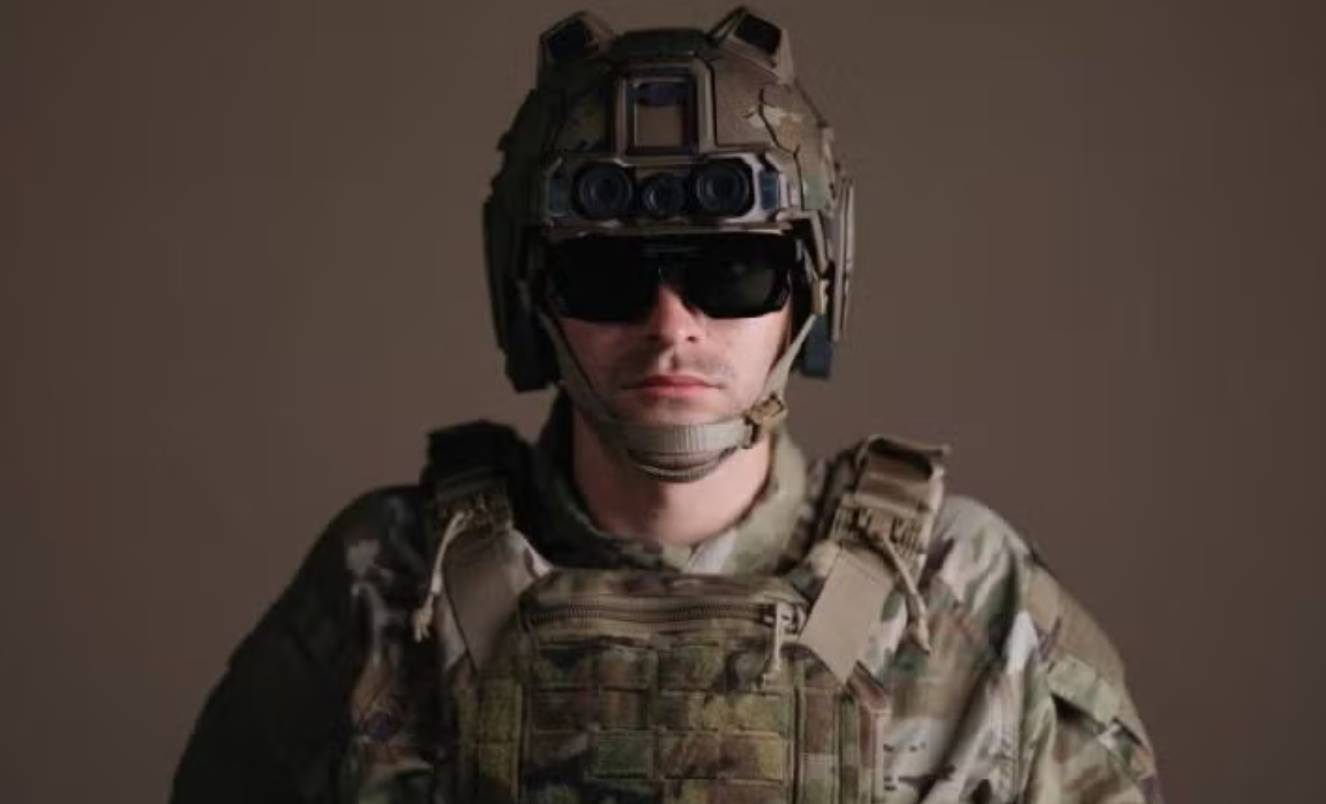
The EagleEye helmet represents a decisive shift away from the traditional combat helmet as a purely protective shell. Instead, it is being engineered as a wearable mission node: a platform that integrates display optics, digital communications, sensor fusion, and command-and-control functions directly onto the soldier’s head. The result is not simply a helmet with gadgets attached, but a system intended to reduce cognitive friction, compress decision cycles, and keep the operator connected to the tactical picture without requiring constant attention to a separate handheld device.


What the EagleEye concept is trying to solve
Modern infantry and special operations units operate in an environment saturated with data: blue-force tracking, UAV feeds, target handoff messages, navigation cues, biometric status, and mission updates from higher headquarters. The operational problem is not a lack of information, but the difficulty of presenting the right information at the right time without overloading the user. EagleEye addresses this by embedding a heads-up display, mission command software, and communications interfaces into a helmet architecture that aims to be both survivable and networked.
In practical terms, the helmet functions as a visual and digital gateway. A soldier can receive maps, compass headings, route markers, target cues, text messages, and sensor overlays in the same field of view that is used for real-world observation. That capability is especially valuable in low-light urban terrain, during vehicle dismounts, or in dispersed operations where line-of-sight with a leader is intermittent.
Core architecture
The EagleEye system is best understood as a layered design:
- Protective shell for ballistic and impact protection.
- Optical display subsystem that projects information into the user’s near-eye field.
- Mission command module for situational awareness, messaging, and tasking.
- Communications and network interfaces to connect to radios, sensors, and higher-echelon systems.
- Power management to support extended operation without excessive battery burden.
The engineering challenge is integration. Every added gram, cable, sensor, or battery affects neck load, thermal comfort, and balance. A helmet platform must therefore meet competing demands: it has to remain stable during sprinting, climbing, and firing; it must not block peripheral vision; and it must preserve compatibility with night vision, hearing protection, eye protection, and ballistic accessories.
Heads-up display performance and human factors
The display element is the most visible part of the EagleEye concept, but it is also the component most constrained by human factors. A helmet-mounted HUD must balance brightness, resolution, latency, and field of view against power draw and weight. If the display is too dim, it disappears under sunlight. If it is too bright, it destroys dark adaptation at night. If latency rises, moving symbology can lag behind actual motion, which is dangerous during movement or vehicle operations.
From a design standpoint, the display must present information in layers of priority. Navigation and friend/foe indications should be persistent and low-clutter. Dynamic tasking, target markers, and alert messages should appear only when relevant. The ideal interface is minimalistic and context-aware, allowing the user to remain focused on the environment rather than on the helmet itself.
There is also a significant ergonomic trade-off between monocular and binocular display architectures. A monocular system is lighter and preserves more natural vision, but it can create eye fatigue and asymmetrical visual load. A binocular or stereoscopic system can support richer imagery and depth cues, but it adds complexity, weight, and alignment sensitivity. In helmet-mounted military applications, the engineering preference often trends toward the lightest solution that still supports the mission set.
Mission command system integration
The phrase mission command system implies more than simple messaging. It suggests a digital architecture capable of pushing tasking, receiving acknowledgements, displaying route data, and sharing position and status with other nodes in the force. In the EagleEye context, that means the helmet is not merely a display accessory; it is a terminal in a tactical network.
This is the major operational advantage. Instead of waiting for radio traffic to be interpreted by a squad leader, or pulling a map from a pouch, the wearer can see mission updates immediately. A leader can redistribute units, mark danger areas, designate rally points, or update movement timing with reduced delay. In distributed operations, even a few seconds of time savings can matter, especially when the unit is moving under observation or in contact.
However, network integration introduces dependencies. The helmet becomes partially reliant on external data links, authentication protocols, and power continuity. If communications are jammed, degraded, or saturated, the system must gracefully fall back to local navigation and limited offline functions. A robust design therefore requires both connected and disconnected operating modes.
Representative technical characteristics
Publicly available details on EagleEye-style systems vary by program and development phase, so exact numbers may differ between prototypes and fielded variants. The table below summarizes the kinds of specifications generally associated with helmet-mounted mission command and HUD platforms.
| Specification | Typical capability | Engineering note |
|---|---|---|
| Display type | Monocular or near-eye HUD | Chosen to reduce weight and preserve situational awareness |
| Data shown | Maps, navigation, blue-force tracking, alerts, text, sensor cues | Prioritized by mission role and threat level |
| Power source | Helmet-mounted or body-worn battery pack | Balance between endurance and neck load |
| Runtime | Several hours to a full mission cycle | Depends on brightness and radio usage |
| Connectivity | Radio, GPS, sensor, and command network interfaces | May include wired and wireless links |
| Weight impact | Moderate to high, depending on configuration | Critical factor for fatigue and mobility |
| Environmental resistance | Dust, rain, shock, vibration, and temperature tolerance | Must survive field abuse and impact events |
Trade-offs versus traditional helmets
A conventional combat helmet optimizes for protection, comfort, and accessory mounting. EagleEye adds a digital layer that improves situational awareness but also introduces penalties. The most obvious penalty is weight. The second is complexity. More components mean more potential failure points, more training burden, and more maintenance demands.
The weight issue is not trivial. When mass is placed high and forward on the helmet, it increases neck torque and can accelerate fatigue during extended wear. Designers often respond by relocating batteries to the rear or to the torso, but that introduces cabling, snag hazards, and distribution challenges. Optical assemblies also need precise alignment, which can be disrupted by impact, fatigue, or changes in headgear configuration.
Another trade-off is signature management. Any display or illuminated interface can create a detectable glow if not properly shielded. Likewise, digital systems can emit RF energy or generate heat. A tactical helmet must therefore be carefully engineered so that its electronic advantages do not create new vulnerabilities.
Operational advantages in realistic scenarios
In urban clearing, the helmet can display building numbers, breach points, and direction arrows without forcing the operator to look down at a map. In mounted operations, it can support route confirmation and blue-force visibility while the soldier keeps both hands occupied. In night operations, the ability to overlay navigation and task data directly in the line of sight can reduce reliance on handheld light sources and limit exposure.
For leaders, the biggest benefit is shared situational awareness. A squad leader can distribute intent quickly, and subordinate members can acknowledge and execute without repeated voice traffic. That reduces radio congestion and helps preserve secrecy when silence is required. If integrated with remote sensors, the helmet can also present target indicators or reconnaissance imagery, effectively turning the wearer into part of a larger sensor-to-shooter chain.
Limitations and integration challenges
Despite the promise, the EagleEye concept faces several hard engineering realities. Display clarity must remain usable in bright daylight and complete darkness. The battery must support mission length without becoming a burden. The user interface must be intuitive enough that training time does not become excessive. And the system must remain reliable after drops, rain exposure, vibration, and long periods in storage.
There is also the issue of software security. A mission command helmet is a networked computing device worn at the edge of the battlefield. That makes it susceptible to software bugs, configuration errors, and adversarial exploitation. Secure boot, encryption, authentication, and resilient update processes are not optional features; they are core survivability requirements.
Finally, there is the matter of user acceptance. Soldiers will not tolerate a system that is heavy, uncomfortable, slow, or distracting. The best helmet technology is the kind that disappears into the mission and only becomes noticeable when it helps the operator make a better decision. That is the benchmark EagleEye must meet.
How it compares with other soldier systems
Compared with earlier soldier modernization efforts, EagleEye is notable for attempting to merge multiple functions into one headborne package rather than distributing them across separate accessories. That approach can simplify the user’s workflow, but it also concentrates risk. If the helmet fails, multiple mission aids disappear at once.
By contrast, more modular systems separate display, radio, navigation, and protection into distinct subsystems. Those designs are easier to repair and scale, but they can be less elegant in use. EagleEye’s value proposition is therefore rooted in integration density: more capability per worn item, provided that the system does not become too cumbersome for real combat use.
Why the concept matters
The significance of EagleEye is not that it puts a screen on a helmet. The significance is that it reflects a broader doctrinal shift toward digitized dismounted warfare. The infantryman is increasingly becoming a connected node in a sensor-rich network, and the helmet is one of the few places where visual command data can be delivered without interrupting movement or weapon handling.
If the system matures successfully, it could help compress the gap between observation, decision, and action. That is the central promise of all soldier-worn mission command technology: not to replace judgment, but to make timely judgment easier under stress.
The final measure of success will not be how advanced the graphics look in a demonstration. It will be whether the helmet improves survivability, reduces confusion, and helps the operator move faster and fight smarter under real battlefield conditions.