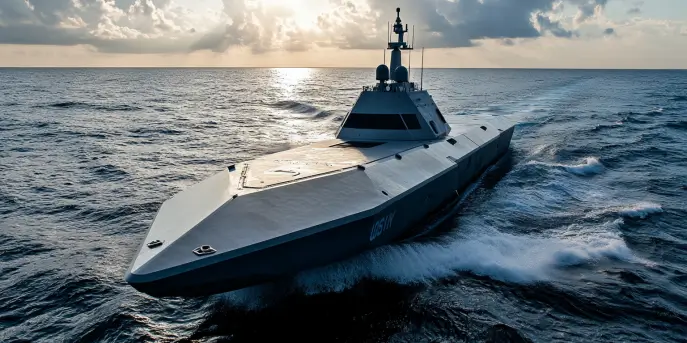


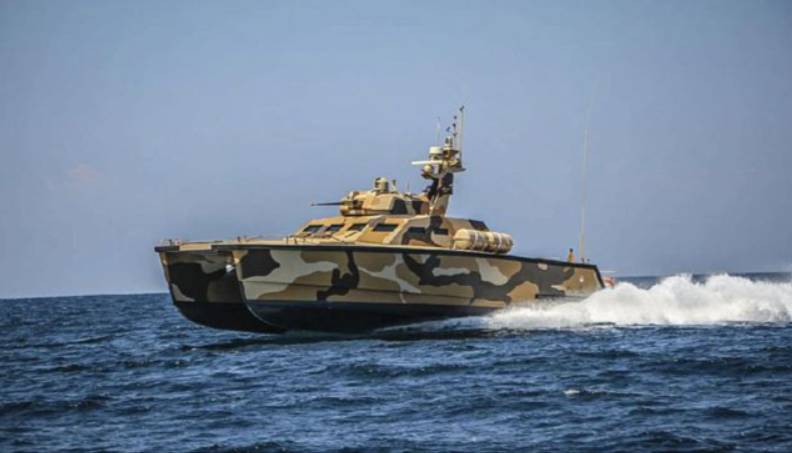
The CB X-18, often described in shorthand as a “tank boat”, reflects a broader trend in modern naval design: the search for a platform that can combine heavy firepower, high mobility, and littoral utility in a single, relatively compact hull. In an era defined by archipelagic conflict, anti-access/area-denial networks, and dispersed maritime operations, the appeal of such a vessel is obvious. A fast, armed boat with armor-like survivability, land-attack capability, and enough presence to influence coastal engagements sits squarely in the space between patrol craft, missile boats, and amphibious support vessels.

What makes the CB X-18 notable is not simply its armament, but the operational logic behind the concept. Small combatants have always had a place in coastal defense, yet contemporary doctrine increasingly demands that they do more than patrol or interdict. They are expected to survive in contested waters, deliver precision or suppressive fire, support maritime denial, and complicate an adversary’s targeting cycle. The “tank boat” label suggests a deliberate attempt to transpose the psychological and tactical attributes of armored warfare onto the maritime domain: shock effect, direct fire, and concentrated lethality at short ranges.
That idea is especially relevant for states facing superior naval powers. In a littoral environment, the side with the largest fleet is not automatically the side with the decisive advantage. Geography, concealment, coastal logistics, and the ability to ambush from within cluttered waters can neutralize some of the benefits of blue-water dominance. A craft like the CB X-18 would likely be intended to exploit those conditions, serving as a mobile fire platform that can surge into threatened sectors, support island garrisons, or reinforce coastal chokepoints without requiring a large surface combatant.
Design logic and battlefield role
The operational value of a boat in this category comes from its ability to compress several roles into one hull. In practical terms, that can include surface strike, escort of fast logistics craft, coastal fire support, anti-landing operations, and the intimidation of irregular or lightly armed maritime threats. The “tank boat” concept is less about matching the armor of a main battle tank and more about borrowing its combat utility: a forward-deployed platform with enough firepower to dominate its immediate battle space.
In a maritime setting, firepower must be balanced against endurance and survivability. A heavily armed small boat can be dangerous, but it is also vulnerable to air attack, drones, anti-ship missiles, and even massed small-caliber fire if caught without cover. That is why the real strategic contribution of the CB X-18 would likely lie in its integration into a broader network: coastal surveillance, electronic support, shore-based missile batteries, UAV cueing, and distributed command and control. Alone, a boat of this type is a target. Connected to a sensor-shooter ecosystem, it becomes part of a layered denial architecture.
This is one reason such platforms are drawing attention across the Indo-Pacific and other maritime flashpoints. They fit the logic of distributed lethality and sea denial far better than they do traditional fleet battles. Rather than seeking command of the sea in the classic sense, they are designed to make contested waters expensive to enter. That changes the calculus for amphibious assault forces, gray-zone operators, and even conventional surface groups tasked with enforcing blockades or conducting maritime security.
Likely armament and mission fit
Although exact configurations can vary, a craft in this class is generally expected to carry a mixture of direct-fire weapons and stabilized weapon stations. Depending on the final fit, that may include a cannon, heavy machine guns, automatic grenade launchers, or missile systems suitable for anti-surface or shore bombardment tasks. The key is not one weapon alone, but the ability to rapidly transition between targets in a cluttered littoral battlespace.
The mission set would likely emphasize:
- Coastal denial against landing craft, raiders, and patrol vessels.
- Fire support for troops defending islands, straits, or river mouths.
- Escort and convoy protection for logistics movements in threatened waters.
- Rapid response to incursions in narrow seas and coastal approaches.
- Psychological deterrence, especially where the visual presence of a heavily armed boat signals readiness and resolve.
In this sense, the CB X-18 is best understood as a tactical tool with strategic implications. It can shape the adversary’s planning by forcing more caution, more reconnaissance, and more expensive force protection measures. Even when not firing a shot, it can influence the tempo of operations by creating uncertainty along the littoral edge.
Mobility, survivability, and the limits of the concept
Speed is often the first selling point for vessels like this, and for good reason. A fast craft can reposition, exploit gaps in surveillance, and reduce exposure time in a kill zone. But mobility alone does not equal survivability. Modern maritime combat is increasingly defined by sensors and precision strike systems that can find, fix, and finish even small targets. As a result, the value of the CB X-18 would depend heavily on how well it can hide, disperse, and operate under emissions control.
Survivability in this class usually comes from a combination of factors rather than heavy armor in the traditional sense. Low radar and infrared signatures, a small visual profile, rapid acceleration, and the ability to operate near shore infrastructure all matter. So does crew training. A well-drilled crew that can launch, recover, and relocate quickly may survive longer than a technically superior craft operated with poor discipline.
Still, there are inherent limitations. A tank boat cannot substitute for air defense, mine countermeasures, or sustained sea control. It is not a platform for prolonged blue-water operations. Weather, sea state, and maintenance burden also impose sharp constraints. The very traits that make a small combatant valuable in the littorals can become liabilities in open water or prolonged campaigns. For defense planners, that means the platform must be judged by mission specificity rather than by generalized naval utility.
Strategic context: why this concept is gaining traction
The rise of systems like the CB X-18 is tied to a changing security environment. Maritime competition is shifting toward the first island chain, enclosed seas, and chokepoints where geography compresses maneuver. In those spaces, smaller combatants can have outsized effects because they operate inside the adversary’s decision cycle. A fleet that must defend carriers, amphibious ships, and logistics corridors will always be vulnerable to concentrated littoral threats.
For coastal states, especially those with limited budgets, the attraction is straightforward: a relatively affordable vessel can impose disproportionate costs on a stronger opponent. That cost-imposition logic is central to modern deterrence. It does not require parity; it requires enough capability to make aggression uncertain and expensive. In peacetime, the boat can support sovereignty patrols and maritime law enforcement. In crisis, it can transition into a combat role as part of a broader defensive posture.
The concept also aligns with the growing importance of unmanned systems and networked warfare. A future force package might pair the CB X-18 with UAVs for targeting, unmanned surface craft for decoying or screening, and shore-based command nodes for battle management. In that model, the boat becomes one node in a distributed maritime strike web. This is a significant shift from legacy thinking, where surface combatants were expected to operate as self-sufficient platforms.
Possible specifications
Publicly available technical data on the CB X-18 may be limited or subject to change, so the following table reflects a notional profile based on the general “tank boat” category rather than confirmed final figures.
| Specification | Notional estimate |
|---|---|
| Role | Fast attack / coastal fire support / sea denial |
| Hull type | Small high-speed combat boat |
| Crew | Small crew, likely optimized for short-duration missions |
| Speed | High-speed littoral maneuver capability |
| Endurance | Limited, mission-dependent |
| Armament | Stabilized direct-fire weapons, machine guns, possible missile fit |
| Sensors | Surface search and fire-control systems, likely network-enabled |
| Primary operating area | Coastal waters, straits, rivers, and archipelagic environments |
Even with limited specifics, the category tells us a great deal. The CB X-18 is likely designed around a doctrinal premise that prioritizes presence, rapid response, and concentrated firepower over endurance or multi-role flexibility. That is not a weakness if the intended battlespace is narrow, contested, and heavily shaped by geography. It is, however, a reminder that naval power is increasingly specialized. The best platform is not necessarily the most heavily armed one, but the one most closely aligned with the operational problem.
Implications for regional navies
If fielded in numbers, boats of this kind could force opposing navies to rethink patrol patterns, base security, and amphibious planning. They increase the burden on intelligence, surveillance, and reconnaissance assets, because commanders must account for small, mobile, and potentially concealed threats along vast coastlines. They also raise the stakes for port defense and maritime domain awareness, since a small craft can emerge from cluttered waters, strike quickly, and withdraw before a conventional response is organized.
For neighboring states, that means more emphasis on distributed sensors, over-the-horizon targeting, helicopter-borne anti-surface weapons, and layered base defense. It also suggests greater demand for mine warfare and counter-infiltration capability, because denying access to such craft is often easier through geography and obstacle planning than through direct engagement alone. In other words, the CB X-18 is not just a boat; it is a forcing function for wider force design.
There is also a political dimension. Platforms with names like “tank boat” tend to attract attention because they symbolize a willingness to adapt armored warfare thinking to maritime defense. That symbolism can be useful domestically, reinforcing narratives of resilience and self-reliance. Externally, it can signal that a state is preparing for asymmetric resistance rather than passive defense. In an age where deterrence often begins with perception, that signaling value should not be underestimated.
The CB X-18 therefore sits at the intersection of doctrine, geography, and industrial pragmatism. Whether it becomes a niche specialty craft or a meaningful component of a larger littoral force will depend on how well it is integrated, trained, and sustained. But even in concept form, it highlights a central truth of contemporary naval warfare: in confined waters, small platforms armed for decisive local effect can alter strategic behavior far beyond their displacement.