

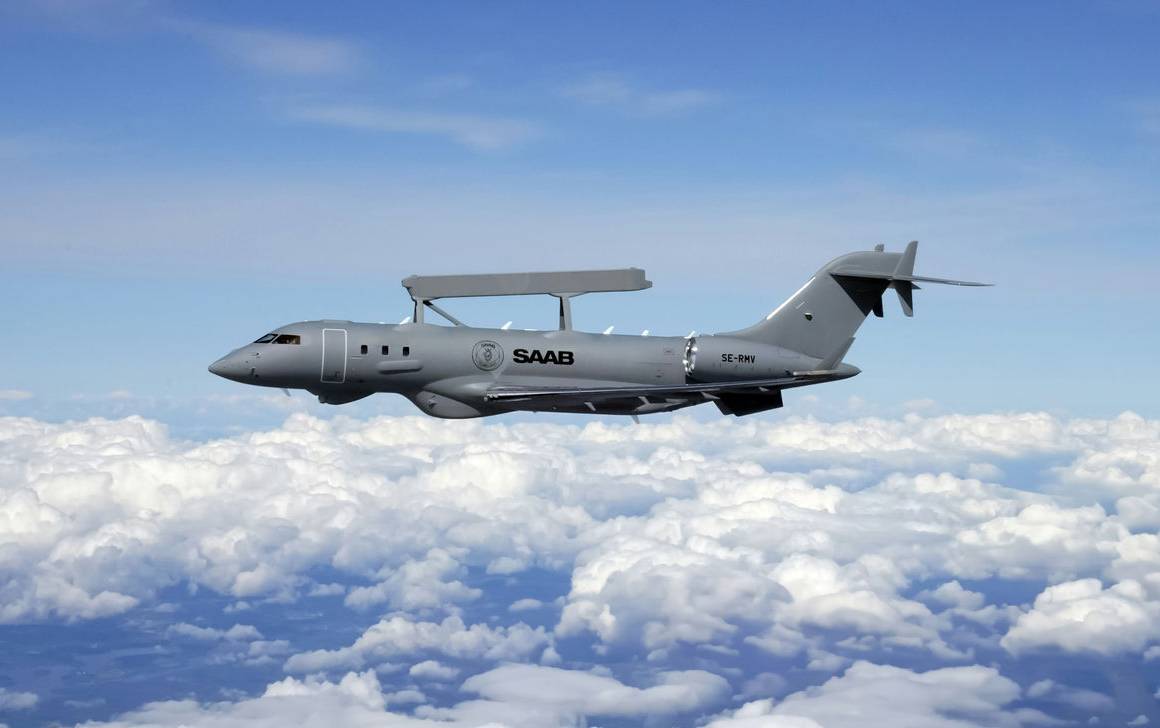
When people think of airborne early warning and control, they often picture the classic rotodome silhouette of an AWACS aircraft orbiting high above the fight, watching everything at once. But the future of aerial surveillance is getting sleeker, smarter, and far more efficient. Enter Saab GlobalEye — a multi-mission airborne early warning and control platform that has become one of the most talked-about sensor aircraft in Western defense circles, and now a serious contender in NATO’s evolving surveillance ecosystem.
GlobalEye is not just a radar plane. It is a flying intelligence hub built around Saab’s Erieye ER radar, layered with additional sensors designed to see beyond the horizon, track air and maritime targets, and support a wide range of missions from air policing to theater surveillance. In a world where stealth, cruise missiles, drones, and low-flying threats are increasingly central to the fight, that kind of all-around awareness is pure gold.
Why GlobalEye matters now
The strategic logic behind GlobalEye is easy to understand. NATO has spent decades relying on a mix of legacy AWACS aircraft, national sensor networks, and allied data sharing. That system still works, but the threat environment has become much more demanding. Russia’s long-range missiles, electronic warfare, swarms of small drones, and maritime pressure in the Baltic and High North all punish slow situational awareness. The alliance needs platforms that can stay aloft for hours, see farther, and feed a faster decision cycle.
That is where GlobalEye shines. Built on the Bombardier Global 6000 business-jet airframe, it offers long endurance, high altitude performance, and lower operating costs than larger jet transports. That means more time on station and less time and money spent getting there. For NATO countries balancing tight budgets with serious security requirements, that combination is extremely attractive.
The airframe: business jet bones, military brain
One of the coolest things about GlobalEye is the marriage of a sleek civilian platform with a dense military sensor suite. The Bombardier Global 6000 is a long-range business jet known for speed, comfort, and range. Saab transforms it into a combat support aircraft by integrating a dorsal radar fairing, mission systems, operator consoles, communications gear, and self-protection equipment.
This is not just a matter of slapping on a radar and calling it a day. The engineering challenge is all about balancing aerodynamic drag, power generation, cooling, structural reinforcement, and mission system integration. The result is a platform that can climb high, cruise efficiently, and remain versatile enough for a broad set of missions. That versatility matters because modern air operations are no longer one-dimensional. A platform that can provide air surveillance one day and maritime domain awareness the next is a real force multiplier.
Erieye ER: the heart of the system
The centerpiece of GlobalEye is the Erieye ER, an advanced active electronically scanned array radar with extended range and improved performance over earlier generations. Unlike mechanically rotating dishes, AESA radars can steer beams electronically, allowing rapid updates and strong multitarget tracking performance. That is exactly what you want when monitoring busy airspace filled with fast jets, helicopters, drones, and low-observable intruders.
Saab has emphasized that the ER version improves range and detection performance while enhancing the ability to track low-signature targets. In practical terms, that means better visibility against smaller or harder-to-detect aircraft, as well as improved resilience in cluttered environments. Over land, over sea, and in the presence of electronic interference, the radar is designed to keep building a clean, usable picture.
That picture is the real product. Sensors are impressive on paper, but the value comes from turning raw detections into a coherent operational display that commanders can trust. GlobalEye is built to do exactly that, fusing radar data with other onboard sensors and offboard inputs to create a comprehensive air and maritime situational awareness picture.
More than air surveillance
GlobalEye is often described as an AWACS-like aircraft, but that only tells part of the story. Traditional AWACS platforms focus heavily on airborne early warning and battle management. GlobalEye, by contrast, is designed as a multi-domain ISR machine. It can track aircraft, surface vessels, and certain land targets, while also supporting border security, maritime patrol, and command-and-control tasks.
That flexibility gives it a major advantage in Europe’s northern and coastal theaters. In the Baltic region, for example, one aircraft may need to watch for hostile aircraft, monitor shipping lanes, observe amphibious movement, and support air defense. GlobalEye is built for that kind of workload. For NATO planners, an aircraft that can be tasked across multiple domains reduces the need for separate specialized fleets or constant platform swapping.
And because it is based on a relatively efficient business jet, it can do all of this without the sort of operating footprint associated with larger legacy surveillance aircraft. That makes it especially appealing to smaller NATO air forces that still want top-tier sensor capability.
GlobalEye versus legacy AWACS
The obvious comparison is with the NATO E-3 Sentry AWACS fleet. The E-3 has been a legend for decades, and for good reason. It has provided wide-area air surveillance and airborne command-and-control since the Cold War. But it is an aging platform built around older airframe technology and a less efficient operating model. Maintenance burden, availability challenges, and modernization costs have all become increasingly significant.
GlobalEye does not try to copy the E-3. Instead, it takes a different approach: smaller, more efficient, and sensor-rich. Its strength lies in modern radar processing, lower operating costs, and flexible multi-mission utility. Where the E-3 is a heavyweight command node, GlobalEye is a more agile intelligence and surveillance platform that can still punch above its weight.
That is not a knock on the old guard — it is a sign of how surveillance architecture is changing. Rather than relying solely on a few giant aircraft, NATO increasingly needs a network of distributed sensors, resilient datalinks, and platforms that can operate more economically while still delivering high-quality data.
Table: Saab GlobalEye at a glance
| Specification | Details |
|---|---|
| Manufacturer | Saab |
| Base airframe | Bombardier Global 6000 |
| Primary radar | Saab Erieye ER AESA radar |
| Mission set | Airborne early warning, air surveillance, maritime surveillance, ISR, command and control |
| Crew | Typically 2 pilots plus mission crew |
| Endurance | Long-endurance mission profile, designed for extended on-station operations |
| Operational altitude | High-altitude business-jet performance envelope |
| Role | Multi-mission airborne surveillance and battle management |
Sensor fusion is the real superpower
Modern airborne surveillance is no longer about a single giant radar doing all the work. It is about fusing radar, electronic support, communications, and data links into a clean operational picture. GlobalEye is built for this reality. Its mission system is designed to ingest multiple streams of information, correlate tracks, and distribute that data to fighters, ships, ground units, and command centers.
That makes it a force multiplier in the truest sense. A fighter pilot with a GlobalEye feed can engage faster and with greater confidence. A naval commander can see incoming air and surface threats earlier. A ground air defense unit can get a better warning picture and avoid wasting precious missiles on false cues. In a contested battlespace, that kind of time advantage can be decisive.
And because the system is built around modern digital architecture, it can evolve. That matters because the threat is not static. New drones, new cruise missiles, new jamming techniques, and new stealth profiles all demand software upgrades and sensor refinements. Platforms like GlobalEye are attractive because they are designed with growth in mind.
Why NATO could be interested
The NATO angle is where things get really interesting. Several alliance members are looking for affordable, modern surveillance aircraft that can complement or replace aging assets. GlobalEye fits that niche beautifully. It offers high-end capability without the scale, cost, or logistical burden of a large transport-based system. For nations operating in the Baltic Sea, North Atlantic, or Arctic approaches, the aircraft’s maritime and air surveillance strengths are especially relevant.
It also aligns with NATO’s push toward interoperability and distributed sensing. Instead of a few massive platforms doing all the work, the alliance is moving toward a more networked model in which airborne, space-based, maritime, and ground sensors all contribute. GlobalEye slots naturally into that architecture.
There is also a procurement reality here: in an era of constrained budgets, decision-makers want platforms that deliver high utility per dollar. A business-jet-based AEW&C aircraft with serious sensor reach and lower lifecycle costs is an easy pitch to defend ministers and parliaments alike.
The engineering trade-offs
Of course, no platform is magic. GlobalEye’s lighter airframe and smaller size mean it is not a one-for-one replacement for the largest AWACS aircraft in every scenario. A bigger platform may carry more crew, more consoles, and potentially offer a different balance of mission persistence and battle management volume. But the trade-off is intentional. Saab is chasing efficiency, flexibility, and modern sensor performance rather than brute size.
That is the same logic driving much of modern defense procurement. The question is no longer simply, “How big is the platform?” It is, “How much usable combat power does it deliver, and how quickly can it be fielded and sustained?” On that score, GlobalEye makes a compelling case.
It also reflects a broader shift in airpower design. The future is not just about the biggest aircraft in the sky. It is about the smartest network, the cleanest data, and the fastest kill chain. GlobalEye is built for exactly that world.
A modern eye in the sky
Saab GlobalEye represents the kind of platform that feels very 21st century: efficient, software-driven, sensor-rich, and mission-flexible. It is a reminder that military aviation innovation does not always arrive in the form of a larger jet or a louder engine. Sometimes the real breakthrough is integrating advanced radar, resilient mission systems, and a practical airframe into one highly capable package.
For NATO, that makes GlobalEye more than just another surveillance aircraft. It is a signpost pointing toward the alliance’s future airborne sensing model — distributed, agile, networked, and built to handle a battlespace that is faster and more complex than ever.
And honestly? That is a very exciting place for defense technology to be.