

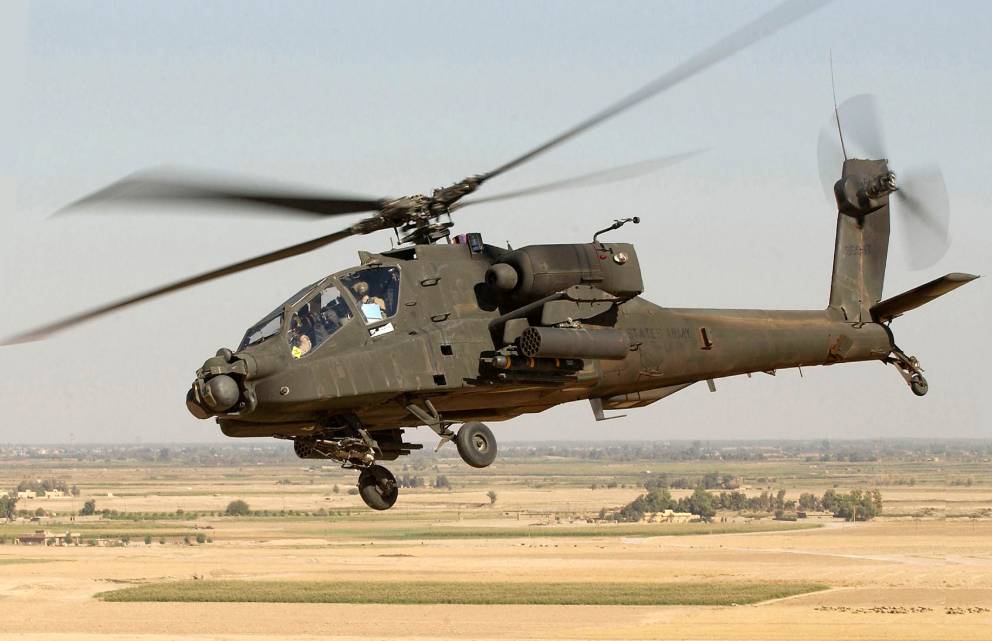
The AH-64 Apache has long been the benchmark for attack helicopter lethality, built around a doctrine of anti-armor strikes, close air support, and battlefield shaping fires. But the rise of inexpensive one-way attack drones, quadcopters, and small tactical UAVs has altered the threat environment in ways that traditional helicopter armament was never optimized to address. A new anti-drone ammunition type for the Apache reflects a broader shift in rotary-wing warfare: platforms once designed to hunt tanks are now being adapted to survive and dominate a sky increasingly crowded by low-cost aerial threats.
Why the Apache Needs a Counter-UAS Solution
Attack helicopters operate at the edge of survivability. They often fly low, slow, and close to the forward line of troops, where they are exposed not only to radar-guided air defenses and man-portable missiles, but also to the proliferation of small unmanned systems. These drones may not match the Apache in range, speed, or destructive power, yet they can still impose tactical penalties by spotting positions, cueing indirect fires, or forcing helicopters to maneuver defensively at the wrong moment.
For the Apache, the challenge is not merely destruction of the drone itself. The more urgent problem is preserving mission tempo. A helicopter that must waste time evading a $2,000 quadcopter or a loitering munition loses operational freedom and burns fuel, flight hours, and crew attention. The emergence of dedicated anti-drone ammunition is therefore less about creating a new niche weapon than about restoring the Apache’s freedom to maneuver in contested airspace.
What a New Ammunition Type Likely Brings
Although the exact engineering approach may vary, anti-drone ammunition for the Apache will likely emphasize a high hit probability against small, agile, low-signature targets. That can mean a proximity-fuzed round, a programmable airburst projectile, or a specialized fragmentation pattern designed to expand the helicopter’s effective envelope against drones flying at short to medium range.
In doctrinal terms, this matters because the Apache’s primary 30mm cannon is already a highly versatile weapon. The addition of a purpose-built anti-UAS round transforms the gun from a largely point-destruction system into a more flexible air-defense tool for the last tactical mile. If the ammunition can cue an airburst in front of a drone or scatter fragments across a compact target volume, the helicopter gains a credible self-protection and local area-denial capability.
Operational Effects on the Battlefield
The most immediate benefit is improved survivability during exposed maneuvers, especially in environments where drones are used to detect helicopter approaches or ambush landing zones. An Apache operating with anti-drone ammunition can potentially suppress small UAVs before they observe the aircraft, reducing the chance that the helicopter is detected, tracked, and targeted by a wider kill chain.
Second, such ammunition broadens the Apache’s role in combined arms formations. Attack helicopters may increasingly be asked to participate in counter-UAS defense for maneuver units, command posts, artillery positions, and logistical nodes. In that sense, the Apache becomes not just a strike asset but a mobile air-defense node able to engage drones of opportunity with minimal setup and no dependence on a separate interceptor battery.
Third, the presence of anti-drone ammunition may alter adversary drone tactics. If small UAVs are easier to defeat by attack helicopters, opponents may be forced toward denser swarming, lower-altitude profiles, terrain masking, or reliance on decoys and relay drones. This has a cascading effect on battlefield complexity: the defender gains options, but the attacker must now spend more resources to achieve the same reconnaissance or strike effect.
How It Fits Apache Doctrine
The Apache’s value has always rested on its ability to combine sensors, precision, and firepower. The latest configurations, particularly those integrating improved targeting systems and networking, already point toward a more distributed battlefield role. A new anti-drone round fits neatly into that evolution because it reinforces one of the Apache’s most important strengths: the ability to rapidly transition between target sets.
In practical doctrine, an Apache crew may be scanning for armor, soft-skinned vehicles, dismounted troops, and UAVs within the same mission set. Ammunition that allows the cannon to engage a drone without requiring a complete weapon-system change or complex reload procedure increases responsiveness. That responsiveness is critical in a cluttered battlespace where a drone may appear briefly, change direction, or disappear behind terrain within seconds.
From a force-employment perspective, this also helps preserve expensive missile inventories. The Apache’s guided missiles are far too costly for routine drone engagements, especially when adversaries are fielding low-value aerial systems in large numbers. A specialized cannon round offers a more economical engagement option, aligning the cost of defense more closely with the cost of the threat.
Table: Likely Characteristics of an Apache Anti-Drone Round
| Attribute | Expected Characteristic |
|---|---|
| Caliber | 30mm |
| Weapon System | M230 chain gun or equivalent Apache cannon integration |
| Projectile Type | Programmable airburst, proximity-fuzed, or enhanced fragmentation |
| Primary Target | Small UAVs, quadcopters, loitering munitions, and similar aerial threats |
| Engagement Range | Short to medium range, dependent on target size and flight profile |
| Key Advantage | Higher probability of kill against maneuvering drones |
| Operational Benefit | Improved self-protection and local counter-UAS capability |
Strategic Implications for Attack Aviation
The appearance of anti-drone ammunition on the Apache signals that attack aviation is entering a more layered defensive era. Helicopters can no longer assume that the air threat will be limited to missiles, fighters, or radar-guided guns. Small UAVs, once dismissed as tactical irritants, now shape operational planning, concealment, and route selection. A counter-UAS ammunition package is one way to ensure that helicopters remain relevant in this environment rather than becoming increasingly constrained by it.
There is also a signaling effect. Adversaries closely watch how Western militaries adapt legacy platforms to emerging threats. If the Apache is equipped with dedicated anti-drone ammunition, it suggests a doctrinal recognition that counter-UAS is no longer a specialized rear-area mission but a front-line requirement. That will likely accelerate similar upgrades across other rotary-wing fleets, including utility helicopters, naval helicopters, and special operations aircraft.
At the geopolitical level, this capability reinforces the broader Western effort to adapt conventional forces to the drone age without waiting for entirely new platforms. Rather than replacing the Apache, militaries are extending its service relevance by modernizing the ammunition ecosystem around it. This is a pragmatic approach: faster to field, cheaper than a new aircraft, and immediately useful in both high-intensity war and gray-zone conflict.
Limitations and Tactical Tradeoffs
Even with specialized anti-drone ammunition, the Apache is not a dedicated air-defense platform. Its engagement envelope remains constrained by line of sight, crew workload, target identification, and the physics of helicopter flight. A round optimized for drones will help, but it will not solve the broader problem of massed, coordinated, or autonomous UAS attacks.
There is also the issue of ammunition capacity. Every round carried for drone defense is a round not available for another target set. Commanders will need to balance the mix carefully based on mission profile, threat assessment, and expected drone density. In some scenarios, the Apache may be best used as a last-ditch counter-UAS shooter, while in others it may provide area security for a larger formation.
Finally, the effectiveness of any anti-drone round depends on training. Crews must learn target discrimination, engagement timing, and the specific ballistic behavior of the new ammunition. Without realistic training against live or simulated UAS targets, the weapon’s theoretical advantages may not translate into battlefield success.
What This Means Going Forward
The development of anti-drone ammunition for the AH-64 Apache is a strong indicator that the helicopter’s combat role is expanding rather than shrinking. As drone threats become more persistent and more sophisticated, the ability to defeat them with organic weapons will become a central requirement for frontline aircraft. The Apache, with its sensors, crewed flexibility, and mature cannon system, is well positioned to absorb that mission.
What emerges is a more versatile attack helicopter, one that can still kill armor and support troops while also contesting the lower reaches of the air domain against cheap, expendable UAVs. In modern warfare, where the smallest aircraft can have outsized effects on tempo and survivability, that may prove as important as the Apache’s original anti-tank mission ever was.