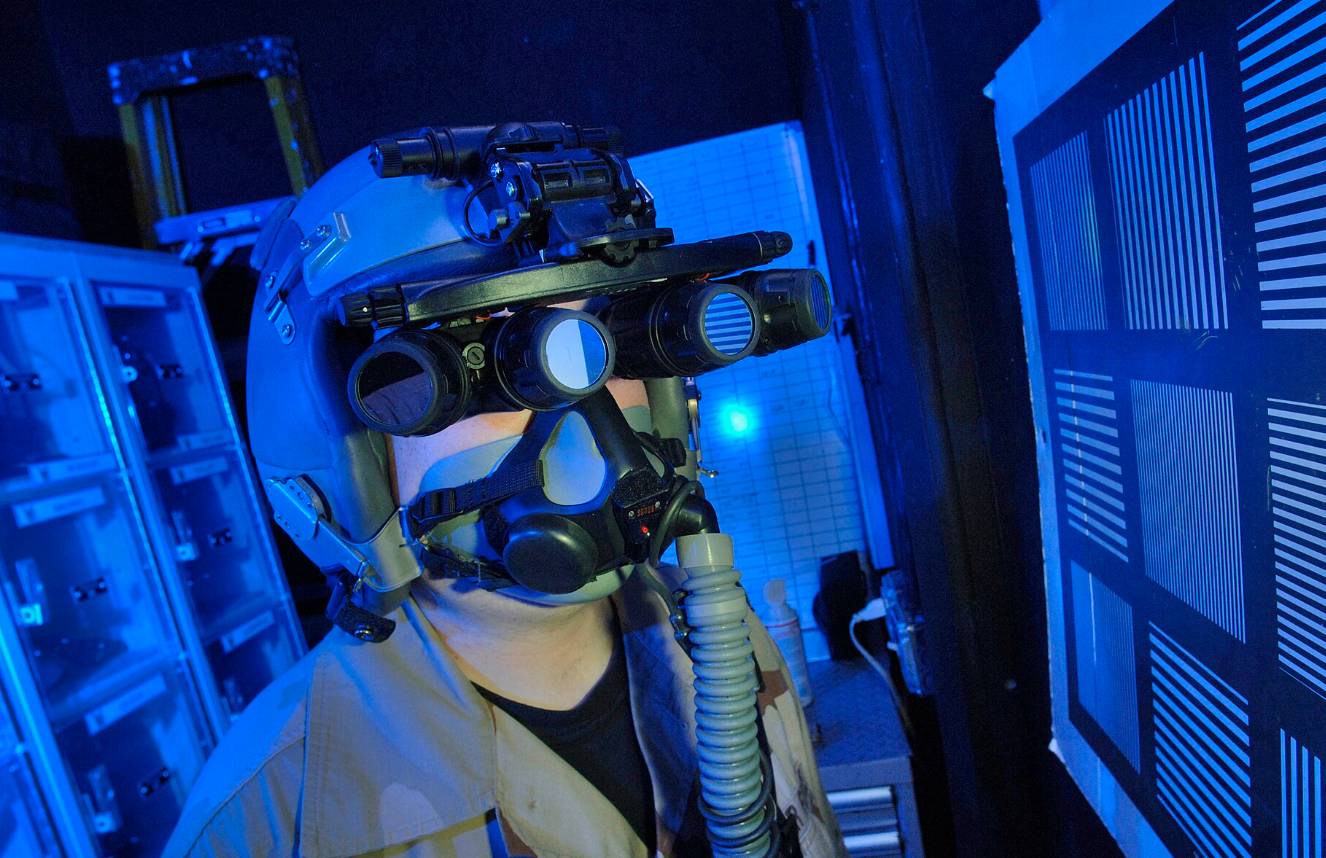
For more than half a century, night-vision equipment has given soldiers a decisive edge after sunset, but it has also imposed a familiar set of compromises. Traditional monocular systems, and even many binocular devices, have long delivered a flattened world in shades of green, where distance judgment depends on experience, ambient light, and constant head movement. The new generation of BiNOD systems promises something more ambitious: true stereoscopic depth perception, restoring a sense of three-dimensional space that earlier night optics could only approximate.
You Might Also Like

This matters because combat in darkness is not merely a question of seeing the enemy first. It is also about moving without stumbling, judging gaps in walls and ditches, negotiating stairs and vehicle interiors, and aiming with confidence under stress. In that sense, BiNOD is part of a long historical arc that stretches from the crude image intensifiers of the Vietnam era to the digital, multi-sensor combat aids now entering service across advanced militaries.
From first-generation image intensifiers to today’s fused vision
The lineage of modern night vision begins with early image-intensification systems developed during the Second World War and refined during the Cold War. Those first devices were bulky, noisy, and limited by short battery life and poor resolution. By the Vietnam War, U.S. forces were fielding starlight scopes and early night goggles that amplified existing light but offered a narrow field of view and significant distortion. They were revolutionary for reconnaissance and ambushes, yet they did not make darkness disappear. They merely made it navigable.
Later generations improved sensitivity, reduced blooming, and extended operational usefulness. Still, most systems retained a fundamental limitation: the human brain was being asked to interpret a largely two-dimensional image. Some binocular goggles provided two eyepieces, but the optical channels often delivered a near-identical image with limited true depth cues. Users learned to compensate by moving their heads, feeling for surfaces, and relying on training. Elite units became adept at this, but the technology itself still lagged behind natural human vision.
BiNOD-type systems emerge from a different design philosophy. Instead of treating night vision as a simple brightening device, they aim to preserve or recreate the visual cues the brain expects for spatial awareness. That means not only separate left and right optical paths, but also careful calibration, improved convergence, and in some cases digital processing that helps the user perceive depth more naturally. In practical terms, the battlefield is no longer just visible; it becomes dimensional again.
What “true stereoscopic” means in the field
Stereoscopic vision depends on the brain’s ability to compare the slightly different images received by each eye. Humans use that disparity, along with motion parallax and other cues, to judge distance. A conventional monocular device breaks that system entirely, forcing one eye to do all the work while the other either remains unaided or is occluded. Even many binocular night sights do not fully recreate the natural separation required for strong depth perception.
BiNOD systems are designed to solve this by delivering a more faithful left-right visual relationship. The result is more intuitive movement in complex terrain. Soldiers can better estimate:
- the height of curbs, walls, and obstacles;
- the distance to doorways, windows, and vehicle hatches;
- the placement of feet on uneven ground or ladders;
- the spacing between teammates in close quarters;
- the relationship between a target and surrounding cover.
These may sound like small improvements, but in night operations they can be decisive. Historically, many injuries during nocturnal training and combat have come not from enemy fire, but from falls, collisions, and misjudged movement. Better depth perception directly addresses that hidden cost of darkness.
Design heritage and technical evolution
BiNOD sits at the intersection of analog image intensification, digital display technology, and ergonomic lessons learned from decades of special operations use. The design lineage is easy to trace. Early goggles prioritized amplification above all else. Later systems added better tubes, improved mounting solutions, and lighter housings. Today’s advanced devices focus on reducing cognitive load as much as increasing brightness.
Several engineering trends define the modern approach:
- Independent optical channels for each eye, allowing a more natural stereo effect.
- Improved tube performance with better signal-to-noise ratios and lower halo effects around bright light sources.
- Ergonomic headborne integration that reduces neck strain and supports long-duration wear.
- Digital enhancement and overlays in some variants, enabling mission data or low-light augmentation.
- Modular power systems for longer endurance and field maintainability.
These features reflect a broader shift in soldier systems. Where once night vision was a standalone specialty item, it is now increasingly part of an integrated suite that includes laser aiming modules, thermal sensors, helmet systems, and navigation aids. The objective is not simply to let troops see in the dark, but to make night operations more like daytime in terms of speed, confidence, and survivability.
How BiNOD changes tactics
The tactical implications are substantial. In urban terrain, stereoscopic perception can reduce the hesitation that often accompanies movement through unfamiliar interiors. In woodland or mountainous terrain, it helps troops judge slopes, drops, and obstacles without excessive probing. During fast-paced raids, it can accelerate entry, breaching, and target recognition. In convoy or vehicle operations, it can improve situational awareness when dismounting into darkness or navigating tight spaces.
Special operations forces have long been the earliest adopters of technologies that later spread more broadly. The same pattern can be seen here. Just as parachutes, suppressors, and laser aiming devices moved from niche use to wider acceptance, high-performance binocular night vision is likely to shape expectations across the force. What begins as an elite capability often becomes the benchmark.
At the same time, the technology introduces new trade-offs. More optical complexity can mean more cost, greater maintenance demands, and sensitivity to calibration. Power management remains critical. Weight distribution on the helmet matters. And even the best night vision can be degraded by weather, smoke, dust, or heavy vegetation. BiNOD improves the experience of darkness, but it does not eliminate the environment’s ability to resist observation.
Comparison with thermal imaging and fusion systems
Night vision and thermal imaging are often mentioned together, but they solve different problems. Image intensification excels at reading terrain, shapes, and ambient detail when at least some light is available. Thermal imaging detects heat differences and can reveal living beings, engines, or recently fired weapons even in total darkness. Each has strengths and blind spots.
BiNOD belongs primarily to the image-intensification family, though some modern systems can be paired with thermal overlays or clip-on fusion sensors. That combination is increasingly attractive because it addresses the old dilemma of choosing between detail and detection. A fused system can help a soldier see the terrain naturally while also highlighting warm targets. This is the direction in which battlefield optics have been moving since the late Cold War: from single-purpose devices toward layered perception.
The historical parallel is instructive. In earlier eras, armies often had to choose between mobility and observation, between sight and concealment. Today’s sensor-rich battlefield compresses those trade-offs. BiNOD is part of the answer, but not the whole answer. It belongs within a larger ecosystem of detection, identification, and decision support.
Representative specifications
Exact specifications vary by model and manufacturer, but the following table reflects typical characteristics associated with advanced stereoscopic binocular night vision systems:
| Specification | Typical range or feature |
|---|---|
| Image type | Dual-channel image intensification |
| Depth perception | True stereoscopic viewing |
| Field of view | Approximately 40 degrees, model dependent |
| Magnification | 1x native |
| Power source | External battery pack or internal batteries |
| Runtime | Varies by tube and power configuration |
| Weight | Dependent on housing and battery setup |
| Mounting | Helmet-mounted interface |
| Additional features | IR illuminator compatibility, manual gain control, thermal fusion options on some variants |
Why this matters beyond elite units
Technologies once reserved for special operations often end up influencing conventional forces, border security units, and allied militaries. As manufacturing improves and procurement priorities shift, the advantages of stereoscopic night vision may become difficult to ignore. Training pipelines could change. Infantry drills may place greater emphasis on natural movement under goggles. Air assault, naval boarding, and mechanized dismount operations could all benefit from better depth judgment.
There is also a psychological dimension. Soldiers who can move more naturally at night tend to operate with greater confidence. That confidence can translate into faster action and lower fatigue. In the history of warfare, technologies that reduce uncertainty have often had outsized effects. The introduction of ranged firearms, artillery observation, radio, radar, and encrypted communications all changed not just what combatants could do, but how they thought about the battlefield. BiNOD belongs in that tradition of devices that alter perception itself.
Night has always been one of war’s great equalizers. It hides errors, magnifies fear, and punishes hesitation. Stereoscopic night vision does not abolish those realities, but it narrows them. By restoring depth to the dark, BiNOD represents another step in the century-long effort to make soldiers’ senses more resilient than the battlefield around them.