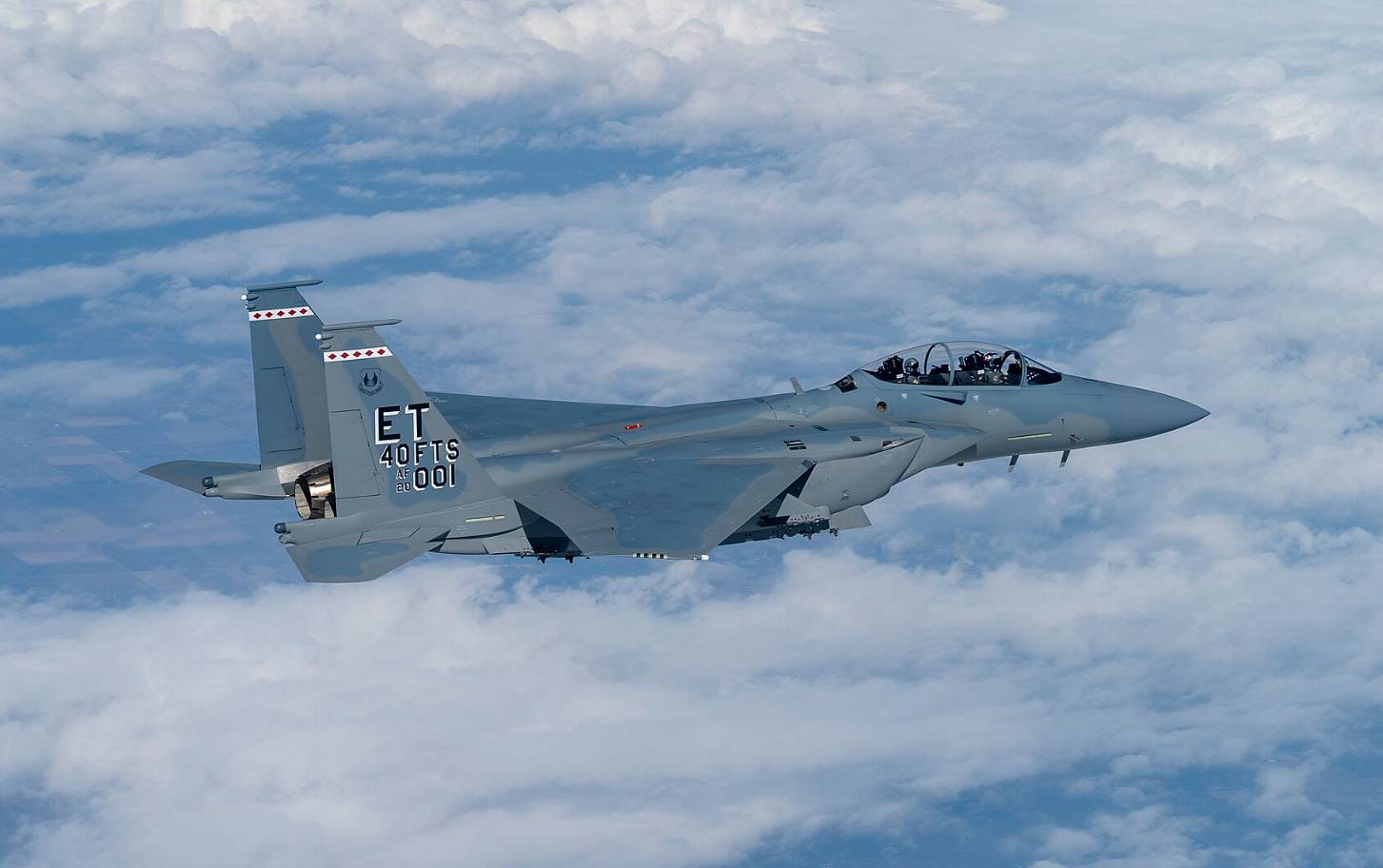
The Boeing F-15EX Eagle II is, in many ways, the latest chapter in one of the longest-lived fighter lineages in modern military aviation. Born from the air superiority imperatives of the early 1970s, the original F-15 Eagle was designed in the shadow of Vietnam to restore the United States Air Force’s edge in air combat. Half a century later, the Eagle II remains a remarkably relevant platform, but its value in the Pacific and other wide-area theaters increasingly depends on range, payload, and endurance as much as raw speed and climb performance.
You Might Also Like
That is why the idea of retrofitting the F-15EX with conformal fuel tanks, or CFTs, matters so much. In practical terms, CFTs can dramatically improve the aircraft’s mission radius and loiter time without imposing the full drag penalty of traditional underwing drop tanks. For a fighter built to carry large weapons loads and remain on station far from friendly bases, that is no small upgrade. It is a reminder that in air warfare, range is often strategy made visible.
A fighter lineage shaped by fuel, range, and geography
The F-15 was never simply about dogfighting. Although its reputation was forged by air-to-air dominance, the airframe was always designed with an appreciation for energy, acceleration, and endurance. The original Eagle emerged from lessons learned in the missile age, when combat radius and fuel state could decide whether a pilot lived long enough to finish the mission. Its enormous Pratt & Whitney F100 engines, spacious internal fuel capacity, and excellent aerodynamics gave it the legs needed for Cold War interception and escort duties over Europe and the Pacific.
Conformal fuel tanks first appeared on the F-15E Strike Eagle, the two-seat strike derivative introduced in the 1980s. Unlike conventional drop tanks, CFTs are sculpted to the fuselage, reducing drag while adding fuel and preserving underwing stations for weapons or electronic warfare pods. The Strike Eagle proved that the F-15 family could evolve beyond pure air superiority into a deep-strike and long-range combat aircraft. That same logic now carries into the F-15EX era.
The Eagle II is not a stealth aircraft, and it was never intended to be one. Instead, it is a modernized heavy fighter built around payload, sensor fusion, open mission systems, and rapid weapons carriage. In an era of contested logistics and vast maritime distances, especially in the Indo-Pacific, the aircraft’s range is not merely a performance statistic. It is a combat enabler.
Why CFTs matter for the F-15EX
Adding conformal fuel tanks to the F-15EX offers a set of operational advantages that are easy to underestimate if one focuses only on headline speed or stealth comparisons. The most obvious is fuel fraction. More fuel means a longer ferry range, more time on station, and more flexibility in mission planning. In a theater where tankers may be vulnerable or in short supply, that matters immensely.
CFTs also preserve payload. A fighter loaded with large external drop tanks often sacrifices weapon stations and aerodynamic efficiency. By contrast, conformal tanks allow the Eagle II to retain much of its heavy ordnance capacity. That aligns with the aircraft’s core purpose: carrying a large number of air-to-air missiles, standoff munitions, or mixed loads without turning into a purely tanker-dependent platform.
There is also a survivability angle. Fewer external drag devices can mean lower radar and infrared penalties than a configuration festooned with drop tanks and pylons. While CFTs do not make a non-stealth aircraft stealthy, they do represent a more disciplined aerodynamic compromise. The aircraft remains large and visible, but less burdened by the penalties of brute-force fuel carriage.
How the Eagle II compares with earlier Eagle variants
To understand the importance of CFT retrofits, it helps to compare the F-15EX with its predecessors. The original F-15A/B had no conformal tanks. It relied on internal fuel and external stores as needed. The F-15C/D later refined the air superiority mission, but range remained bounded by the realities of large airframes and fuel consumption. The F-15E introduced CFTs as a matter of course because long-range strike demanded them.
The F-15EX sits at a crossroads between the F-15C and F-15E philosophies. It is a twin-engine heavyweight meant to replace aging air superiority Eagles while also serving as a missile truck and weapons carriage platform. In some ways, it is closer to the Strike Eagle in mission flexibility than the legacy F-15C. That makes CFTs especially logical. They extend the aircraft’s endurance without fundamentally altering its role as a high-capacity, long-range fighter.
Historically, this mirrors a broader pattern in fighter development. The McDonnell Douglas F-4 Phantom II also evolved through variants that balanced range, weapons load, and mission specialization. The same can be said of the F-14 Tomcat, whose large airframe and generous fuel state were central to fleet defense over the open ocean. The lesson is persistent: in wide theaters, the fighter that can stay longer, fly farther, and carry more often enjoys an operational advantage over the fighter that is merely faster on paper.
Potential operational benefits in the Pacific
The Indo-Pacific is the natural proving ground for any discussion of range. Distances between bases, launch points, and defended targets can be enormous. Tanker vulnerability, dispersed basing, and the need for long-duration patrols all place a premium on aircraft that can cover distance without constant refueling. The F-15EX, especially with CFTs, fits neatly into this environment.
With additional fuel onboard, an Eagle II could support longer combat air patrols, more flexible escort missions, and deeper standoff strike profiles. It could also serve as a more persistent weapons delivery platform in a distributed force architecture. In a conflict where F-35s, bombers, airborne sensors, and unmanned systems work together, the F-15EX can fill the role of the heavy-lift shooter — the aircraft that arrives with a large magazine of missiles and enough fuel to use them effectively.
There is an important historical echo here. During the Cold War, long-range fighter-interceptors such as the F-106 Delta Dart and later the F-14 were valued not only for speed but for the ability to cover large expanses of airspace. Today, the challenge is less about chasing bombers over the Arctic and more about operating across maritime chokepoints, island chains, and anti-access/area-denial networks. The geometry has changed, but the logic of range remains the same.
Table: F-15EX Eagle II and CFT-related considerations
| Specification | F-15EX Eagle II | Notes with CFTs |
|---|---|---|
| Crew | 1 | Single-seat configuration |
| Engines | 2 × Pratt & Whitney F110-GE-129 or equivalent | High thrust supports heavy fuel and weapons loads |
| Internal fuel | Approximately 13,000 lb class | Varies by configuration |
| Conformal fuel tanks | Compatible | Significantly increases mission endurance without occupying underwing stations |
| Payload | Up to 29,500 lb class | CFTs help preserve weapons carriage while extending range |
| Max speed | Mach 2 class | CFTs may slightly affect top-end performance and drag |
| Primary role | Air superiority, multirole, weapons truck | Range extension strengthens all mission sets |
Tradeoffs and engineering realities
No military modification is free. CFTs add weight, complexity, and some maintenance burden. They are not detachable in the way drop tanks are, so they become part of the aircraft’s permanent aerodynamic profile while installed. That can slightly reduce agility and increase fuel consumption in certain regimes. The fighter’s performance envelope must be balanced against mission needs.
Still, for an aircraft like the F-15EX, the trade is often worthwhile. The Eagle II is not trying to out-stealth the F-22 or outmaneuver a lightweight day fighter in a knife fight. It is designed to deliver sensors, missiles, and firepower at range. If CFTs extend that reach, they reinforce the aircraft’s core utility rather than distort it.
There is also a procurement and sustainment angle. Retrofitting existing airframes or integrating CFTs from the outset can be a cost-effective way to improve capability without procuring an entirely new platform. In an era of shrinking fleets and rising costs, incremental enhancements often deliver more combat value than revolutionary promises. The history of air power is full of such pragmatic upgrades: better radar, better avionics, better fuel management, and better stores carriage have often mattered as much as brand-new airframes.
What it says about the future of air combat
The growing emphasis on CFT-equipped F-15EX aircraft reflects a broader shift in military aviation. Air combat is becoming less about the single duel between fighters and more about building a distributed network of sensors, shooters, and refuelers across enormous distances. In that environment, a fighter with range and payload can be as important as a stealth aircraft with low observability.
The Eagle II’s appeal lies in its versatility. It can escort, intercept, patrol, and strike. With conformal tanks, it does so with greater persistence and fewer compromises. The aircraft is a product of Cold War air combat thinking, but it is being repurposed for 21st-century theater-scale operations. That evolutionary continuity is part of what makes the F-15 family so enduring.
Seen in historical perspective, the move to retrofit or emphasize CFTs is not a niche tweak. It is a statement about what modern air warfare demands. Speed still matters. Maneuver still matters. But in the age of long-range missiles, dispersed basing, and vast maritime distances, the fighter that can carry more fuel without sacrificing payload may have the most practical edge of all.
In the Eagle II, the old fighter lineage meets new strategic reality. And in that meeting, conformal fuel tanks are not merely accessories — they are enablers of reach, endurance, and relevance.