

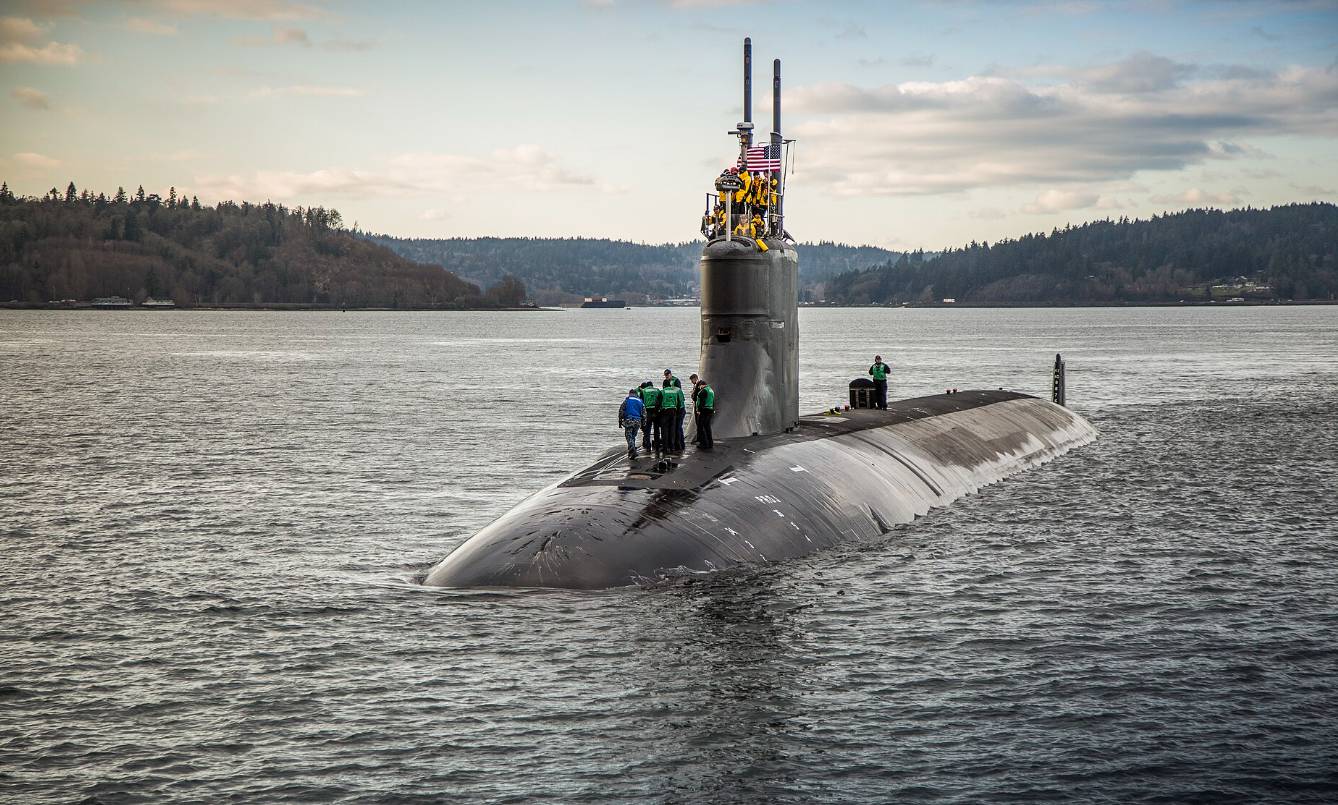
The Seawolf-class attack submarine represents the apex of U.S. Cold War undersea engineering: a platform designed to hunt Soviet ballistic missile submarines, penetrate heavily defended bastions, and dominate the acoustic battlefield at extreme range. Even by the standards of modern nuclear attack boats, the class remains extraordinary for its combination of quieting, speed, sensor performance, weapons capacity, and deep-diving resilience. Built in very limited numbers, the Seawolf-class was less a fleet program than a technological benchmark — a submarine optimized for the harshest mission set imaginable.
You Might Also Like
Design objective: a submarine built for the worst-case threat
Seawolf was conceived during the late Cold War, when U.S. planners expected Soviet SSBNs and SSNs to operate in dense anti-submarine warfare environments, protected by layers of escorting surface combatants, maritime patrol aircraft, seabed sensors, and fast attack submarines. The U.S. Navy wanted a boat that could close the distance first, detect first, and shoot first — all while surviving sustained operations in contested waters under the Arctic ice and in deep ocean environments.
Compared with the preceding Los Angeles-class, Seawolf was designed with a much larger hull, significantly improved acoustic isolation, a far more capable combat system, and a torpedo room sized for large payload flexibility. The engineering philosophy emphasized absolute performance over affordability. That approach produced a submarine with outstanding acoustic discretion, but also a unit cost so high that the original procurement plan collapsed after only three boats.
Core specifications
| Specification | Seawolf-class |
|---|---|
| Type | Nuclear-powered attack submarine (SSN) |
| Displacement | Approximately 8,600 tons surfaced; about 9,140 tons submerged |
| Length | About 107.6 meters |
| Beam | About 12.0 meters |
| Propulsion | 1 x S6W nuclear reactor, steam turbines, pump-jet propulsion |
| Speed | Reported in excess of 35 knots submerged |
| Diving depth | Commonly assessed well beyond 240 meters; exact limit classified |
| Crew | Approximately 140 personnel |
| Armament | 8 x 660 mm torpedo tubes; up to 50 weapons |
| Primary weapons | Mark 48 ADCAP torpedoes, UGM-109 Tomahawk cruise missiles, mines, specialized payloads |
Stealth: the defining attribute
The Seawolf-class is often described as the quietest attack submarine ever built in the U.S. inventory, and that reputation is rooted in a broad set of design choices rather than a single breakthrough. Quieting begins with the pump-jet propulsor, which reduces cavitation at high speed and significantly lowers detectable tonal signatures. Unlike a conventional open propeller, the pump-jet shrouds the rotor and stator assembly, allowing the submarine to sustain higher speeds with less acoustic penalty.
Equally important is the raft-mounted machinery layout. Major equipment is isolated from the hull on vibration-damping structures, reducing the transmission of machinery noise into the water. The hull itself incorporates extensive anechoic coating and carefully managed internal arrangement to minimize acoustic leakage. Each sensor, pump, turbine, and auxiliary system was scrutinized for vibration, resonance, and tonal output. The result was not merely a “quiet submarine” but one engineered as an integrated acoustic system.
In practical terms, Seawolf’s stealth advantage offered two operational benefits: first, it could detect adversaries at longer range while remaining undetected itself; second, it could maneuver aggressively without surrendering acoustic initiative. In undersea warfare, that can be decisive. The platform’s low self-noise also improves sonar processing by reducing background clutter, allowing operators to extract faint contacts from difficult acoustic environments.
Sensor suite and combat system
Seawolf’s sensor architecture reflected the end-of-Cold-War transition from analog-heavy ASW to highly automated digital processing. The class was fitted with an advanced sonar suite centered on a large bow array and flank arrays, supplemented by towed-array sensors for long-range passive detection. The integrated combat system fused acoustic, navigation, and fire-control data to support rapid target classification and weapon assignment.
While many of the exact performance figures remain classified, the class is widely regarded as possessing exceptional passive detection capability, especially against quiet submarines. A large sonar aperture, refined signal processing, and very low self-noise combine to give Seawolf a powerful advantage in the passive search regime. That matters because the submarine that detects first can typically control the engagement geometry and maintain tactical initiative.
The class was also designed with robust under-ice and deep-ocean navigation capability. That included high-quality inertial navigation, precise depth control, and environmental systems capable of supporting long-duration deployments in remote waters. The emphasis on mission endurance matched the intended tasking: prolonged patrols in the North Atlantic and Arctic approaches, where Soviet submarines were expected to transit or patrol.
Weapons capacity and tactical flexibility
Unlike many attack submarines that optimize around a specific weapon mix, Seawolf was built with a generous internal payload volume and eight large torpedo tubes. The tubes are sized at 660 mm, larger than the 533 mm standard on many other navies’ submarines, allowing it to launch heavyweight torpedoes, encapsulated payloads, and specialized weapons with greater flexibility.
The standard loadout could include:
- Mark 48 ADCAP heavyweight torpedoes for anti-submarine and anti-surface warfare
- UGM-109 Tomahawk cruise missiles for land attack and maritime strike
- Naval mines for area denial missions
- Special operations or experimental payloads, depending on mission requirements
With room for up to 50 weapons, Seawolf had a notably large warload for an attack submarine of its era. That gave it the ability to conduct multiple engagements without immediate resupply, an important advantage in prolonged high-intensity conflict scenarios where logistics may be constrained.
Speed versus stealth: the engineering bargain
Seawolf’s claimed submerged speed in excess of 35 knots is remarkable, particularly for a submarine optimized for low acoustic signature. High speed typically increases noise, cavitation risk, and hydrodynamic drag. Achieving both speed and stealth required careful attention to hull form, propulsion integration, and machinery isolation.
This is where Seawolf’s engineering stands out. The design uses a relatively large pressure hull and refined hydrodynamics to maintain efficient flow at high transit speeds. The pump-jet helps preserve discretion, but the trade-off remains real: at very high speeds, any submarine becomes noisier. The Seawolf-class’s advantage is that it can sprint when tactically necessary while still retaining a lower signature than many earlier designs operating at similar speeds.
That combination is especially valuable in attack-submarine work, where a boat may need to reposition rapidly to intercept a contact, evade an adversary, or exploit an intelligence cue before the target changes course. In those moments, Seawolf’s speed is not just a performance metric — it is an operational enabler.
Comparative assessment versus Los Angeles and Virginia
To understand Seawolf’s place in submarine development, it helps to compare it against the classes that bracket it in the U.S. Navy’s timeline. The Los Angeles-class was the workhorse of the late Cold War and post-Cold War periods, with far greater numbers but less acoustic finesse. The Virginia-class, which followed Seawolf, prioritized affordability, modular growth, and multi-mission adaptability while still achieving impressive stealth.
| Feature | Seawolf-class | Los Angeles-class (early) | Virginia-class |
|---|---|---|---|
| Primary design emphasis | Maximum stealth and combat power | Fleet quantity and Cold War ASW | Balanced stealth, strike, and cost control |
| Propulsor | Pump-jet | Conventional propeller | Pump-jet |
| Weapons tubes | 8 large tubes | 4 tubes | 4 tubes |
| Weapons capacity | Up to 50 | About 37 | About 37 to 50 depending on configuration |
| Speed | Over 35 knots | Over 30 knots | Over 25 knots, class-dependent |
| Acoustic signature | Extremely low | Low, but higher than Seawolf | Very low, optimized for modern ASW threats |
| Procurement outcome | 3 boats built | 62 boats built | Large ongoing production run |
Seawolf’s biggest disadvantage was never tactical performance. It was cost. The Cold War ended, budgets tightened, and the threat environment changed. The Navy could not justify buying dozens of ultra-expensive submarines designed for a Soviet Navy that was no longer expanding at the same pace. As a result, only three boats were completed: USS Seawolf (SSN-21), USS Connecticut (SSN-22), and USS Jimmy Carter (SSN-23).
The unique case of Jimmy Carter
The third hull, Jimmy Carter, was built to a modified configuration with an extended hull section to support classified payloads, special operations, and advanced mission systems. This makes it one of the most specialized submarines in U.S. service. The lengthened platform provides additional internal volume for experimental equipment and mission-specific capabilities that go beyond conventional attack-submarine roles.
That modification illustrates an important truth about the Seawolf design: the class’s large size and generous internal margins made it adaptable for special missions even after the original strategic rationale for mass production disappeared. In other words, the design was so capable that it could be repurposed into a unique intelligence and special operations platform without losing its core naval architecture advantages.
Operational relevance in the modern era
Although built for the Cold War, the Seawolf-class remains highly relevant in today’s undersea environment. Modern anti-submarine warfare has become more sophisticated, with improved sensors, networked surveillance, and quiet diesel-electric submarines in littoral regions. Yet Seawolf still offers a potent combination of speed, stealth, endurance, and payload flexibility that is difficult to match.
Its mission set today would likely include high-end undersea warfare, intelligence collection, covert strike support, and the pursuit of advanced submarines in contested waters. The class’s very low acoustic signature still matters enormously because undersea warfare remains a detection game. A platform that can approach closer without being heard retains a major tactical edge regardless of the decade.
Maintenance and sustainment are more complicated, of course. The small class size means limited logistics commonality and higher per-hull support cost. But from a pure combat-performance standpoint, Seawolf remains an elite asset — a submarine whose capabilities still sit near the top of the global benchmark set.
Why the Seawolf-class still commands attention
The Seawolf-class endures in professional discussion because it exemplifies what happens when requirements are pushed to their technical limit. It is not the most numerous submarine, nor the most economical, nor the most politically successful procurement in U.S. naval history. But it may be the clearest expression of maximum-performance SSN design ever fielded by the United States.
Its strengths are easy to summarize:
- Exceptional stealth through deep acoustic engineering
- Very high submerged speed without abandoning low observability
- Large weapons capacity and flexible payload options
- Deep-ocean and under-ice mission competence
- Advanced sensors and high-end ASW lethality
Its weakness is equally clear: cost. Seawolf demonstrates the classic defense acquisition tension between peak capability and affordable force structure. In a different strategic era, it might have become the dominant U.S. attack submarine family. Instead, it became a rare, technically dazzling outlier — one that still stands as a reference point for what nuclear attack submarines can achieve when performance is the primary design driver.