

The .950 JDJ: a purpose-built recoil event disguised as a rifle
The .950 JDJ, also known as 24.1×70mm, occupies a category of its own: not merely a big-bore sporting rifle, but a hand-built mechanical system engineered to launch a projectile of absurd mass with enough momentum to make conventional magnum cartridges look diminutive. Created by J.D. Jones of SSK Industries, the cartridge and its companion rifle were developed not as a military anti-materiel weapon, but as a sporting rifle in the strict sense of the term—an ultralarge bore arm intended for civilian ownership, handloading experimentation, and the sheer challenge of controlling one of the most extreme shoulder-fired platforms ever assembled.

In practical terms, the .950 JDJ is less about field utility and more about mechanical limits. Its bullet diameter of 0.950 inch places it well beyond traditional .45-caliber big game rifles and into a realm typically reserved for elephant guns and artillery-adjacent novelty weapons. Yet the platform is not a crude stunt. It is a carefully engineered single-shot rifle with a massive barrel, reinforced action structure, enormous muzzle brake, and a stock system designed to distribute recoil across the entire shooter-to-earth interface as efficiently as possible.
Cartridge architecture and ballistic character
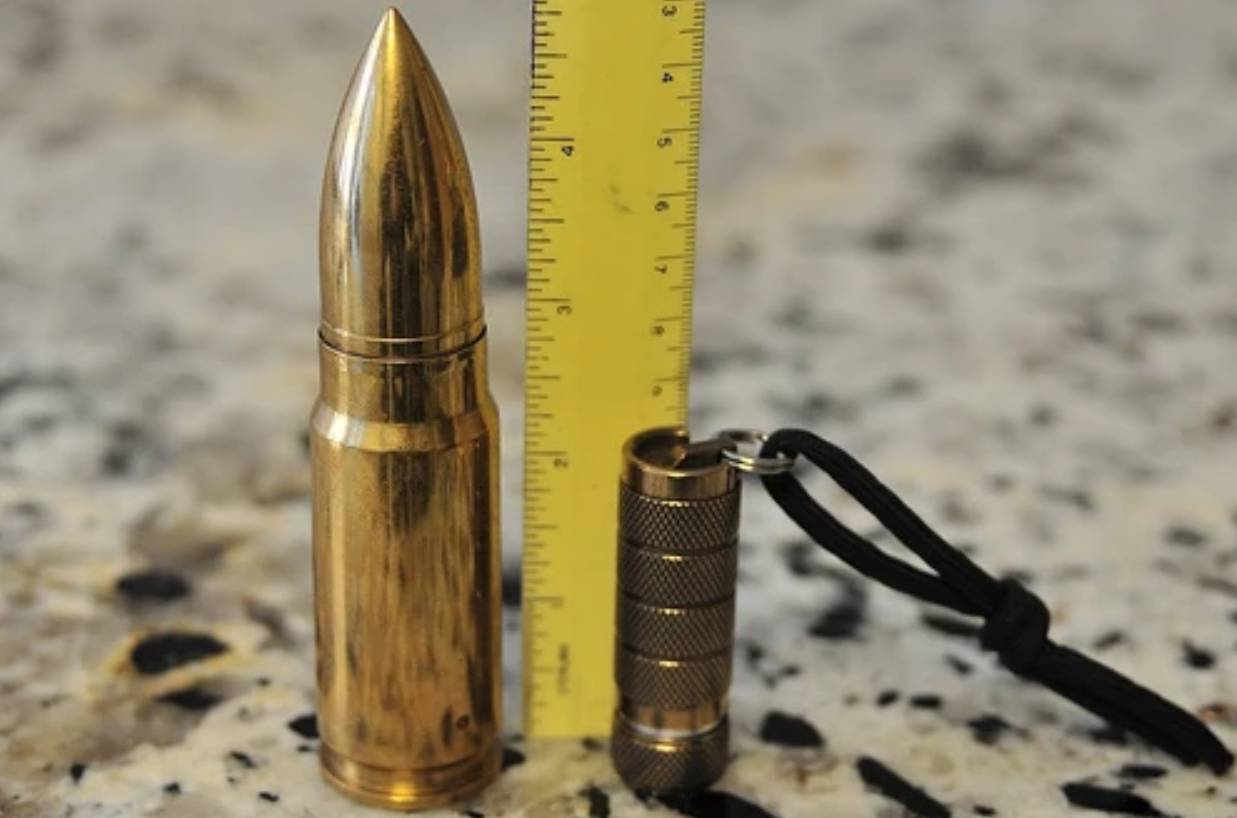
The .950 JDJ is built around a case dimensioned at 24.1×70mm, with the case length and chamber geometry tailored to stabilize and launch extremely heavy projectiles. Reported projectile weights commonly fall in the 3,600 to 3,800 grain range, with muzzle velocities around 2,200 to 2,300 ft/s depending on load and barrel length. That combination yields muzzle energies that are startling even by artillery standards in the context of a shoulder-fired gun, often cited at approximately 35,000 to 36,000 ft-lb.
To put that in perspective, a typical .375 H&H Magnum rifle load produces around 4,000 ft-lb, while a .50 BMG rifle cartridge may generate roughly 12,000 to 14,000 ft-lb. The .950 JDJ therefore operates at roughly three times the energy of .50 BMG and nearly an order of magnitude above standard dangerous-game cartridges. This is the core of its reputation: not just large caliber, but enormous momentum and impulse transfer.
The projectile itself is not the only thing that matters. A cartridge of this scale generates enormous chamber pressures, barrel thrust, and recoil impulse. The engineering challenge is less about making it fire and more about making it fire repeatedly without destroying either the rifle or the shooter’s shoulder girdle. That is why the rifle is typically built as a very heavy single-shot platform, with reported rifle weights around 50 pounds or more, depending on configuration.
Why the rifle had to be single-shot
Multi-round feeding is mechanically possible in theory, but the .950 JDJ exists far outside the practical design space of conventional repeating rifles. Magazine geometry for a cartridge of this diameter would be enormous, and the stresses imposed on feed lips, bolt lugs, extraction surfaces, and receiver walls would be severe. The cartridge’s size and mass also make it physically awkward to handle in any repeatable, reliable repeater format. A single-shot action eliminates the need for a magazine, simplifies the receiver, and allows the entire rifle to be optimized for strength rather than rapid fire.
That design choice also reflects the cartridge’s intended use. The .950 JDJ is not a hunting rifle in the traditional practical sense; it is a statement rifle, a demonstration of what happens when engineering constraints are pushed until the result becomes almost theatrical. Single-loading a cartridge this large is slow, deliberate, and highly visible, which suits the rifle’s identity as a range-bound curiosity and collector’s artifact.
Ballistic performance in context
Although the .950 JDJ is exceptionally powerful, its real-world external ballistics are not as simple as its energy figure suggests. A very heavy bullet traveling at moderate velocity tends to retain momentum well, but it also suffers from significant drop over distance and a trajectory that is far from flat. The projectile’s ballistic coefficient can be respectable given the mass, yet the sheer frontal area imposes substantial drag. At practical distances, the rifle is best understood as a short- to medium-range impact weapon rather than a precision long-range system.
In comparative terms, the cartridge’s performance is closer to a giant blunt-force penetrator than to a long-range sniper round. It can destroy extremely durable targets and produce dramatic terminal effects, but its relevance to actual hunting or tactical employment is limited. For game animals, the .950 JDJ would be grotesquely excessive. For hardened material targets, it still faces the limitations inherent to shoulder-fired weapons: stability, barrel life, recoil management, and accuracy degradation from shooter fatigue.
Representative specifications
| Specification | .950 JDJ / 24.1×70mm |
|---|---|
| Bullet diameter | 0.950 in (24.1 mm) |
| Case length | 70 mm |
| Projectile weight | Approx. 3,600–3,800 grains |
| Muzzle velocity | Approx. 2,200–2,300 ft/s |
| Muzzle energy | Approx. 35,000–36,000 ft-lb |
| Action type | Single-shot |
| Rifle weight | Approx. 50 lb or more |
| Primary designer | J.D. Jones / SSK Industries |
| Intended role | Sporting / novelty / extreme big-bore demonstration |
Recoil management: the central engineering problem
If muzzle energy is the headline, recoil is the fine print that defines the experience. The .950 JDJ produces recoil impulse on a scale that makes traditional magnum rifles feel tame. Managing that recoil requires multiple layers of mitigation: mass, muzzle brake efficiency, stock geometry, and shooter technique. The rifle’s huge mass is the first line of defense. Newtonian mechanics are unforgiving, and simply making the gun heavy reduces rearward acceleration. But weight alone is not enough.
A massive muzzle brake is essential. By redirecting propellant gases laterally and rearward, the brake reduces free recoil by a substantial margin. The trade-off is blast. Anyone near the muzzle experiences an enormous overpressure signature, making hearing protection and careful range discipline mandatory. The recoil system is therefore a compromise: the shooter sacrifices comfort and the surrounding firing line sacrifices tranquility in exchange for a rifle that can be fired without catastrophic human consequences.
Stock fit matters as well. The geometry must spread force over the shoulder and minimize local pressure points. Even then, practical shooting comfort is closer to managing a small cannon than a sporting rifle. The platform’s notoriety comes from this mismatch between conventional rifle ergonomics and the raw physics of the cartridge.
Accuracy, barrel life, and practical limitations
Extreme-power cartridges often face a trade-off between raw performance and usable precision. The .950 JDJ is no exception. Heavy projectiles and relatively modest velocity can be compatible with acceptable accuracy, but the platform is sensitive to load consistency, barrel harmonics, and shooter-induced disturbance. Because the rifle is so large and heavy, benchrest-style firing is the normal mode of use, yet even there the blast and recoil can make sustained groups difficult.
Barrel life is another open question in the way it is with smaller cartridges, but the scale of powder charges and heat generation suggests accelerated wear compared with conventional sporting rifles. The larger practical issue is not simply erosion but the economic and logistical burden of ammunition. A cartridge this exotic is expensive to manufacture, difficult to source, and dependent on specialized components. Handloading is the norm, and even then the cost per shot is extreme.
In field terms, the .950 JDJ does not benefit from the advantages that make a .375 or .416 dangerous-game rifle attractive. It is too large, too heavy, too loud, and too specialized. Its existence is justified by performance excess rather than tactical or hunting efficiency.
Comparative analysis with other extreme rifles
Compared with other large-bore rifles, the .950 JDJ stands at the far end of the spectrum. The .50 BMG is widely recognized as the benchmark for shoulder-fired power, yet it is fundamentally a machine-gun cartridge adapted for rifles. The .700 Nitro Express, a classic dangerous-game round, delivers immense stopping power, but it remains within the bounds of a traditional double rifle. The .950 JDJ eclipses both in diameter and energy while abandoning conventional sporting rifle ergonomics entirely.
Its greatest significance is symbolic. It demonstrates that civilian rifle design can still push into almost absurd territory when the objective is not mass adoption, but the exploration of the outer limits of firearm engineering. For enthusiasts, it is a collector’s item, a range spectacle, and a proof-of-concept for the relationship between bore diameter, projectile mass, and recoil management.
| Cartridge | Bullet Diameter | Approx. Energy | Typical Platform | Relative Recoil |
|---|---|---|---|---|
| .375 H&H Magnum | 0.375 in | ~4,000 ft-lb | Bolt-action sporting rifle | High |
| .50 BMG | 0.510 in | ~12,000–14,000 ft-lb | Heavy rifle / anti-materiel | Very high |
| .700 Nitro Express | 0.700 in | ~8,000–9,000 ft-lb | Double rifle | Extreme |
| .950 JDJ | 0.950 in | ~35,000–36,000 ft-lb | Single-shot custom rifle | Exceptional |
Engineering trade-offs that define the platform
The .950 JDJ embodies a set of trade-offs that are almost brutally clear. Increase bore diameter and projectile mass, and you gain immense impact energy and momentum. But you also incur penalties in rifle weight, ammunition cost, blast, recoil, and practical portability. Increase rifle mass to tame recoil, and the system becomes unwieldy. Add a muzzle brake, and you reduce shooter punishment while dramatically increasing side blast. Choose single-shot simplicity, and you sacrifice speed of follow-up shots. Every choice is a compromise, and the final product is a rifle that makes those compromises visible at a glance.
That visibility is part of its appeal. In a world of increasingly optimized, modular, and standardized firearms, the .950 JDJ is unapologetically singular. It does not attempt to be versatile. It does not attempt to be convenient. It exists to stretch the concept of a sporting rifle until the result borders on mechanical sculpture.
What the .950 JDJ represents
The .950 JDJ is best understood as the apex of civilian big-bore excess: a rifle that answers the question how far can a sporting cartridge be pushed? with a number so extreme that the answer becomes more philosophical than practical. It is a machine of record-setting proportions, a heavyweight outlier in firearm history, and a reminder that technical ambition sometimes produces objects whose value lies in their extremity alone. For the shooter who wants practicality, there are better options. For the shooter who wants to stand beside the outer boundary of shoulder-fired firepower, the .950 JDJ remains one of the most remarkable sporting rifles ever built.