

Few machines in modern history have captured the public imagination like the fighter jet. From the first swept-wing interceptors of the early Cold War to the stealth aircraft now shaping the skies over contested regions, fighter jets have become symbols of national power, technological ambition, and aerial warfare’s relentless evolution. Their fame is not merely a matter of speed or firepower. The most legendary fighters earned their reputations in combat, influenced doctrine, and, in some cases, altered the balance of power between states.
Why certain fighter jets become legends
Not every capable aircraft becomes famous. Some fighters are remembered because they arrived at a decisive moment in history; others because they were repeatedly proven in combat, or because their design was so elegant and effective that it set a standard for generations. The most legendary jets often share a few traits: adaptability, combat success, strong industrial backing, and a place in a larger strategic story. A fighter that dominates an era or survives long enough to be upgraded across decades tends to outlive its original mission and become an icon.
That pattern has deep roots. The Spitfire, Bf 109, P-51 Mustang, MiG-15, F-4 Phantom II, F-15 Eagle, and F-16 Fighting Falcon each became more than aircraft; they became shorthand for airpower itself. In the missile age, the aircraft that survived were often the ones that evolved, just as earlier piston fighters had to adapt from dogfighting tools into escorts, interceptors, and strike platforms. The lineage from turn-and-burn duels over Europe to beyond-visual-range combat over the Gulf is visible in the metal, radar, and avionics of these famous jets.
Supermarine Spitfire: the aircraft that became a national symbol
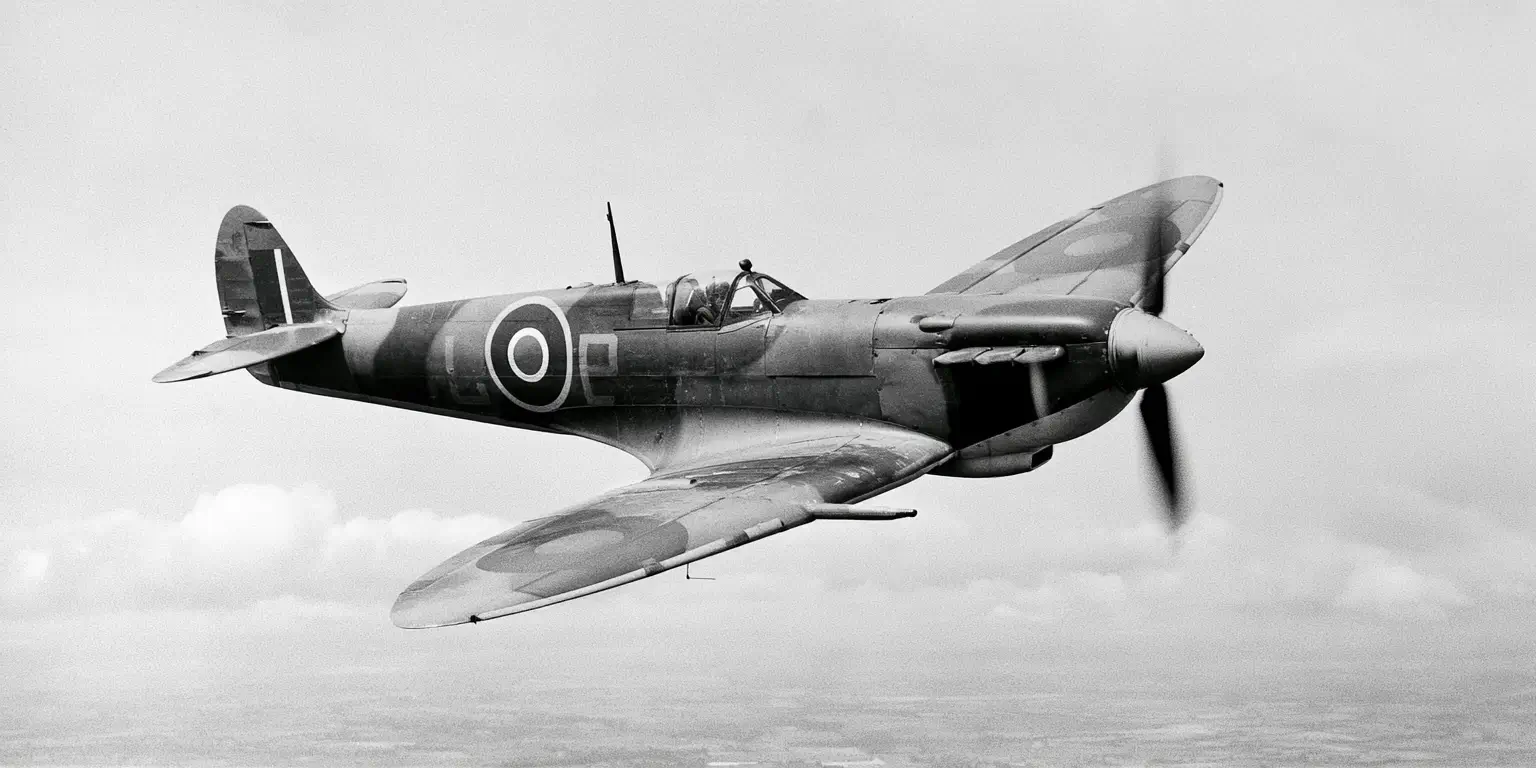
The Spitfire is perhaps the most beloved fighter aircraft ever built. Its elliptical wings, graceful lines, and Battle of Britain service gave it a mythic aura that still endures. But the Spitfire was not famous only because it looked beautiful. It was a technically advanced fighter for its time, continuously improved, and adaptable enough to fight from 1938 through the end of World War II in multiple roles.
In 1940, the Spitfire helped defend Britain against the Luftwaffe during one of the most consequential air battles in history. It was not alone in that effort — the Hurricane carried a large share of the burden — but the Spitfire’s performance in combat, its association with British resilience, and its long service life made it legendary. Like the best combat aircraft, it was a moving target for improvement: better engines, stronger armament, and refined aerodynamics kept it relevant even as the war changed around it.
Messerschmitt Bf 109: the hard-edged standard of the Luftwaffe
The Bf 109 was the German counterpart to the Spitfire in the popular imagination, though the two aircraft followed different design philosophies. Compact, powerful, and brutally effective, the Bf 109 was the backbone of German fighter forces from the Spanish Civil War through the end of World War II. It became one of the most produced fighters in history and served as the mount of many of the Luftwaffe’s top aces.
Its fame comes from longevity and combat record. The Bf 109 fought across every major front in Europe and the Mediterranean, and it remained dangerous even as Allied aircraft improved. It was also a reminder of a recurring truth in fighter development: a good basic airframe, if upgraded often enough, can remain relevant far beyond its original expectations. The Bf 109’s weaknesses — limited fuel, narrow landing gear, and handling challenges — never erased its reputation because it was there, in large numbers, at the center of the air war.
North American P-51 Mustang: the escort fighter that changed the bomber war
The P-51 Mustang is legendary for a different reason: it solved a problem. Before its arrival in full strength, heavy bombers over Europe were vulnerable without long-range escort. The Mustang’s combination of range, speed, and high-altitude performance helped make strategic daylight bombing far more sustainable. That operational transformation made the P-51 one of the most important fighters of the Second World War.
Its importance extends beyond its combat record. The Mustang represented the maturing of aerodynamic design and engine integration, especially once paired with the Rolls-Royce Merlin. It became a benchmark for fighter efficiency: fast, far-ranging, and lethal. Its legacy lives on in the idea that air superiority is not just about winning dogfights, but about enabling an entire air campaign.
MiG-15: the jet age arrives in combat
If the Spitfire and Mustang represent the pinnacle of piston-era fighter development, the MiG-15 symbolizes the leap into the jet age. When it appeared over Korea in 1950, it shocked Western pilots and planners. With swept wings, strong climb performance, and formidable armament, the MiG-15 challenged the assumption that the United States and its allies would dominate the skies simply by virtue of postwar airpower.
The MiG-15 became famous because it forced a real air-combat confrontation between jet fighters. It also revealed the importance of pilot training, tactics, and base operations in addition to raw aircraft performance. Over Korea’s MiG Alley, the aircraft became a symbol of the early Cold War and a harbinger of future superpower air competition. Its design lineage can be traced to wartime German aerodynamic research, but its combat meaning was distinctly Soviet: the jet had arrived as a practical weapon, not a promise.
F-4 Phantom II: the brute-force multirole icon
The F-4 Phantom II is one of the most recognizable fighters ever built, and for good reason. It served with the United States Navy, Air Force, and Marine Corps, as well as numerous allied air forces, and it flew in Vietnam, the Middle East, and many other conflicts. Originally conceived as a fleet defense interceptor, it evolved into a multirole workhorse capable of air superiority, strike, reconnaissance, and suppression missions.
The Phantom’s legend lies partly in its paradoxes. It was large, fast, and powerful, yet in its early years it lacked an internal cannon. It excelled in missile combat and high-speed interception, but Vietnam exposed the need for better situational awareness, maneuverability, and close-range weapons. The aircraft’s later success in upgraded forms and foreign service made it one of the great adaptable fighters of the Cold War. It is a classic example of an aircraft that shaped doctrine as much as it was shaped by it.
MiG-21: the compact Cold War warrior
The MiG-21 became famous because it was everywhere. Small, simple, and fast, it was one of the most widely produced supersonic fighters in history and served in dozens of air forces across the world. Its fame comes not from elegance or payload, but from ubiquity and longevity. For many nations, the MiG-21 was the first true supersonic fighter they operated.
In conflicts from Southeast Asia to the Middle East and South Asia, the MiG-21 became both a national symbol and a battlefield staple. It represented the Soviet approach to fighter design: relatively affordable, easy to field in numbers, and capable enough to challenge more complex Western types under the right conditions. Its long service life demonstrates how an aircraft can become legendary not by being perfect, but by being available, exportable, and good enough to matter.
F-15 Eagle: air superiority perfected
The F-15 Eagle is legendary because it redefined what air superiority could look like in the post-Vietnam era. Designed with an uncompromising emphasis on dominance in air-to-air combat, it combined powerful engines, advanced radar, high thrust-to-weight ratio, and excellent maneuverability. The result was a fighter that arrived with an almost unmatched combat record and a reputation for never having been defeated in air-to-air combat in confirmed U.S. service.
The Eagle’s fame rests on a lesson learned from earlier wars: air combat is a system of systems. The F-15 benefited from better radar, training, missiles, and maintenance support, but it also embodied the idea that a cleanly defined mission can produce extraordinary results. It became an icon of American air power during the late Cold War and remains relevant today through continued upgrades and allied variants.
F-16 Fighting Falcon: the agile multirole everyman
The F-16 became famous for democratizing high performance. Lightweight, highly maneuverable, and relatively affordable compared with heavier twin-engine fighters, it spread widely among NATO allies and partners. Its fly-by-wire controls, bubble canopy, and excellent visibility made it a favorite among pilots, while its multirole flexibility allowed it to transition from pure air combat to precision strike and electronic warfare support.
The F-16’s legend is tied to scale. It has been built in huge numbers, served in numerous air forces, and fought in conflicts from the Balkans to the Middle East. Like the Mustang in the propeller era, it became a standard against which others were measured. It also illustrates how fighter fame can arise from a combination of good engineering, export success, and long-term relevance rather than from a single dramatic battle.
Table: famous fighter jets and their defining traits
| Aircraft | First Flight | Notable Strengths | Why It Became Legendary |
|---|---|---|---|
| Supermarine Spitfire | 1936 | Agility, continuous upgrades, iconic design | Battle of Britain hero and symbol of national resilience |
| Messerschmitt Bf 109 | 1935 | Speed, climb, mass production | Backbone of the Luftwaffe across World War II |
| North American P-51 Mustang | 1940 | Range, performance, escort capability | Transformed bomber escort and strategic air war |
| MiG-15 | 1947 | Swept wings, climb, heavy armament | Defined early jet combat in Korea |
| F-4 Phantom II | 1958 | Speed, multirole flexibility, export success | Cold War icon with global combat record |
| MiG-21 | 1955 | Supersonic performance, simplicity, affordability | One of the most widespread fighters ever built |
| F-15 Eagle | 1972 | Air superiority, sensors, acceleration | Set the modern standard for dominance in the air |
| F-16 Fighting Falcon | 1974 | Agility, versatility, export appeal | Mass-produced multirole fighter with global reach |
The deeper reason these jets endure in memory
Aircraft become legendary when they are tied to a story larger than themselves. The Spitfire is tied to survival. The Mustang is tied to strategic victory. The MiG-15 is tied to the dawn of the jet age. The Phantom is tied to the maturation of missile combat and the hard lessons of Vietnam. The F-15 and F-16 are tied to the professionalization and globalization of modern air warfare. Each aircraft reflects a different stage in the evolution of aerial combat.
Fighter jets also endure in the public imagination because they are visible expressions of invisible power. They are fast enough to seem futuristic, yet concrete enough to be understood as machines with engines, wings, weapons, and pilots. In that sense, they occupy a special place in military history: technical artifacts that also function as cultural symbols. The most famous fighter jets are legendary not merely because they won battles, but because they helped define what air power meant in their age.
As modern aircraft move further into the age of stealth, sensors, networking, and unmanned teaming, the criteria for fame may change. But the old pattern remains. A fighter becomes legendary when it is good enough to fight, useful enough to last, and important enough to shape history. The names change; the logic of legend does not.