

Military power is often discussed in terms of troop numbers, doctrine, and geopolitical reach, but the most immediate measure of battlefield effectiveness is equipment. An army with modern main battle tanks, layered air defense, precision fires, robust tactical aviation, protected mobility, and secure digital command networks can generate combat power far beyond its manpower footprint. Conversely, a large force equipped with legacy platforms may struggle against a smaller opponent with superior sensors, lethality, and sustainment.



Ranking the world’s strongest armies by equipment requires more than counting vehicles. The meaningful questions are: How modern is the inventory? How deep is the procurement pipeline? How much of the force is serviceable at any given time? And how effectively do platforms integrate into a networked kill chain? The armies below are widely regarded as the most formidable when evaluated through the lens of equipment quality, combined-arms depth, and industrial replenishment capacity.
How equipment strength is measured
Equipment power is usually assessed across several layers:
- Armored fighting vehicles — main battle tanks, infantry fighting vehicles, and armored personnel carriers.
- Indirect fire — self-propelled artillery, multiple launch rocket systems, precision-guided munitions, and counter-battery radars.
- Air defense — short-, medium-, and long-range systems that deny enemy air superiority.
- Tactical aviation — attack helicopters, transport helicopters, and battlefield surveillance aircraft.
- Communications and ISR — battlefield networks, drones, electronic warfare, and reconnaissance systems.
- Logistics and sustainment — recovery vehicles, bridging assets, engineering equipment, and maintenance depth.
In practice, the strongest armies combine modern platforms with mass production, high readiness, and a doctrine that actually uses the equipment coherently. That distinction matters because a technically impressive inventory can still underperform if maintenance rates, crew training, or ammunition stocks are weak.
Ranking the strongest armies by equipment
The following ranking emphasizes overall equipment quality and scale rather than pure headcount.
1. United States Army
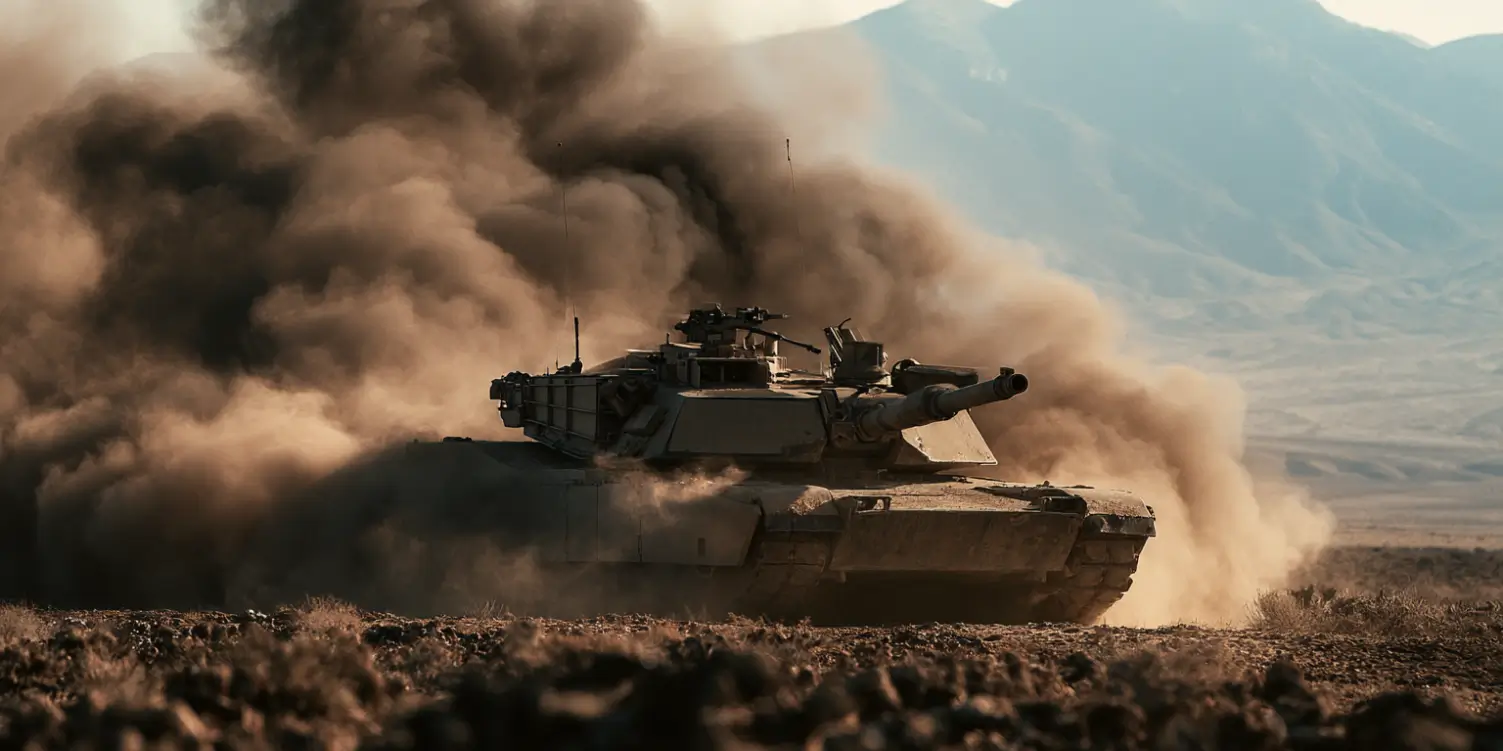
The U.S. Army remains the benchmark for equipment dominance. Its heavy formations center on the M1A2 Abrams main battle tank, with the latest SEPv3 and SEPv4 upgrade paths bringing improved power generation, survivability, sensors, and digital architecture. The Abrams’ 120 mm smoothbore gun, advanced armor package, and active protection integration potential keep it relevant against peer armor.
Its mechanized backbone includes the M2A3/M2A4 Bradley family and the newer AMPV, while self-propelled artillery is anchored by the M109A7 Paladin. On the rocket side, HIMARS and M270A2 provide long-range precision strike capability that can be paired with ISR assets and joint fires. In air defense, the Army fields Patriot, NASAMS in selected roles, Avenger, and emerging counter-UAS systems. Few armies can match this combination of depth, digital integration, and sustainment capacity.
Key strengths: unmatched logistics, precision fires, mature C4ISR, and global industrial support.
2. Russian Ground Forces
Russia’s ground forces remain formidable because of massed armored inventories, heavy artillery, and a design philosophy that privileges firepower and survivability. The T-72B3, T-80BVM, and T-90M constitute the core of the tank fleet, with the T-90M generally representing the most capable serial Russian MBT in service. Russia’s artillery arm is especially significant: 152 mm self-propelled guns, MLRS such as Grad, Uragan, and Smerch/Tornado variants, and extensive tube artillery stocks give it very high fire volume.
Where Russia excels is not elegance but density. Its equipment ecosystem is built for attrition warfare, layered fires, and rapid regeneration from industrial stockpiles. The trade-off is that many platforms rely on legacy architecture, and combat losses have exposed vulnerabilities in optics, communications, and active protection saturation. Even so, in sheer artillery-centric lethality, Russia remains one of the most dangerous armies on the planet.
Key strengths: artillery mass, armored inventory depth, and high tolerance for attrition.
3. People’s Liberation Army Ground Force
The PLA Ground Force has undergone one of the fastest modernization cycles in the world. Its newer Type 99A and Type 96A tanks, ZBD-04A infantry fighting vehicles, ZBL-08 wheeled armored vehicles, and a broad family of precision artillery and rockets reflect a shift toward networked, informationized warfare. The PLA also benefits from large-scale domestic production, allowing rapid fleet refresh and standardized sustainment.
Compared with Russia, China’s advantage lies in newer electronics, growing sensor fusion, and stronger industrial throughput. The PLA’s air defense and counter-UAS layers are particularly important, as are its expanding drone and reconnaissance ecosystems. While untested in a major high-intensity land war, the force is clearly built around integrated combined arms rather than isolated platform excellence.
Key strengths: modernizing inventory, industrial scale, and increasingly sophisticated battlefield networking.
4. Indian Army
The Indian Army fields a diverse and increasingly modern equipment mix shaped by continental deterrence requirements. Its tank fleet includes upgraded T-90S Bhishma variants, T-72M1 derivatives, and the indigenous Arjun series. Mechanized infantry relies on BMP-2 Sarath vehicles, while artillery modernization has accelerated through ultra-light howitzers, advanced towed systems, and rocket artillery expansion.
India’s strongest equipment advantage is not uniformity but improvement momentum. Indigenous programs, imported high-end systems, and licensed production combine to create a large, adaptable force. Air defense modernization, attack helicopter fleets, and growing drone procurement further enhance battlefield survivability. The main challenge remains inventory heterogeneity, which complicates maintenance and logistics.
Key strengths: scale, improving artillery, and a mix of indigenous and imported systems.
5. South Korean Army
South Korea’s army is one of the most technologically advanced in Asia. Designed for immediate high-intensity conflict, it fields K2 Black Panther tanks, K21 infantry fighting vehicles, K9 Thunder self-propelled howitzers, and robust short-range air defense. The K9 in particular is a world-class artillery platform, offering high rate of fire, mobility, and export success.
South Korea’s equipment strength is amplified by excellent readiness, dense sensor coverage, and strong command-and-control integration. The army’s structure is optimized for rapid response, with protected mobility and artillery systems built to operate under heavy counterfire and missile threat. While smaller than China or India, its equipment quality is exceptionally high.
Key strengths: cutting-edge artillery, modern armor, and high readiness.
6. Israeli Ground Forces
The Israeli Ground Forces are defined by combat-proven equipment, rapid adaptation, and a ruthless focus on survivability. The Merkava Mk.4 main battle tank and Namer heavy APC exemplify this approach, prioritizing crew protection, modular armor, and battlefield endurance. The Iron Dome, David’s Sling, and related layered air defense systems create an exceptionally protective environment for ground maneuver.
Israel’s equipment strength is less about mass and more about integration. Precision strike, active protection systems, secure communications, and extensive UAV support let relatively small formations achieve outsized effects. In a peer comparison, Israel’s qualitative edge is among the highest in the world.
Key strengths: survivability, layered missile defense, and battle-tested electronic integration.
Important engineering trade-offs
Every army’s equipment philosophy reflects trade-offs. The U.S. prioritizes premium capability, digital integration, and logistics depth, but that comes with high acquisition and sustainment costs. Russia emphasizes firepower density and stockpile scale, though at the cost of electronics sophistication and survivability margins. China is leveraging industrial capacity to close qualitative gaps quickly, but its systems are still proving themselves under wartime stress. India’s challenge is standardization across a sprawling inventory. South Korea and Israel have achieved remarkable quality, but their smaller force structures place a premium on rapid mobilization and precision rather than mass.
The strongest army equipment package is therefore not just the one with the most tanks or the newest missiles. It is the one that can detect first, strike first, survive first, and reload first. On that basis, the United States Army remains the most complete equipment ecosystem, while Russia, China, South Korea, India, and Israel each dominate specific dimensions of land warfare in ways that make them formidable in very different scenarios.