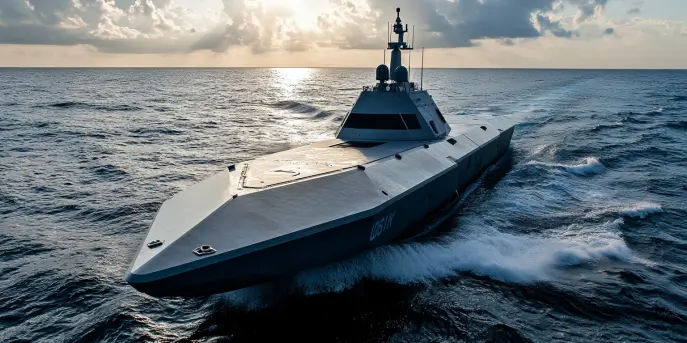
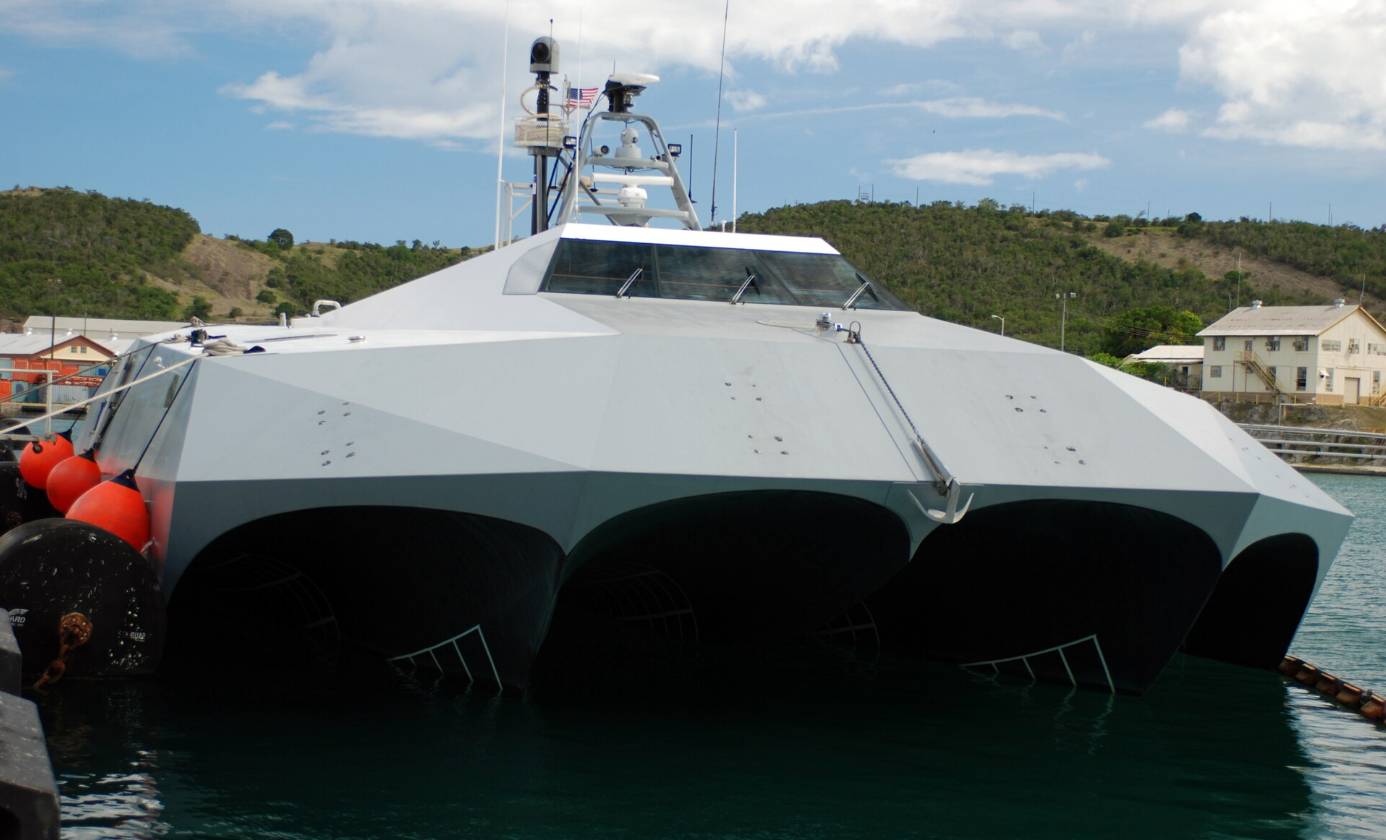
The M80 Stiletto is one of those rare Navy craft that looks like it came straight out of a design study and somehow made it to the water. Built as an experimental high-speed platform, it was not meant to be a traditional patrol boat, and that is exactly why it still gets attention years after its debut. The Stiletto was built to test what happens when you combine speed, low radar signature, modular mission equipment, and an unconventional hull form into a single package. In the real world, that makes it less of a one-size-fits-all combatant and more of a floating laboratory for the future of littoral warfare.
You Might Also Like
From a sailor’s perspective, the Stiletto matters because it shows how the Navy thinks about the near shore fight. The littorals are crowded, shallow, noisy, and full of clutter. Big ships are powerful, but they do not always have the agility or the signature management needed close to shore. A craft like the M80 Stiletto was intended to explore whether a smaller, faster, stealthier vessel could move sensors, special operations forces, unmanned systems, and strike payloads into contested waters without drawing immediate attention.
What Makes the Stiletto Different
The first thing anyone notices is the hull. The M80 uses a pentamaran configuration, which means five hull elements working together instead of the more familiar monohull or catamaran. The center hull and outer sponsons are arranged to improve stability while allowing a very wide deck and a shallow draft. That matters in operational waters where speed alone is not enough; the boat must also remain steady enough for launching equipment, handling weapons, and working in choppy seas.
The second thing is the stealth shaping. The Stiletto was designed with faceted surfaces and a low profile to reduce radar cross section. That does not make it invisible, and no serious sailor would make that claim, but it does mean the boat can be harder to pick out compared with a conventional fast craft. In practice, signature reduction buys time. It can delay detection, complicate tracking, and force an adversary to work harder to classify what they are seeing.
The third is modularity. The Stiletto was built as an experimental platform, so the Navy could fit different mission packages and evaluate them without rebuilding the entire craft. That is one of the most useful ideas to come out of the program. A fast boat that can be reconfigured for surveillance, boarding support, special operations insertion, or unmanned systems control has far more utility than a platform locked into a single role.
Specifications at a Glance
| Specification | Detail |
|---|---|
| Designation | M80 Stiletto |
| Type | Experimental stealth high-speed vessel |
| Hull form | Pentamaran |
| Length | Approximately 88 feet |
| Primary role | Testing, littoral operations, mission modularity, special operations support |
| Signature reduction | Reduced radar profile and low visual silhouette |
| Speed | High-speed experimental platform, dependent on configuration and sea state |
| Builder | McMullen & Wing |
Speed Is Only Part of the Story
In military boating, speed gets the headlines, but speed without control is just expensive drama. The Stiletto was built to be fast, yes, but also stable enough to do useful work at speed. That is where the hull form becomes important. A wider platform with good ride characteristics can carry people and gear more safely than a conventional narrow hull slamming through waves. For operators, that means less fatigue, better accuracy for sensors and weapons, and a better chance of completing the mission when the sea state is not cooperating.
In the field, a fast boat has to do more than sprint. It has to launch, recover, loiter, maneuver in confined waters, and stay relevant after the initial burst of speed is over. The Stiletto’s value was in demonstrating that a stealthy high-speed craft could remain operationally useful rather than becoming a one-trick performance machine. That distinction matters because many concept boats look impressive on paper and then become maintenance burdens once they are actually used hard.
Why the Navy Built It
The Navy has long needed ways to operate in coastal environments where larger ships may be too exposed, too slow to react, or too politically visible. The Stiletto was an answer to a set of questions the fleet has been asking for years: How do you move quietly close to shore? How do you insert or extract small teams? How do you carry sensors and networks forward without presenting a large target? How do you test new technology without waiting for a full shipbuilding cycle?
That is where an experimental vessel earns its keep. The Stiletto was never meant to replace a destroyer, littoral combat ship, or patrol craft. It was meant to explore the edges of what a small combatant could do. The Navy learned from it in areas like low-observable shaping, command-and-control integration, rapid mission reconfiguration, and the handling of modern sensors on a small deck space. Those lessons matter because future combat increasingly rewards platforms that can see first, move first, and strike first without broadcasting their position.
Field Utility and Real-World Limitations
No platform is magic, and the Stiletto has limits. The same low profile that helps reduce detection also constrains volume. There is only so much space for fuel, weapons, crew accommodations, and mission gear. That means the boat must be used carefully and supported well. If you ask too much of a small experimental craft, you will expose the tradeoff immediately: payload versus endurance, stealth versus seakeeping, speed versus range.
Another limitation is survivability. A small boat can be hard to find, but once found, it may not absorb punishment like a larger warship. That is a reality of size. The Stiletto is best understood as an enabler, not a platform meant to soak up damage in a high-intensity surface duel. Its strongest use case is in the gray zone and in the opening phases of a conflict, where speed, deception, and distributed operations can create tactical advantage.
- Strengths: fast transit, low profile, modular payloads, shallow-water usefulness
- Weaknesses: limited payload, limited endurance, smaller survivability margin
- Best mission set: special operations support, testing new systems, coastal reconnaissance, distributed maritime operations
What the Hull Says About the Future
The most important thing about the M80 Stiletto is not the boat itself, but what it represents. The Navy has increasingly moved toward distributed maritime operations, where smaller platforms, unmanned systems, and networked sensors work together instead of relying only on large capital ships. The Stiletto fits that logic. It is a testbed for a force that wants to be harder to target, harder to predict, and faster to adapt.
The pentamaran concept also shows that hull design still matters. There is no substitute for good naval architecture. A boat’s geometry affects everything: speed, stability, deck space, acoustic signature, wake, and how it behaves in rough water. The Stiletto’s unusual layout was not just for show. It was an attempt to squeeze practical capability out of a compact footprint, and in that respect it was a serious piece of experimentation.
Weapons, Sensors, and Mission Packages
As an experimental craft, the Stiletto was used to examine how different payloads could be integrated into a small stealth vessel. That could include surveillance equipment, communications systems, mission command tools, and the ability to support small teams. The point was not to make it a fully armed combatant in the traditional sense, but to understand how a small fast craft could fit into a larger kill chain.
That is where modern naval warfare is heading. A small platform that can detect, classify, cue, and transmit targeting data may be just as valuable as a platform carrying heavier guns. The Stiletto’s legacy is tied to that shift. It helped prove that the future of small naval craft is not just about carrying more weapons, but about carrying better information and linking that information to other shooters.
Operational Takeaway
From the deckplate view, the M80 Stiletto is a reminder that innovation in the fleet usually starts with a platform that looks strange, costs more than people expect, and answers questions nobody can fully settle in a briefing room. That is the nature of experimentation. Some ideas fail. Some become niche tools. A few influence the entire force.
The Stiletto belongs in the last category. It may never have become a frontline warship, but it helped shape thinking about stealthy small combatants, modular mission design, and high-speed littoral operations. Those are not abstract concepts. They are the kinds of capabilities that matter when a commander needs to move fast, stay hidden, and make a decision before the other side realizes what is in the water.
For anyone tracking the evolution of U.S. naval power, the M80 Stiletto is worth remembering. It is not just an unusual boat. It is a marker on the road toward a more distributed, more adaptive, and more survivable fleet.