

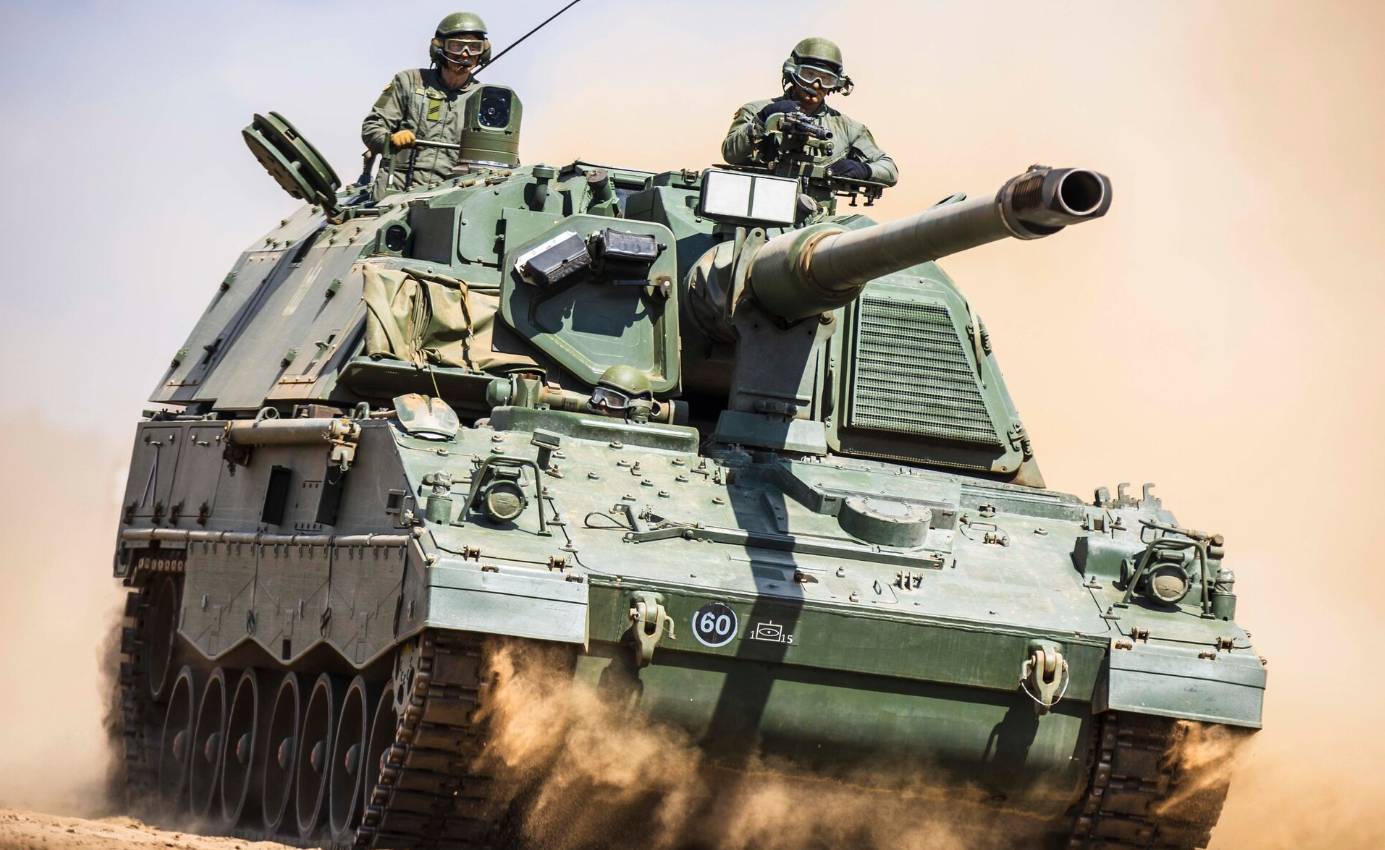
The Panzerhaubitze 2000 (PzH 2000) is widely regarded as one of the most capable self-propelled howitzers ever fielded because it combines unusually high rates of fire, long-range 155 mm artillery performance, advanced automation, and a level of survivability that was exceptional at the time of its introduction and still remains highly relevant today. Developed by Krauss-Maffei Wegmann with broader German industry participation, the system was designed not simply to replace older tracked artillery, but to redefine what a modern artillery platform could do in a high-intensity, NATO-standard battlefield.
What sets the PzH 2000 apart is not a single headline feature, but the way multiple engineering choices reinforce one another. Its 52-caliber gun, advanced fire-control system, fully automated ammunition handling, and robust chassis create a weapon that can arrive, fire a dense and accurate burst, and relocate before counter-battery fire can react. In an era where artillery survivability depends on shoot-and-scoot tactics and digital targeting, that combination is exactly why the PzH 2000 has earned a reputation as a benchmark system.
Core technical profile
The PzH 2000 is built around the NATO-standard 155 mm caliber and a long 52-caliber barrel that maximizes muzzle velocity and projectile energy. The vehicle weighs roughly 55 tonnes combat-loaded, placing it among the heavier tracked howitzers in service. That mass is not accidental: it supports recoil absorption, armor protection, and a highly stable firing platform, all of which improve accuracy and sustained firing behavior.
Its crew is typically five, though the automation level allows the system to perform many tasks that would otherwise require more personnel. The vehicle carries a substantial onboard ammunition load and uses a modular propellant system, allowing the gun crew to tailor ballistic performance to the mission profile. In practice, this means the PzH 2000 can execute both high-volume suppressive fires and long-range precision missions with equal seriousness.
Key specifications
| Specification | PzH 2000 |
|---|---|
| Caliber | 155 mm NATO |
| Barrel length | 52 calibers |
| Combat weight | Approximately 55 tonnes |
| Crew | 5 |
| Maximum rate of fire | Up to 10-12 rounds per minute in short bursts |
| Sustained rate of fire | Lower than burst rate, optimized for thermal and mechanical limits |
| Range | Beyond 30 km with standard ammunition; significantly greater with base bleed / assisted rounds |
| Automation | Fully automated loading and fire-control integration |
| Role | Self-propelled howitzer / deep fire support |
Why the rate of fire matters
One of the most famous characteristics of the PzH 2000 is its impressive burst rate. In practical terms, the system can fire multiple rounds in rapid succession and, with its computerized fire-control solution, place those rounds on the target so that they arrive nearly simultaneously. This capability is often associated with the concept of multiple-round simultaneous impact (MRSI), a tactic that dramatically increases lethality by compressing the time window available for enemy reaction.
The tactical value is straightforward. A conventional artillery detachment that fires slowly gives the enemy more time to disperse, seek cover, or launch counter-battery fire. By contrast, a system like the PzH 2000 can deliver a short, dense volley and then displace. This makes it especially dangerous in high-tempo operations where sensor-to-shooter timelines are measured in minutes or seconds.
That rapid firing capability comes with trade-offs. Barrel heating, recoil stress, ammunition feed mechanics, and crew safety all impose limits on how long the system can sustain peak output. The PzH 2000 is therefore best understood not as a machine that endlessly fires at maximum speed, but as one optimized for short, violent bursts of firepower followed by movement. In modern artillery doctrine, that is exactly the right compromise.
Range and ballistic efficiency
The 52-caliber barrel is central to the PzH 2000’s reputation. Longer barrels generally allow propellant gases to accelerate the projectile for a greater duration, increasing muzzle velocity and extending range. For a heavy 155 mm shell, that can translate into substantial operational advantages: more standoff distance, more engagement options, and less exposure to enemy fires.
With standard NATO ammunition, the PzH 2000 reaches ranges beyond the older generation of 155 mm systems. With extended-range projectiles, such as base-bleed or rocket-assisted munitions, it can push much farther. Exact range depends on shell type, charge configuration, atmospheric conditions, and firing angle, but the overall ballistic envelope places the PzH 2000 among the top-tier conventional artillery systems in the world.
This range advantage is not merely about firing farther. It is about controlling more of the battlespace. An artillery battery that can hit targets from greater distances can position itself deeper behind the front line, reduce vulnerability to direct fire, and force the enemy to expand reconnaissance and counter-battery assets. In real combat, that often matters as much as the projectile itself.
Automation as a force multiplier
The PzH 2000 stands out for its automation. Ammunition handling, loading, and fire-control processes are highly mechanized, reducing crew workload while increasing consistency. This matters because artillery is a system of systems: the gun, the crew, the fire-direction center, the navigation suite, and the communications network must all work together under time pressure and often under fire.
Automation reduces human error, speeds up the firing cycle, and enables smaller crews to operate a complex artillery weapon effectively. It also supports quicker transitions between moving, halting, firing, and relocating. In modern warfare, where survivability depends on minimizing time spent stationary, those seconds saved can be decisive.
There is a cost to this sophistication. The PzH 2000 is mechanically and electronically more complex than simpler self-propelled guns, which increases maintenance demands and makes logistics more demanding. It is a system that rewards disciplined support, trained crews, and a mature sustainment pipeline. That is one reason it is often associated with advanced NATO armies rather than low-budget mass artillery forces.
Protection and mobility
Unlike towed artillery, the PzH 2000 is a fully tracked armored vehicle. This gives it battlefield mobility across broken terrain, soft ground, and mud where wheeled systems may struggle. Its armor protection is designed to shield the crew from small arms fire, shell fragments, and battlefield debris while they operate close to the front.
Mobility is not just about top speed. The PzH 2000 must be able to reposition rapidly after firing, and its tracked chassis supports tactical displacement over rough ground. The vehicle’s weight does impose engineering constraints on strategic mobility and transportability, but that trade-off is deliberate: mass contributes to a stable firing platform, survivability, and recoil management.
This balance between protection and mobility is another reason the system is highly regarded. Many artillery systems specialize in either cost, range, or movement. The PzH 2000 integrates all three to a degree that makes it especially dangerous in peer conflict environments.
Fire-control and battlefield integration
Modern artillery is no longer a matter of aiming a gun and pulling a lanyard. The PzH 2000 is built for digital battle management, rapid coordinate processing, and networked fire missions. Its fire-control system can ingest target data, compute ballistic solutions, and align the weapon with minimal delay. That reduces the time from target acquisition to effect on target.
In a NATO context, interoperability matters. The PzH 2000 was designed to operate within standardized command-and-control structures, allowing it to receive target data from observers, drones, counter-battery radars, and higher headquarters. This makes it far more effective than artillery platforms that rely on slower, more manual workflows.
The result is a platform that is not just powerful, but responsive. In high-intensity operations, responsiveness often determines whether artillery is a blunt support weapon or a decisive maneuver enabler.
Comparative assessment
To understand why the PzH 2000 is viewed so highly, it helps to compare it with other modern self-propelled howitzers. While several systems are excellent in their own right, the German vehicle consistently scores at or near the top in burst fire rate, automation, ballistic performance, and overall combat maturity.
| System | Caliber | Barrel | Notable strength | Main trade-off |
|---|---|---|---|---|
| PzH 2000 | 155 mm | 52 calibers | Exceptional burst fire, automation, long-range performance | Heavy, expensive, complex |
| M109A7 | 155 mm | 39 calibers | Upgraded logistics continuity, mature U.S. ecosystem | Shorter range and lower fire performance than 52-caliber systems |
| AS90 | 155 mm | 39 calibers | Proven British platform, solid mobility | Older architecture and less modern automation |
| CAESAR | 155 mm | 52 calibers | Excellent strategic mobility, lower weight | Less protection and lower sustained protection than tracked systems |
| K9 Thunder | 155 mm | 52 calibers | Strong balance of mobility, range, and production scale | Different protection and automation philosophy |
The comparison shows the PzH 2000’s niche clearly. It is not the lightest, cheapest, or easiest to transport. It is the system that most aggressively pushes the envelope on high-end conventional artillery performance. That is why it frequently appears in discussions of the best modern howitzers: it is the platform that most fully embodies what a cutting-edge tracked artillery system should be.
Operational reputation
The PzH 2000 has built its reputation through service with multiple operators and through combat use in demanding environments. Reports from the field have generally reinforced the design philosophy behind the system: when properly maintained and operated with a disciplined logistics chain, it offers exceptional accuracy, rapid response, and strong battlefield survivability.
At the same time, real-world use has also highlighted the realities of high-performance artillery. Sustained high-tempo firing can accelerate wear, especially on barrels and autoloading mechanisms, and intensive combat conditions place heavy demands on maintenance teams. These are not flaws unique to the PzH 2000; they are the inevitable consequences of pushing artillery engineering to the edge of performance.
The broader lesson is that the PzH 2000 is best appreciated as a high-performance system rather than a commodity artillery piece. Like a precision machine tool or a combat aircraft, it rewards careful operation and disciplined support. In exchange, it delivers capabilities that remain difficult to match.
Why it is still a benchmark
The reason the PzH 2000 continues to be treated as a benchmark is that it addresses the central artillery problem of the modern battlefield better than most of its peers: how to deliver overwhelming fire quickly, accurately, and at sufficient range while remaining alive long enough to fire again. Its answer is a combination of long-range ballistics, automation, digital integration, and armored mobility.
Even as newer systems emerge, the PzH 2000 remains a reference point because it established a template. Any modern howitzer that claims to be best-in-class is usually measured against the German standard in at least one of four areas: rate of fire, automation, range, or survivability. Very few systems manage to challenge it on all four at once.
That is why the PzH 2000 is considered by many analysts and artillery professionals to be the best modern howitzer: not because it is perfect, but because its design choices align so closely with the demands of contemporary high-intensity warfare.