

From Next-Generation Squad Weapon competition to fielding reality
The U.S. Army’s rollout of the SIG Sauer XM7 rifle and XM250 automatic rifle marks one of the most consequential small-arms transitions in decades. Replacing the 5.56×45mm M4A1 carbine and M249 SAW at the squad level, the new weapons are the first mass-issued components of the Army’s Next Generation Squad Weapon (NGSW) program. They are designed around a fundamentally different ballistic philosophy: a more powerful 6.8mm common cartridge paired with a hybrid-case architecture intended to deliver higher muzzle energy, extended effective range, and improved terminal performance against modern body armor.

What makes this rollout especially notable is not just the caliber shift, but the engineering trade-space behind it. The Army is asking infantry squads to accept more weapon mass, more recoil impulse, and more ammunition weight in exchange for a significant step up in lethality and reach. SIG Sauer’s solution uses a family resemblance between the rifle and automatic rifle, but the two weapons are tuned for different combat roles and different recoil-management requirements.
Core program goals and why the Army changed course
The NGSW competition emerged from the Army’s assessment that 5.56mm systems were increasingly constrained in future high-end combat. The service wanted a weapon that could defeat advanced armor at longer distances, retain energy better through barriers, and preserve accuracy in a heavily obscured battlefield. The requirement was not simply “more powerful,” but more powerful without becoming unmanageable at the squad level.
The XM7 and XM250 address this by firing the 6.8×51mm SIG Fury family of ammunition, which uses a hybrid construction that combines a steel base, brass body, and polymer or composite elements depending on variant. The key engineering advantage is pressure tolerance. The cartridge can operate at substantially higher chamber pressures than conventional brass-cased ammunition, enabling higher velocity from a relatively compact cartridge envelope.
That pressure margin is central to the Army’s concept: a compact weapon system with increased downrange energy, while preserving portability and controllability. The penalty is a more complex and expensive ammunition ecosystem, with greater thermal and mechanical demands on the weapon and logistics chain.
XM7: a carbine-class rifle built for a heavier fight
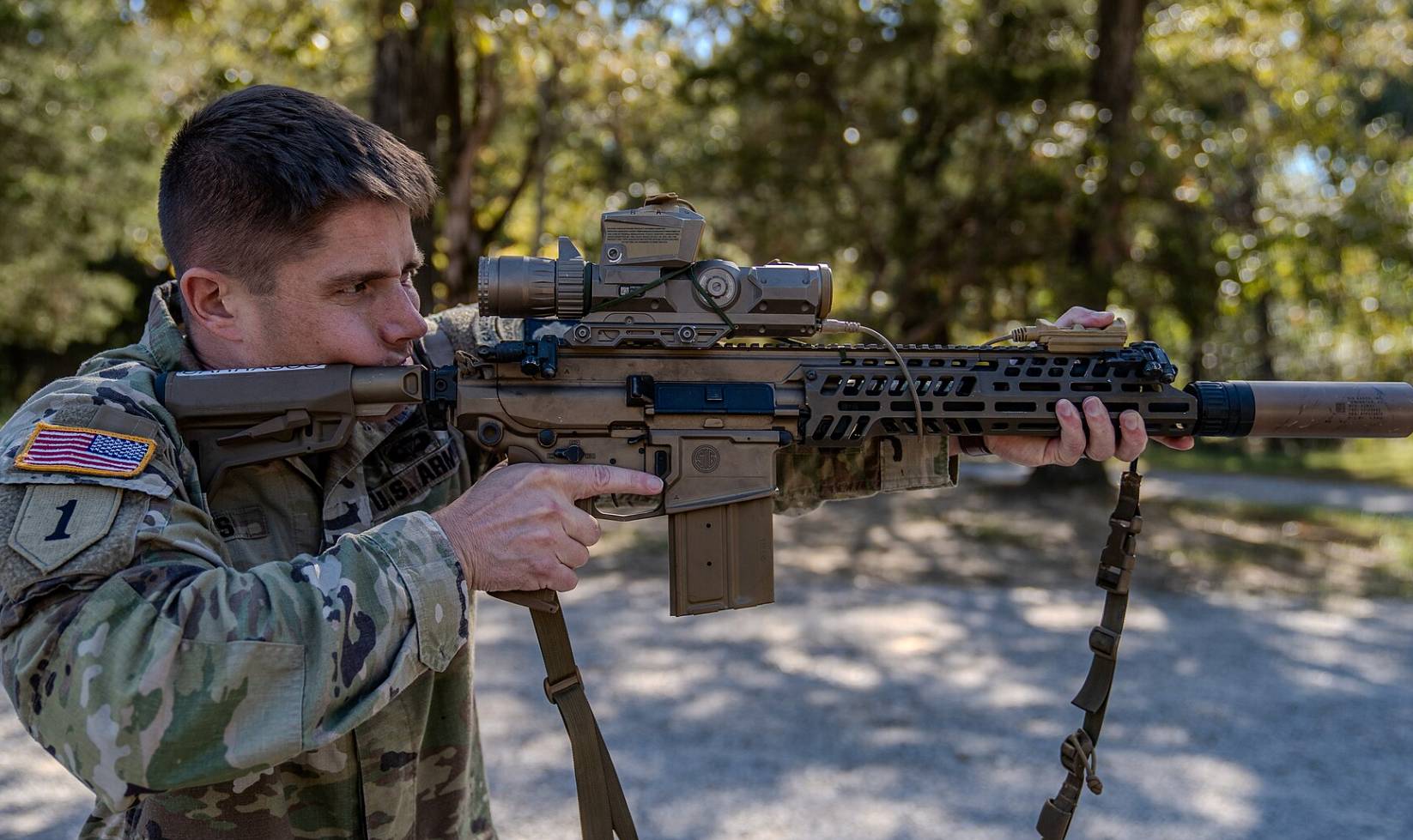
The XM7 is the individual rifle intended to replace the M4A1 in selected infantry formations. It is a short, gas-operated, magazine-fed, semi-automatic and automatic-capable rifle chambered in 6.8mm. In Army service, it is typically paired with a suppressor and an advanced fire-control optic, reflecting the program’s emphasis on first-round hit probability and signature reduction.
Compared with the M4A1, the XM7 is larger and heavier, but it brings much greater ballistic performance. The weapon uses a short-stroke gas piston system rather than direct impingement, a choice that helps manage fouling and heat in a higher-pressure environment. The rifle’s architecture also supports ambidextrous controls, modular accessory mounting, and a folding or collapsible stock arrangement depending on configuration.
On paper, the XM7’s advantages are easiest to see in range and energy retention. The 6.8mm projectile carries more momentum and typically has better penetration through intermediate barriers than 5.56mm rounds. In practical terms, that means improved effect at longer distances and a better chance of maintaining lethality after passing through foliage, light cover, or structural material.
The trade-off is recoil. The XM7’s impulse is noticeably higher than a standard M4A1, especially when firing rapid strings. That makes the optic, suppressor, and training regimen critical. The Army is not simply replacing one rifle with another; it is introducing a new marksmanship doctrine built around advanced fire control, disciplined shot placement, and more deliberate engagement techniques.
XM250: the squad automatic rifle enters a new power class
The XM250 is the belt-fed automatic rifle intended to replace the M249 SAW in the squad automatic weapon role. Like the XM7, it fires the 6.8mm common cartridge, but its design prioritizes sustained fire, heat management, and controllable bursts from a lighter, more compact chassis than legacy belt-fed weapons.
One of the most important aspects of the XM250 is that it attempts to bridge the gap between a traditional light machine gun and a squad automatic rifle. It is lighter than the M249 in many configurations, yet it is delivering a much more powerful cartridge. That makes the weapon particularly relevant for squads that need suppressive fire with better long-range effect and improved barrier defeat.
Its belt-fed operation supports longer engagements without the magazine capacity constraints of rifle systems. However, the high-pressure 6.8mm round imposes serious engineering demands on feed reliability, barrel life, bolt durability, and thermal management. The weapon’s design therefore reflects a careful balance: enough mass and robustness to survive sustained fire, but enough weight reduction to remain tactically useful in dismounted operations.
The XM250 also benefits from the same broader system integration as the XM7, especially the optic and ammunition family. This commonality reduces some logistics complexity, even if overall ammunition bulk and weight remain higher than legacy 5.56mm systems.
Technical comparison with legacy infantry weapons
The XM7 and XM250 should be understood not as isolated guns, but as replacements for a broader infantry fires ecosystem. Their value proposition depends on how they compare with the M4A1 and M249 in the metrics that matter most: muzzle energy, effective range, weight, controllability, and ammunition burden.
| System | Role | Cartridge | Approx. Weight | Feed System | Key Advantage |
|---|---|---|---|---|---|
| XM7 | Individual rifle | 6.8×51mm SIG Fury | Heavier than M4A1 | Detachable magazine | Greater range and armor defeat |
| XM250 | Squad automatic rifle | 6.8×51mm SIG Fury | Lighter than M249 in many configs | Belt-fed | Long-range suppression and lethality |
| M4A1 | Carbine | 5.56×45mm NATO | Lightweight | Detachable magazine | Low recoil and low ammo weight |
| M249 SAW | Light machine gun | 5.56×45mm NATO | Heavier and bulkier | Belt-fed | Sustained fire with manageable recoil |
While exact numbers vary by configuration, the rough engineering picture is clear. The 6.8mm NGSW family is optimized for a future battlefield where enemies are more dispersed, more protected, and more able to engage at long distance. The Army is trading some mobility and ammunition density for a significant increase in per-round effectiveness.
The optic and fire-control layer is part of the weapon system
The Army’s fielding package includes the XM157 fire control optic, which is a major part of the overall lethality concept. This is not a simple day optic. It integrates rangefinding, ballistic computation, environmental sensing, and aiming reticles into a single system intended to reduce the cognitive load on the shooter and improve first-round hit probability.
This matters because the XM7 and XM250 are not being rolled out as stand-alone guns. They are part of a sensor-to-shooter ecosystem. The optic helps compensate for the ballistic complexity of the 6.8mm round, especially at extended range and under variable atmospheric conditions. In effect, the Army is trying to buy not only more range, but more usable range.
The practical consequence is that the weapons system becomes more dependent on batteries, electronics, and training than previous iron-sight or low-tech optic paradigms. That creates a new sustainment burden, but it also reflects a broader shift in infantry combat toward digitally assisted precision at the individual and squad level.
Engineering trade-offs: power, pressure, heat, and weight
The XM7 and XM250 are impressive because they solve a difficult problem: how to push 6.8mm performance out of compact weapons without making them completely impractical. But every solution introduces a cost.
- Higher chamber pressure: improves velocity and energy, but increases stress on the bolt, barrel, and receiver.
- Heavier ammunition: fewer rounds can be carried for the same load, affecting endurance and tactical flexibility.
- Greater recoil: demands better training and more disciplined firing techniques.
- Added system complexity: hybrid ammunition, suppressors, and electronic optics all increase sustainment demands.
- Thermal management: high-pressure firing accelerates wear and raises the importance of barrel life and cooling intervals.
These trade-offs explain why the Army has not treated the transition as a simple universal replacement. The rollout is phased, and the service is learning how these weapons behave in real units, under real conditions, with real load plans and maintenance cycles. That iterative fielding approach is essential because the NGSW family is a system-of-systems change, not merely a caliber swap.
Rollout status and what to watch next
The ongoing rollout is still in its early operational chapters. As more units receive the XM7 and XM250, attention will focus on reliability, parts wear, ammunition availability, and how the new weapons affect squad tactics. The most important questions are not whether the guns are more powerful — they are — but whether that power can be sustained in the field without creating unacceptable burdens elsewhere.
There are also broader implications for allied militaries and the defense industry. If the Army’s fielding proves successful, it could accelerate interest in higher-pressure intermediate cartridges, hybrid-case ammunition, and integrated optic-fire-control packages across NATO and partner forces. Conversely, if the sustainment costs prove too high, the program could be remembered as a technically elegant but operationally constrained leap.
For now, the XM7 and XM250 represent a clear statement of intent. The Army is betting that future infantry combat will reward range, penetration, and precision enough to justify heavier weapons and more complex logistics. The rollout will determine whether that bet pays off in squad-level combat power.
At-a-glance specifications
| Specification | XM7 | XM250 |
|---|---|---|
| Role | Individual rifle | Squad automatic rifle |
| Cartridge | 6.8×51mm SIG Fury | 6.8×51mm SIG Fury |
| Operating system | Short-stroke gas piston | Gas-operated belt-fed platform |
| Feed | Detachable magazine | Belt-fed |
| Primary advantage | Precision and extended-range lethality | Suppression and sustained fire |
| Primary trade-off | Higher recoil and weight than M4A1 | Ammo weight and heat management |
The real story of the XM7 and XM250 is not that they are simply “new rifles.” It is that they are the visible edge of a doctrinal shift in how the Army expects infantry squads to fight. That shift is still unfolding, and the data from fielding will matter as much as the engineering drawings that launched the program.